



Lean Machine: 3D‑Printed Composite Vises Boost Fabrication Efficiency
We met with Lean Machine at IMTS 2018 and had the opportunity to interview their team about how they are leveraging the Markforged Mark Two printer.
Lean Machine, based in Saskatoon, Canada, began as a machine shop in 2006. Today they provide steel and aluminum fabrication, alongside a wide range of advanced manufacturing services.
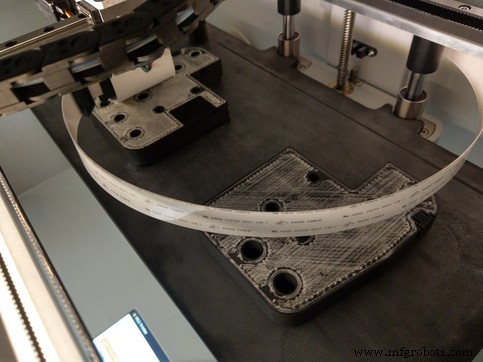
Previously, Lean Machine had to decline jobs because the tooling required was often more expensive than the finished product. They needed a printer capable of producing robust composite parts for jigs, fixtures, work‑holding devices, and more. After an extensive search, they selected the Mark Two for its precision, cost‑effectiveness, and continuous carbon fiber filament. “It’s perfect. We were blown away by the accuracy and mechanical performance,” said Josh Grasby, R&D manufacturing engineer.
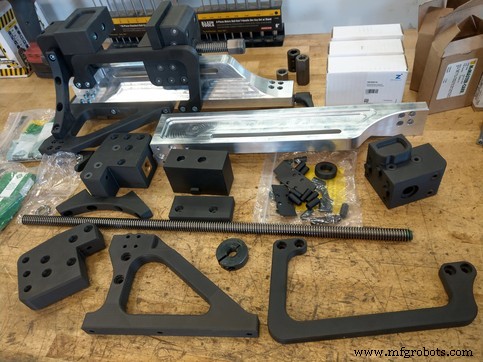
Since acquiring the Mark Two, Lean Machine engineers have embraced design for additive manufacturing (DfAM) rather than conventional design. From bending tools to soft jaws, they can now solve problems rapidly without burdening their machining department. “I don't think there's a work center in our shop we haven't printed parts for,” Josh joked.
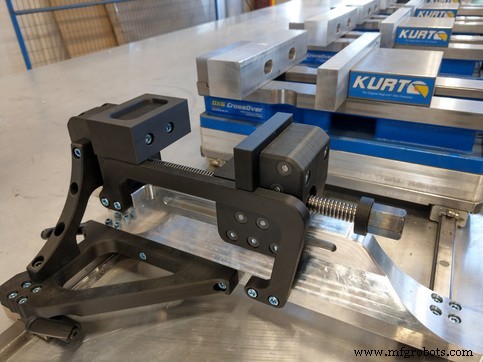
The team documented their experience with the Mark Two in a blog post focused on 3D‑printed composite vises. Engineers faced the challenge of cutting cantilevered workpieces, requiring minimal material removal per pass to meet quality standards. They designed custom vises that fit the 5‑axis gantry spindle, enabling efficient machining of workpiece ends. The complete process—from design to printing to testing—spanned only a few days. The vises incorporated off‑the‑shelf components such as roller‑thrust bearings and specialized handbrakes, and included more than twenty 3‑D‑printed composite parts, some reinforced with fiberglass or continuous carbon fiber for added strength. Watch the short video below to see the results.
Within four months of using the Mark Two, Lean Machine discovered unexpected benefits. One notable advantage is the ability to insert a threaded rod into a part, attach fasteners, and later adjust geometry for crowning—an accidental yet powerful discovery. “We’ve had so many accidental discoveries that are just blowing our minds,” Josh said excitedly. The team is now rethinking their production strategy, considering additive manufacturing as the first step instead of the traditional subtractive route. “We’ve been able to take jobs we couldn’t before,” he added.
Request a sample part to test the strength of our materials.
3D printing
- Expert Guide to Modern Change Machines: Design, Components, and Future Trends
- The Evolution and Manufacturing of Sewing Machines: From 19th‑Century Innovation to Modern Automation
- Pantyhose: The Ultimate Guide to Elegant Women’s Hosiery
- Boost Strength‑to‑Weight in 3D‑Printed Parts with Automatic Composite Sandwich Panels
- Small Manufacturers Leverage AI to Drive Lean Operations and Efficiency
- Cut Labor & Waste: 5‑Axis CNC 3‑D Printing of Composite Molds
- ORNL Unveils Advanced 3D-Printed Composite Machine Base
- RAMPF Introduces Eight-Head TFP Machine for Cost-Effective, High-Performance Composite Parts
- Timken Strengthens Automation Capabilities with Acquisition of Intelligent Machine Solutions
- Oilfield Manufacturer Cuts Lathe Count by 20% With Smart Upgrades