



The Evolution and Manufacturing of Sewing Machines: From 19th‑Century Innovation to Modern Automation
Background
Before 1900, women spent most daylight hours stitching garments by hand, both at home and in factories. The advent of the sewing machine liberated them from laborious, poorly paid factory shifts and democratized affordable, high‑quality clothing. Industrial models enabled mass production, while portable home machines opened sewing to hobbyists and new crafts.
History
The first sewing‑machine patents appeared in the late 18th century. In 1790, English cabinetmaker Thomas Saint secured a patent for a heavy machine that used a notched needle to stitch leather and canvas. In 1807, William and Edward Chapman introduced a needle with an eye at its tip, a critical improvement that set the stage for modern lock stitches.
French inventor Barthélemy Thimonnier filed a 1830 patent for a chain‑stitch machine that employed a curved needle. His factory produced army uniforms and, by 1841, operated 80 machines. A mob of displaced tailors destroyed the machines and nearly killed Thimonnier, underscoring the industry’s resistance to mechanization.
Across the Atlantic, Walter Hunt’s 1834 machine used an eye‑pointed needle and a secondary thread from below to create a locked stitch, but it never received a patent. Elias Howe, working in Boston, perfected a similar design in 1846, earning a landmark patent and establishing sewing‑machine law as a precedent for intellectual property disputes.
Isaac M. Singer, an actor and mechanic, refined Howe’s design and obtained his own patent in 1851. His overhanging arm positioned the needle over a flat table, allowing cloth to be worked in any direction. By the 1860s, Singer’s merged patents and the Civil War demand for uniforms turned him into a global industrial leader and a millionaire inventor.
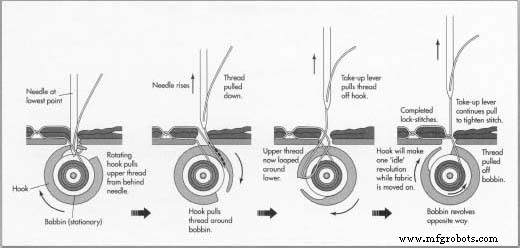
Subsequent breakthroughs included Allen B. Wilson’s rotary hook shuttle and four‑motion feed in the 1850s, Singer’s extensive patent portfolio, and the introduction of electric motors by Singer in 1889. Today, computer‑controlled machines perform intricate buttonholes, embroidery, blind stitching, and a wide array of decorative stitches.
Raw Materials
Industrial machine
Industrial sewing machines rely on cast‑iron frames and an array of metal fittings—steel, brass, and alloys—crafted to withstand continuous factory use. Many manufacturers produce these parts in‑house, while vendors supply pneumatic, electric, and electronic components.
Home sewing machine
Home machines prioritize lightness and versatility. Casings are typically molded from durable plastics and polymers, and the frame is made from injection‑molded aluminum. Copper, chrome, and nickel plating enhance specific parts. Precision‑machined metal components, motors, and custom circuit boards are sourced from specialized suppliers or produced internally.
Design
Industrial machine
Industrial machines are the world’s most precisely engineered devices after automobiles. They are larger, heavier, and purpose‑built for single functions. Garment manufacturers often chain a series of such machines—each performing a distinct step—to produce finished apparel. Design begins with field testing at customer plants, incorporating user feedback, competitive analysis, and desired improvements such as speed or noise reduction. Prototypes undergo rigorous trial, and the manufacturing engineering team finalizes tolerances, material sourcing, and production tooling.
Home sewing machine
Design for home machines starts with consumer focus groups that identify sought‑after features. R&D, in partnership with marketing, drafts specifications, creates prototypes, and tests durability and stitch quality in controlled labs. Successful models advance to production, where designers coordinate electronics, mechanical components, and ergonomics to deliver a user‑friendly experience.
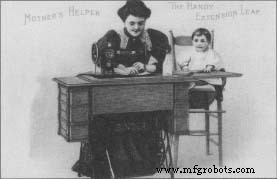 A 1899 trade card for Singer sewing machines. (From the collections of Henry Ford Museum & Greenfield Village.)
Isaac Merritt Singer didn’t invent the sewing machine, but his marketing genius made the brand synonymous with sewing. Singer’s partner, Edward Clark, introduced the pioneering hire‑purchase plan, allowing families to acquire a $125 machine through manageable monthly payments. Singer’s strategy also tackled psychological barriers: he showcased machines in elegant showrooms, employed women demonstrators, and advertised the time‑saving benefits for domestic life.
The Manufacturing Process
Industrial machine
- 1. The frame, or "bit," is cast in iron via CNC machining, then forged, heat‑treated, ground, and polished to precise specifications.
- 2. Motors are typically supplied by external vendors to accommodate varying voltage and regulatory standards.
- 3. Pneumatic and electronic components may be manufactured in‑house or sourced; most industrial machines rely on metal parts due to their single‑purpose nature.
Home sewing machine
Key production steps include:
- 4. Gears are molded from synthetic materials or custom‑tooled for fit.
- 5. Drive shafts are hardened, ground, and plated with alloys as needed.
- 6. Presser feet are machined for specific sewing tasks, hand‑polished, and nickel‑plated.
- 7. The aluminum frame is drilled and milled with high‑speed cutting tools.
- 8. Covers are precision‑molded from high‑impact synthetics and assembled into modules.
- 9. Electronic circuit boards are produced by robotics, undergo burn‑in, and are individually tested.
- 10. All components are assembled on a robotic‑assisted line, with teams conducting quality checks at every stage.
- 11. Finished machines are packaged with accessories and manuals, then shipped to distribution centers.
Quality Control
Quality inspectors evaluate raw materials, incoming components, and every assembly stage. Independent audits verify that each machine meets specifications before final testing for safety and stitch performance.
Byproducts/Waste
Manufacturing generates minimal waste. Metal scraps are recycled or sold to salvage dealers, ensuring a sustainable production cycle.
The Future
Integrating electronics with software expands creative possibilities. Upcoming innovations include threadless machines that use thermal fluids for seamless finishes and computer‑driven embroidery that transforms screen designs into fabric masterpieces. As consumers upgrade basic models with optional add‑ons, sewing machines evolve into personalized crafting tools, promising endless creativity.
Manufacturing process
- EEG Machines: Design, Manufacturing, and Emerging Applications
- Vending Machines: A $36.6B U.S. Industry Powerhouse
- Voting Machines: History, Technology, and Standards
- Expert Guide to Modern Change Machines: Design, Components, and Future Trends
- Comprehensive Overview of Modern ECG Machines: Technology, Manufacturing, and Future Innovations
- Milking Machines: Design, History, and Future Innovations
- Pantyhose: The Ultimate Guide to Elegant Women’s Hosiery
- Discover the Evolution of Washing Machines: From Hand-Powered to Modern Electric Models
- Build a Fully Functional CNC Machine with Arduino Nano R3
- JW Machine: Precision CNC Contract Manufacturing Services