



Milking Machines: Design, History, and Future Innovations
Background
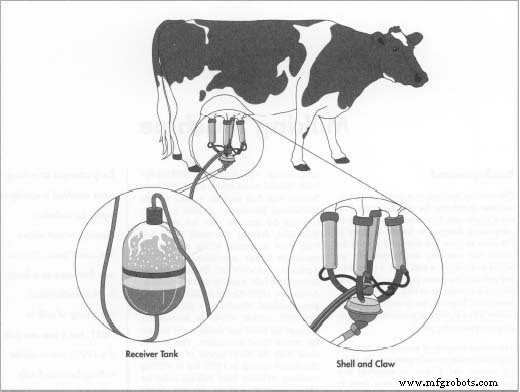
Milking machines are sophisticated, semi‑automatic assemblies that can service up to 200 cows per hour. The system is not a single unit but a coordinated set of components—including a cluster that attaches to the cow, milk and pulse tubes, a pulsator, a vacuum pump or blower, and optional record‑keeping jars or milk meters. Together, these parts enable milk to flow into a pipeline for onward transport to processing facilities.
The cluster itself comprises teat cups, a shell and liner that perform the milking action, and a claw or manifold that spaces the cups and connects them to the milk and pulse tubes. Milk is drawn from the udder by creating a vacuum within the cup, while the pulsator alternates suction and air pressure. During the milk phase the vacuum pulls milk through the teat canal; during the rest phase air pressure collapses the liner, massaging the teat and restoring blood flow. This rhythmic milk‑and‑rest cycle is essential for both cow health and high‑quality milk yield.
History
Early milking attempts date back to around 380 B.C., when Egyptians used wheat straws in conjunction with hand milking. Mechanical suction was first employed in 1851, but early designs caused excessive blood loss and fluid congestion. The Royal Agricultural Society of England offered a prize for a safe, effective milking machine, which spurred further development. In the 1890s, Alexander Shiels of Glasgow introduced a pulsator that alternated suction levels, successfully extracting milk while preserving circulation. That innovation, along with the double‑chambered teat cup of 1892, led to the widespread adoption of milking machines, which became industry standard after the 1920s. Today, virtually all dairy production relies on machine milking.
The Manufacturing Process
Milking machine components are produced and assembled in major facilities worldwide using traditional fabrication techniques. Stainless steel and high‑grade plastics form the milk‑contact surfaces, while cast iron and steel constitute vacuum pumps, controls, and metering devices.
Receiving
- Stainless steel arrives as large sheets or tubes. Sheets are protected by vinyl liners during transport; the liners are removed before forming and machining. The raw material typically has a dull finish, which will be polished later.
Cutting, Machining, and Forming
- Sheets are sent to a polishing station where large machines achieve a smooth surface. After initial polishing, they move to rollers and numerically controlled punch machines that cut and shape parts. Some components are formed or bent on large brakes. This stage produces mounting panels, structural parts, and small detail pieces for claws and pumps.
Creating the Shell and Claws
- The shell that houses the liner is fabricated by extrusion—steel tubing is forced through a heated die to form a rigid, elongated piece. Claws are produced as a series of smaller extruded tubes that assemble into a manifold spacing the teat cups. Manual welding in fixtures shapes the final components, which then receive a polishing step.
Making the Receivers
- Receiver tanks, typically stainless steel, hold 15–26 gallons (60–100 L) of milk. Most are steel; a few are custom‑made plastic. Production involves spinning a thin steel disc on a lathe, forming cup‑shaped ends over a mandrel, welding the body to the head, and creating inlet/outlet openings. Hand polishing ensures a sanitary finish. Some receivers include translucent plastic panels so farmers can visually gauge milk output.
Polishing
- All contact stainless steel parts undergo a meticulous polishing process—using mechanized belts, cloths, and spinning wheels—to meet food‑handling standards. Hand polishers finish the claws, receivers, and pipelines, ensuring a hygienic surface for milk contact.
Making the Vacuum Pumps or Blowers
- These ‘drivers’ are typically manufactured by specialized vendors. The sealed iron case houses timing gears and a high‑speed impeller (≈3,000 rpm) that generates the vacuum. Raw castings are hand‑machined, then CNC‑cut to precise tolerances. Assembly requires exact 0.002‑inch clearances; coordinate measuring machines verify fit. After final assembly, technicians test the pump in a controlled booth before shipment.
Assembly
- Finished parts converge in dedicated assembly bays where technicians select components according to system specifications—often customized for specific farm operations. Pressure and load tests confirm performance. Final assembly occurs on the farm, where cows are positioned in stalls and stations designed to maximize milk extraction.
During assembly, line connections—from valves to pumps to meters—are inspected for tolerances. Vacuum pumps or blowers are tested under simulated loads to ensure efficient milk and air removal. Vacuum controllers that maintain proper vacuum levels are selected, and all air and milk lines are sized and connected with appropriate hardware. Controls are prepared for installation.
Standards
Milking machine manufacturers must comply with multiple industry and governmental standards. Inspections are conducted throughout manufacturing, and installations are performed by certified dealers and electrical contractors. Designers follow the Association of Agricultural Engineers’ guidelines and sanitary protocols set by dairy industry councils.
The Future
Recent technological advances are reshaping milking systems. Automatic detacher units allow cows to move freely; they can detect the end of a milking cycle, shut off vacuum, and disengage the claw automatically. Automatic backflushing units inject chemical and rinse solutions into pipelines and clusters, reducing mastitis risk. Electronic transponders on cow neck‑tags enable real‑time tracking of individual milk production.
Robotics are leading the frontier, especially in Europe. Fully automated attachment devices—though still under refinement—promise minimal manual labor, overseeing the entire milking process from cow entry to departure.
Manufacturing process
- EEG Machines: Design, Manufacturing, and Emerging Applications
- Soy Milk: Production, Nutrition, and Quality Standards
- Expert Guide to Modern Change Machines: Design, Components, and Future Trends
- Milk: Production, Processing, and Nutrition in the United States
- Yogurt: History, Production, and Health Benefits
- The Evolution and Manufacturing of Sewing Machines: From 19th‑Century Innovation to Modern Automation
- The Art and Science of Cheese: From History to Modern Production
- Pantyhose: The Ultimate Guide to Elegant Women’s Hosiery
- Discover Fresh Milk Vending Machines: Convenient, Affordable, and Eco‑Friendly
- JW Machine: Precision CNC Contract Manufacturing Services