



Nurse‑Inventor Robin Brunnquell 3D‑Prints a Custom, Durable Assistive Chair with Markforged
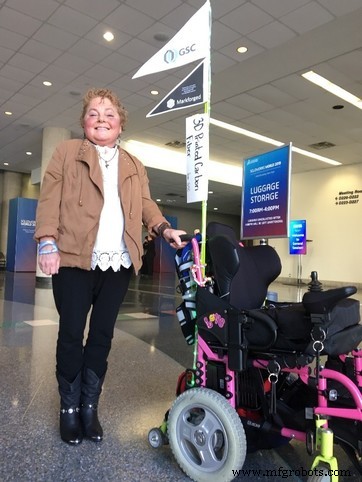
In the fall of 2018, nurse and medical designer Robin Brunnquell walked into GSC’s office with a clear mission: create a stronger, highly customizable chair that would meet her complex mobility and respiratory needs. As a long‑time friend of GSC’s leadership, she knew the company’s partnership with Markforged would make her vision a reality.
Robin’s chair had to be compact, weather‑resistant, and capable of carrying a ventilator, battery pack, and emergency supplies. Conventional market parts were too weak and hard to modify, so she turned to Markforged’s high‑strength composites and bespoke design workflow.
Using Markforged’s Onyx material reinforced with Kevlar® and carbon fiber, the team built parts that could handle 30 lb loads on rough terrain. Features include:
To allow adjustments, bolts were inserted via Markforged’s pause feature and heat‑set inserts were used to secure them. The result was a lightweight yet robust system that met Robin’s functional and aesthetic requirements.
Robin’s early prototype, dubbed the “Power Walker,” was a learning experience—she humorously notes the nickname “Face Plant” that emerged when her family first tried it. Subsequent iterations, refined with SOLIDWORKS 3D CAD and supported by a year of free software from the SOLIDWORKS Entrepreneurial Program, led to the advanced seat for her mobility Segway. She even attended SOLIDWORKS World in February to showcase her improvements.
Aaron Niedermann, GSC’s 3D Printing Field Technician, highlights the engineering depth: “We chose Kevlar® for the ventilator bracket to ensure it could sustain 30 lb on uneven terrain, and carbon fiber for other high‑stress parts. The pause feature allowed us to insert bolts and create adjustable mounts—critical for a user who needs flexibility.”
Robin’s journey began in 2007 after a severe asthma episode and subsequent steroid treatment led to tracheomalacia, avascular necrosis, and MRSA infection. Multiple surgeries—including hip, shoulder, and back replacements—followed by a fall in 2013 caused a broken back and pelvis. Compounded by a vertebral compression fracture treated with the Kiva Method, her spine’s curvature and nerve impingement necessitated further surgical attempts, yet EMG tests revealed irreversible damage. “Necessity is the mother of invention,” she says, citing Plato.
Today, Robin continues to innovate, aiming to expand affordable, reliable assistive devices for people with disabilities. Her work exemplifies how hands‑on medical expertise, coupled with advanced additive manufacturing, can transform patient care.
Biography: Robin Brunnquell is a medical designer, inventor, and CEO of Hatikvah Health, LLC. She earned a BSN from the University of Wisconsin‑Milwaukee in 1980 and later studied SOLIDWORKS at Moraine Technical College Park (2010‑2013). --- ---Design and Production Highlights
From Prototype to Prototype Success

Medical Background and Motivation
3D printing
- Revolutionizing Bone Implants: How 3D Printing Enhances Fit, Longevity, and Performance
- Veronica Anderson Breaks Barriers as Mercedes‑Benz of Chicago’s First Female Technician
- Nurse‑Inventor Robin Brunnquell 3D‑Prints a Custom, Durable Assistive Chair with Markforged
- ERP Solutions Secure Critical Oxygen Supply for Hospitals
- Boost Your 3D Prints: 5 Proven Strategies for Strength and Durability
- The Longevity of PLA 3D Prints: How Long They Last
- How to Sandblast 3D Prints for a Professional Finish
- Medical Manufacturing: AI, Automation & 3D Printing Driving Innovation
- Women in IT: Empowering Careers & Shattering Gender Stereotypes in Tech
- Proven Strategies for Crafting High-Quality 3D Prints