



Swisslog Expands into Vertical Farming with Cutting‑Edge Automation
Swisslog, a provider of warehouse automation systems, is making a push into the vertical farming market and has demonstrated newly built technologies specifically designed for the sector.
The company says its automation systems can bring scalability, flexibility and lower costs to vertical farming, allowing them to be installed and maintained in a wide range of pre-existing and purpose-built spaces.
These systems help broaden the applicability of growing crops and bring food production closer to consumers in densely populated urban areas.
Dr Christian Baur, CEO of Swisslog, says: “At Swisslog, we are continually researching and exploring applications where our automation technology could improve efficiencies, drive industries forward and contribute to our society.
“By bringing automation technology to vertical farming, we can help strengthen the food supply chain, transform abandoned urban buildings into growing facilities, contribute to reductions in pollution and, most importantly, eliminate food deserts.”
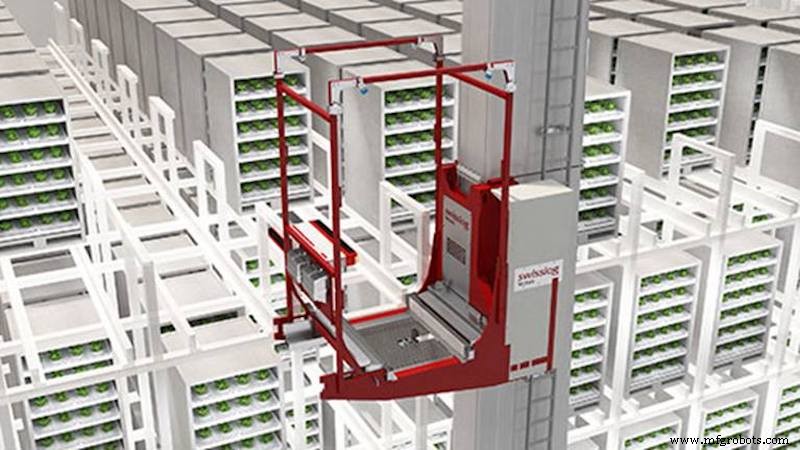
The broad portfolio of Swisslog automation solutions provides enormous flexibility in customizing systems and configurations based on the strategy, growing process, crop type and space availability of the vertical farming operation.
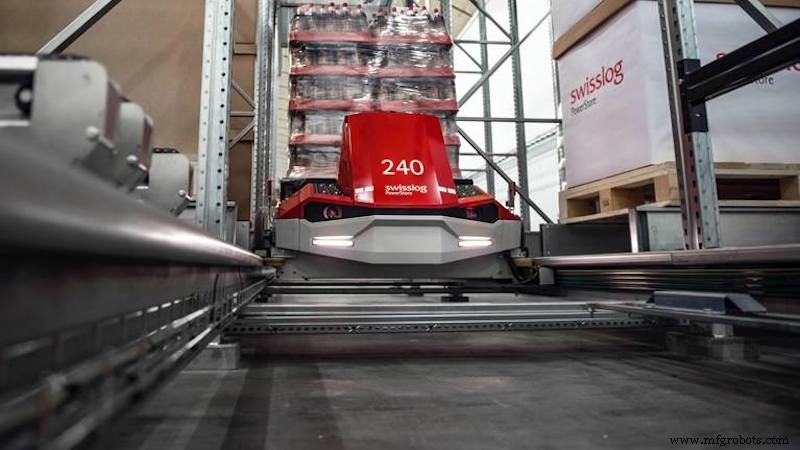
For instance, one approach could use a shuttle system with a modular design, such as Swisslog’s PowerStore high density shuttle system.
In this possible installation, automated shuttles would move around discrete plant shelving units inside an enclosed room or facility.
Each shelving unit could hold multiple plant trays, depending on plant growth height needs. Shelving units would move around the enclosed space based on the needs of the plants for water, nutrients, light, planting, germination, maintenance, harvesting and monitoring.
Markus Schmidt, president of Swisslog Americas, says: “Without the help of cost-effective and flexible automation, vertical farming is not profitable or scalable beyond the niche applications it currently occupies.
“By taking a logistics-market approach to vertical farming, we can provide scalable, adaptable, cost-effective automation solutions for low-footprint, vertically stacked installations that can handle planting, monitoring, maintenance and harvesting – as well as the complex scheduling and logistics of such an operation.”
While the global market for vertical farming is forecasted to increase, many operations are still only able to profitably grow a limited number of crops.
The innovative Swisslog automation solutions will help the industry overcome barriers to growth by providing the following potential benefits:
- Orchestrating the process by using essential parts of Swisslog’s SynQ management software to support automated flow in production of the plant.
- Enabling installation into in diverse types of spaces (for example abandoned warehouses in urban centers, unused floor space in office buildings or new purpose-built facilities)
- Lowering the cost of labor for harvesting, planting and logistics.
- Reducing energy use by optimizing lighting system.
- Decreasing costs of nurturing the plant by using unique space management arrangement
- Shrinking transportation costs by enabling vertical farming to be placed closer to point of sale.
Swisslog is working with farming companies and grocers to explore potential applications and installations and has a number of pilot installations currently in operation. The company expects a larger customer application of the automation system to be deployed by summer 2021.
Automation Control System
- Vertical Farming: Tackling Waste and Inefficiency in the Global Food Supply Chain
- Swisslog: Automation Offers Clear Solution to COVID-19 Disruption in E‑Grocery Supply Chains
- Swisslog Partners with H-E-B to Launch Automated Micro‑Fulfillment Centers for Online Grocery
- How Automation Transforms Farming: Boosting Efficiency & Family Time
- Supply Chain Automation: Driving the Future of Logistics Efficiency
- Conexiom: Powering Touchless Supply Chains with AI Automation
- Automation & IoT: Shaping the Future of Supply Chain Management
- Charting the Future of Automation in Supply Chain Operations
- Understanding Supply Chain Management: Key Concepts & Benefits
- 5 Proven Strategies to Overcome Factory Automation Hurdles Caused by Supply Chain Disruptions