



Process Automation I/O Systems: Market Trends, Decentralization, and Ethernet‑Based Field Connectivity

Key Definitions
- NOA (Namur Open Architecture) – Developed by the User Association of Automation Technology (NAMUR), NOA adds a parallel communication channel (wireless, Bluetooth, 4G/5G, etc.) to existing instruments, enabling the capture of “stranded data” without disrupting primary control signals.
- Ethernet – APL™ (Advanced Physical Layer) – A joint effort by manufacturers and OPC, this emerging standard brings Ethernet connectivity to field instruments, supporting long cable runs and intrinsic safety for power and data over a single pair.
- OPC UA (Unified Architecture) – The OPC Foundation’s open, platform‑agnostic protocol that facilitates secure, interoperable machine‑to‑machine communication.
- MTP (Module Type Packages) – NAMUR’s evolving standard that provides a universal language for describing module characteristics, enabling seamless integration across manufacturers.
Market Size & Major Players
The global process I/O system market is valued at just over $3 billion, growing at a CAGR of approximately 3.7% (source: industry reports). Leading vendors hold the following market shares:
- Siemens – 14%
- ABB – 10%
- Honeywell – 9%
- Rockwell Automation – 8%
Current Trends in Process Automation I/O
- Decentralization – Remote I/O stations in the field reduce cabling complexity and improve system resilience.
- Decline of Traditional Fieldbuses – Wiring sensors directly to I/O terminal boards eliminates cross‑wiring cabinets.
- Universal (Late‑Binding) I/O – Configurable modules enable rapid system delivery and late‑stage field wiring.
- Intelligent Sensors – Higher‑resolution data supports advanced control, remote diagnostics, and asset management.
- Ethernet‑Based Field Connectivity – PROFINET and Ethernet – APL™ are leading the shift to high‑speed, deterministic communication.
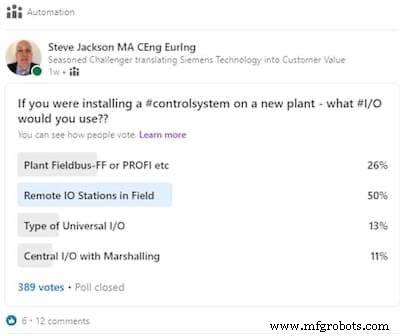
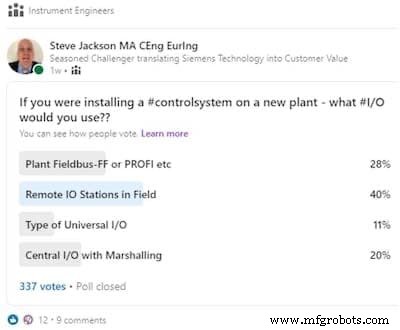
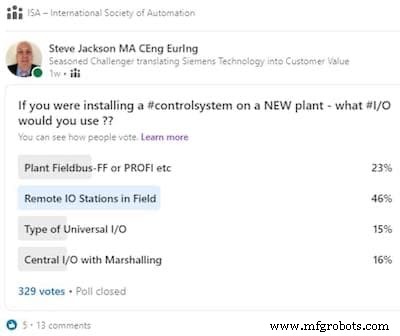
LinkedIn poll results (Automation community) confirm remote I/O stations are the top priority, while universal I/O ranked lower among Instrument Engineers and ISA members. Fieldbus usage unexpectedly remains the second favorite across groups.
Why Plant Fieldbuses are Declining
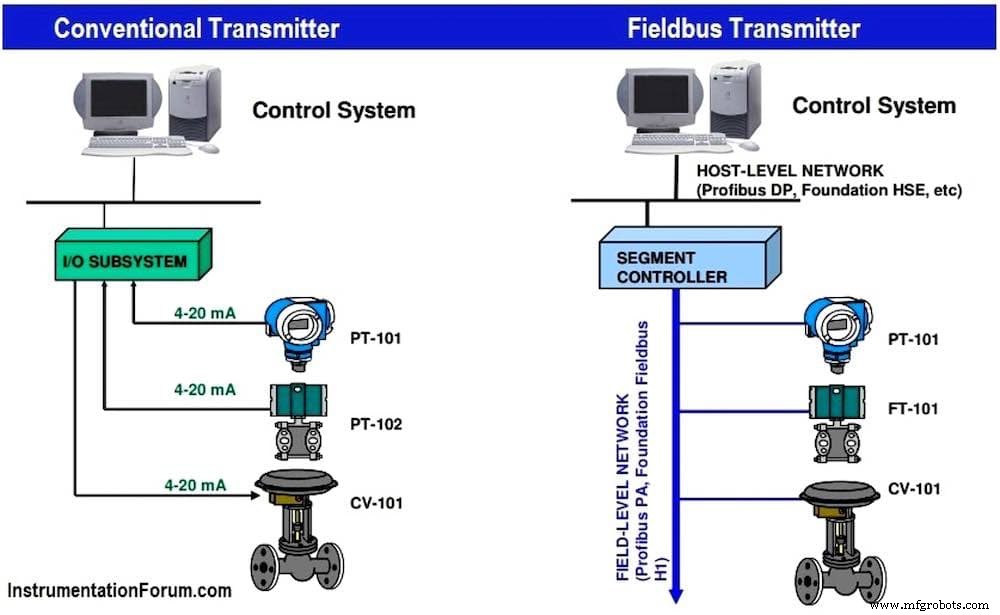
Decentralization has long driven the use of fieldbuses, yet their adoption has waned. In the oil & gas sector, for example, engineers now justify choosing conventional 4‑20 mA HART over Foundation Fieldbus (FF) because:
- Cost savings from reduced cabling are minimal in hazardous areas.
- Fieldbus installations often involve complex earthing, grounding, and technical support.
- Parallel data channels (e.g., NOA) and HART already provide remote diagnostics and asset management.
Wireless solutions are gaining traction for low‑scan, non‑control measurements, but power requirements can offset cabling savings.
PROFIBUS: The Surviving Fieldbus
PROFIBUS remains popular outside oil & gas, powering motor control centers and variable speed drives. Its evolution into PROFINET offers deterministic Ethernet speeds, making it ideal for remote I/O.
The Rise (and Limits) of Universal I/O
While decentralization drives remote I/O, universal modules are increasingly deployed in main control rooms by DCS vendors. Benefits include:
- Reduced delivery times and earlier field wiring.
- Flexibility to reconfigure I/O late in the project lifecycle.
However, universal systems face constraints:
- Limited support for diverse I/O types (intrinsic safety, redundancy, SIL, galvanic isolation).
- Higher cost per channel compared to dedicated modules.
- Lower density (55–140 I/O/m) versus fixed I/O (400–500 I/O/m).
Cost‑Effectiveness: Fixed vs. Universal I/O
High‑density fixed modules are often more economical, especially when installed remotely to cut plant cabling and reduce footprint. Combining dedicated I/O with a universal backplane can offer the best of both worlds.
Example: Siemens ET200SP HA I/O supports up to 896 signals in a single cabinet. It can be plugged into a generic backplane for last‑minute reconfiguration, while a configurable 16‑channel card handles the final 10% of changes.
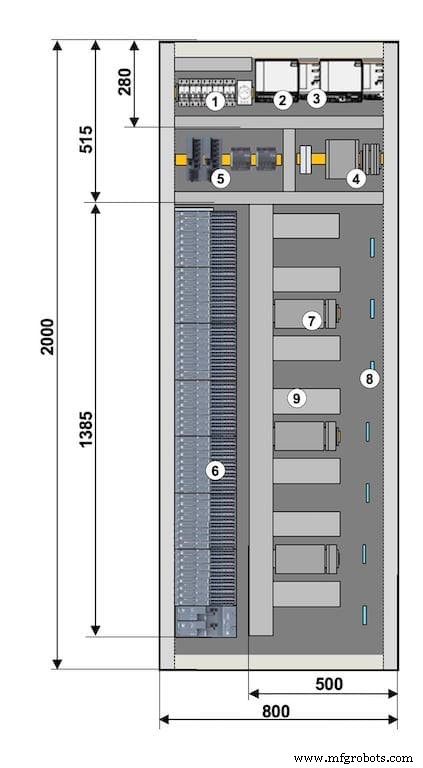
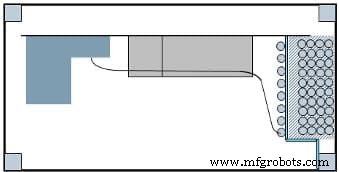
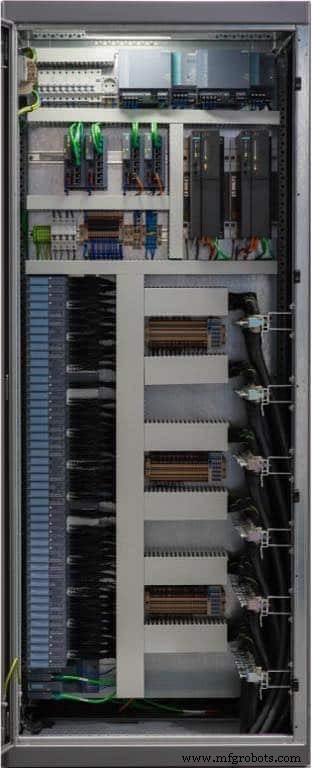
Direct‑Connection Cabinet: 56 I/O Modules (up to 896 I/O), 800 × 2000 mm (W × H)
Key Features
- One‑sided access, 400 mm depth
- Ambient temperature -20 °C – +40 °C
- 120/230 V AC redundant power
- Direct connection up to 2.5 mm²
- PROFINET over copper or fiber
- Supports up to 56 field cables (20 mm diameter)
1 - Infeed MCB and RCB
2 - AC/DC SITOP PSU 8200 40A (Siemens, 6EP3334‑8SB00‑0AY0)
3 - Redundancy module SITOP PSE202U (Siemens, 6EP1961‑3BA21)
4 - Power distribution & cartridge fusing
5 - Optional hardware (e.g., SCALANCE XC206‑2‑SFP, Siemens, 6GK5 206‑2Bs00‑2AC2)
6 - T 200SP HA with interface module and bus adapter
7 - Spare wire & ground terminals
8 - Cable fixation & shielding profile
9 - Cable duct
EPCs and Late‑Binding I/O
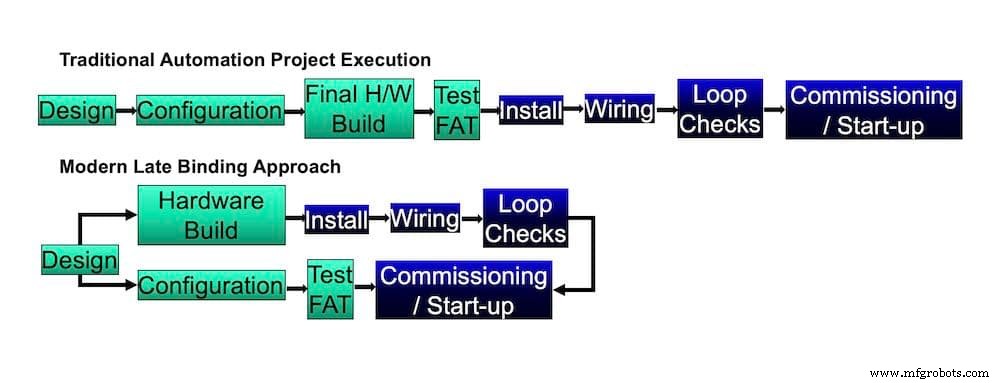
Engineering, Procurement & Construction (EPC) firms favor late‑binding because it aligns with the typical project sequence: instrumentation is finalized after piping, mechanical, and process design. Decoupling hardware from software allows early DCS configuration and rapid field deployment.
Ethernet‑Based Field Connectivity
Smart sensors increasingly connect directly to Ethernet, reducing the need for separate I/O buses. PROFINET and upcoming Ethernet – APL™ solutions deliver high‑speed, deterministic links suitable for remote I/O and individual instrument access.
Universal Plug‑and‑Produce Solutions
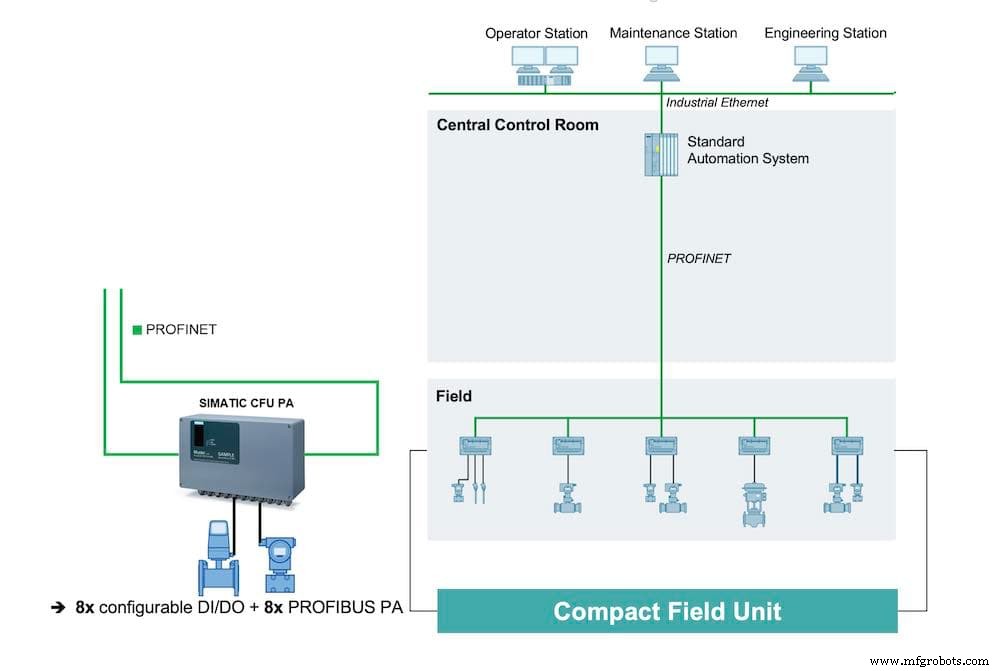
The Siemens Compact Field Unit (CFU) exemplifies this approach. Using PROFINET (or soon Ethernet – APL™), it remotely distributes up to eight PROFIBUS PA instruments, automatically recognizing each port. This enhances flexibility, cuts cabling, and revitalizes PROFIBUS PA adoption.
From Instruments to MTP: A Unified View
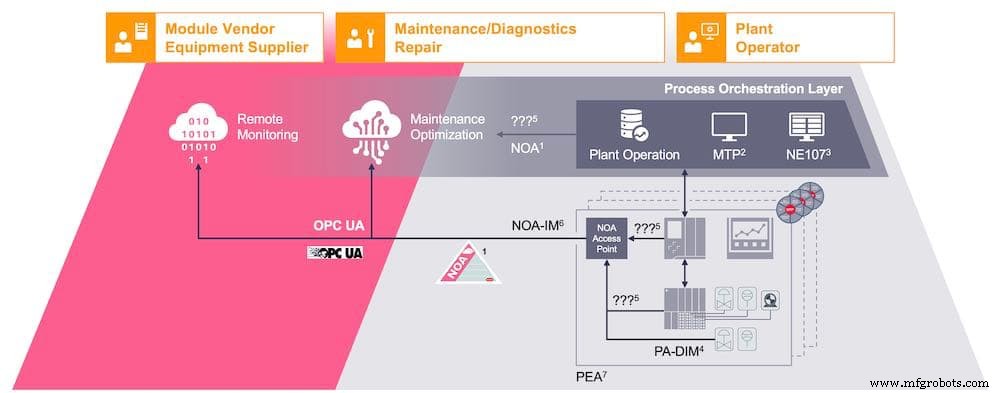
Smart instruments are evolving into modular packages. NAMUR’s MTP offers a standardized description for green‑field projects, while NOA provides the parallel communication channel needed for brown‑field sites. Together they pave the way for a seamless, OPC UA‑based automation landscape.
MTP Modular Automation and NOA NAMUR Open Architecture are Complementary
Conclusions
- Decentralization continues to dominate, but the decline of fieldbuses and the rise of universal I/O illustrate industry nuances.
- Foundation Fieldbus sees reduced adoption due to technical complexity and legacy issues.
- PROFIBUS remains prevalent outside oil & gas, largely because of its integration in electrical systems.
- EPCs prefer late‑binding I/O to accelerate delivery and early cabling.
- High‑density fixed I/O is often more cost‑effective and space‑efficient than universal solutions.
- All approaches—fixed remote I/O, universal modules, NOA, and Ethernet – APL™—will coexist for the foreseeable future; the dominant strategy will emerge over time.
Stay tuned as the automation ecosystem evolves.
Automation Control System
- Mastering C Input and Output (I/O): scanf() and printf() Explained
- Python File I/O: Mastering File Operations, Reading, Writing, and Management
- How Software‑Configurable I/O is Revolutionizing Building Automation
- Mastering File I/O in C: Creating, Opening, and Managing Files
- 6 Key Automation Trends Revolutionizing Automotive Manufacturing
- Panasonic Introduces Advanced NPM G Series Factory Automation Systems
- 2022 Automation Landscape: Top 10 Trends Driving Enterprise Innovation
- Emerging Trends Shaping Industrial Automation: 2024 Outlook
- Advanced Automation in Welding: Enhancing Precision & Efficiency
- Standardized Systems Accelerate Industrial Design Efficiency