



Time‑Sensitive Networking (TSN): Merging OT and IT for Real‑Time Industrial Ethernet
Time‑Sensitive Networking (TSN): Merging OT and IT for Real‑Time Industrial Ethernet
Operational Technology (OT) and Information Technology (IT) traditionally serve distinct real‑time requirements. OT traffic—such as machine‑control commands and sensor readings—demands deterministic delivery with fixed latency and minimal jitter. IT traffic, by contrast, is best‑effort and prioritizes throughput over strict timing.
Time‑Sensitive Networking (TSN) unifies these domains on standard Ethernet, delivering real‑time guarantees while preserving the simplicity and ubiquity of Ethernet cabling. By adding a deterministic layer to Ethernet, TSN reduces network delays, enforces predictable latency, and allows OT and IT packets to coexist on the same physical medium.
What Is TSN?
TSN is a family of IEEE standards that extends Ethernet to support time‑critical applications. Its architecture comprises three layers:
- Foundational standards – the core IEEE specifications that define timing, scheduling, redundancy, and preemption.
- Profiles – industry‑specific parameter sets that configure the foundational features for a particular application (e.g., IEC 60802 for industrial control).
- Protocols – the actual data‑link layer implementations that carry the traffic.
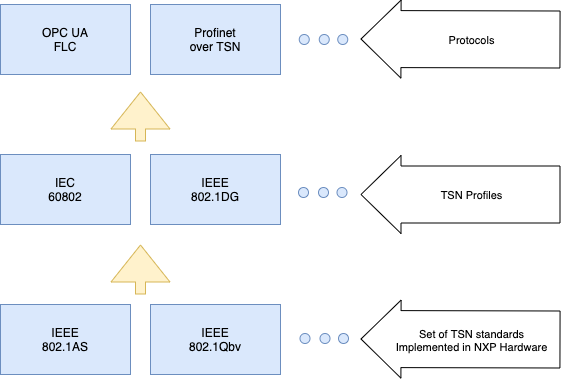
Essential TSN Standards
- IEEE 802.1AS – builds on Precision Time Protocol (PTP) to synchronize all network devices to a common time base, enabling time‑aware scheduling.
- IEEE 802.1Qbv – introduces a time‑aware shaper that reserves specific time slots for packets, ensuring minimal jitter and predictable latency.
- IEEE 802.1CB – provides frame replication and elimination (FRER) for fault‑tolerant, redundant communication without burdening host CPUs.
- IEEE 802.1Qbu/802.1Qbr – support frame preemption and guard‑band allocation, allowing high‑priority frames to interrupt lower‑priority traffic while keeping cycle times stable.
For deeper technical details, consult the Fundamentals of Time‑Sensitive Networking white paper.
Enabling TSN with NXP Devices
NXP’s product lineup offers hardware and software support for the key TSN standards. The following table summarizes which devices implement which standards:

All three platforms—Layerscape LS1028A, i.MX RT1170, and i.MX 8M Plus—ship with comprehensive open‑source TSN drivers (including PTP), SDKs, and ready‑to‑run examples. They run Open Industrial Linux (OpenIL) or other real‑time operating systems, making them ideal for fast prototyping and long‑term deployment.
Device Highlights
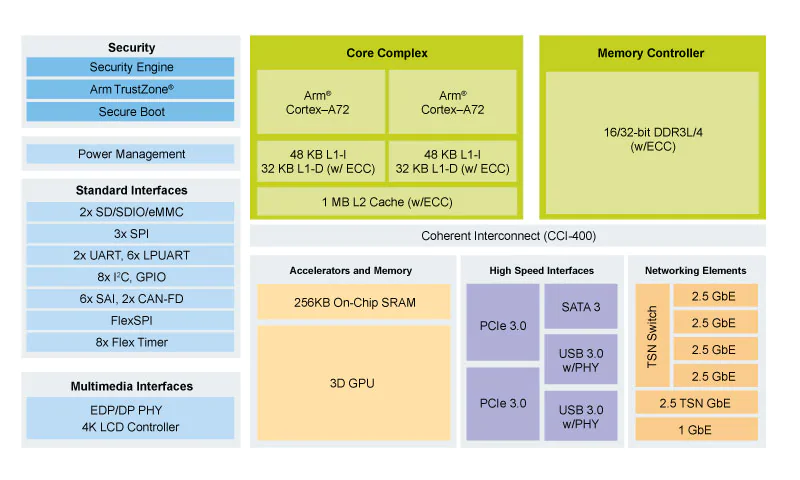
Layerscape LS1028A
The LS1028A is a dual‑core Cortex‑A72 application processor tailored for automotive and industrial workloads. It integrates a hardware Ethernet switch that supports TSN over four ports, a CAN‑FD interface, an on‑chip GPU, and robust security features. Typical use cases include industrial routers, robotics, and industrial HMI.
i.MX RT1170
Featuring a dual‑core architecture—Cortex‑M7 up to 1 GHz and Cortex‑M4 up to 400 MHz—the i.MX RT1170 is among the fastest MCUs on the market. It offers up to 2 MB SRAM, three Ethernet interfaces, advanced security primitives, and optional 2D GPU acceleration, making it suitable for HMI, robotics, and low‑power industrial control.

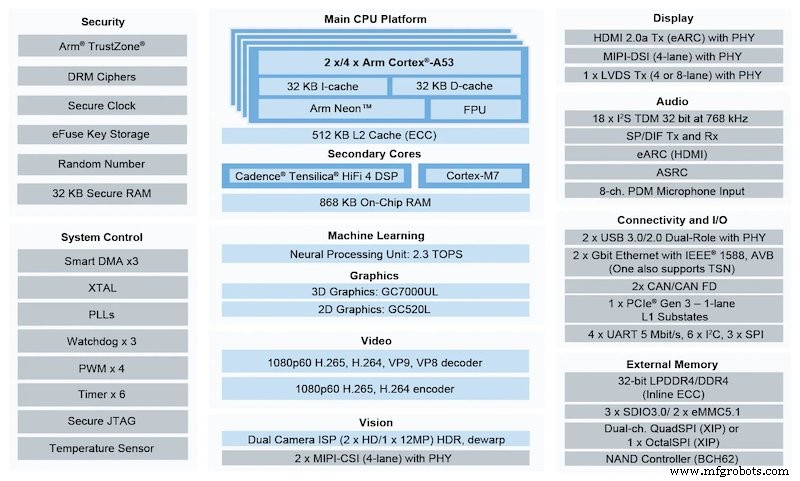
i.MX 8M Plus
The i.MX 8M Plus delivers high‑performance machine‑vision and AI capabilities with a dedicated NPU (2.3 TOPS), multi‑interface CAN‑FD, and TSN‑capable Ethernet. It also features multiple 2D/3D graphics accelerators and inline ECC for reliability.
All three devices belong to NXP’s 15‑year longevity program, ensuring availability throughout the full product lifecycle—critical for safety‑critical and certification‑heavy applications.
TSN‑Based Demo Architecture
The demo illustrates how TSN‑capable devices can cooperate to deliver deterministic, synchronized operation:
- The i.MX 8M Plus performs image recognition with its ISP and NPU, generating real‑time control commands.
- The i.MX RT1170 receives those commands and drives a robotic arm to pick items from a conveyor belt.
- The Layerscape LS1028A acts as the TSN backbone, routing frames between the two edge devices and any additional nodes while preserving tight latency bounds.
- A laptop simulates best‑effort traffic to demonstrate TSN’s resilience under mixed workloads.
For a live demonstration, see Machine Learning and TSN with NXP’s i.MX 8M Plus.
Industry Articles are a form of content that allows industry partners to share useful news, messages, and technology with All About Circuits readers in a way editorial content is not well suited to. All Industry Articles are subject to strict editorial guidelines with the intention of offering readers useful news, technical expertise, or stories. The viewpoints and opinions expressed in Industry Articles are those of the partner and not necessarily those of All About Circuits or its writers.
Automation Control System
- Designing Industrial IoT Systems with the RTI DDS Toolkit in LabVIEW 2017
- Microchip Introduces SparX‑5i Switches to Power Time‑Sensitive Networking in Industrial Ethernet
- Time‑Sensitive Networking: How TSN Drives Predictable Industrial Ethernet
- Elevating Manufacturing Excellence with Industry 4.0: The Rise of Quality 4.0
- Four Proven Strategies to Simplify Industrial IoT Network Design
- Streamline Electrical Harness Design with E3.series
- Master E3.series for Industrial Equipment Design: Unified Electrical & Mechanical Engineering
- Design-Driven HMI Panels for Safer, More Efficient Machine Operation
- Maximizing Production with Advanced Additive Manufacturing Software
- Essential Safety Standards for Mobile Industrial Robots