



Superconducting Devices: Fundamentals, Applications, and Emerging High‑Temperature Technologies
Superconducting devices harness the unique properties of materials that exhibit zero electrical resistance and expel magnetic fields below a critical temperature. Though they are not yet mainstream, they enable ultra‑sensitive signal amplification, magnetic field detection, and photon counting, and they can switch in picoseconds.
Superconductivity
In 1911, Heike Kamerlingh Onnes discovered that mercury becomes superconducting at 4.2 K, a breakthrough that earned him the Nobel Prize. While most metals see their resistance decrease as temperature falls, only a handful—including lead, aluminum, tin, and niobium—drop to exactly zero once they cross their critical temperature, Tc. The result is lossless current flow that can persist for thousands of years in a closed loop.
Cooper Pairs
Electrical resistance in ordinary conductors originates from electrons scattering off the crystal lattice. In a superconductor, electrons pair up into a Cooper pair mediated by phonon exchange. This bound state occupies a lower energy level than individual electrons and can glide through the lattice without scattering, eliminating all energy dissipation.
Josephson Junctions & Transistors
A Josephson junction consists of two superconductors separated by a thin insulating barrier. Even with zero applied voltage, electrons can quantum‑tunnel through the barrier. When a voltage is applied, the tunneling current oscillates at a frequency directly proportional to that voltage, a relationship so precise that the SI unit of voltage is now defined in terms of Josephson oscillations.
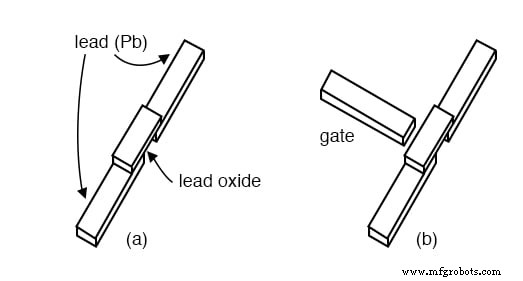
The addition of a gate electrode capacitively coupled to the junction yields a Josephson transistor, which offers extremely low power dissipation and is a key component in superconducting logic families such as SQUIDs and Rapid Single Flux Quantum (RSFQ) circuits.
Superconducting Quantum Interference Device (SQUID)
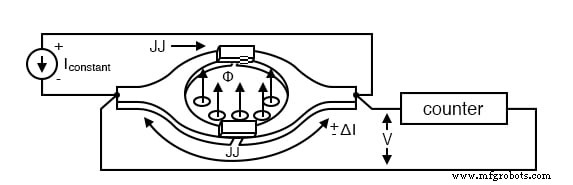
A DC SQUID is a superconducting ring interrupted by two Josephson junctions. It acts as an exquisitely sensitive magnetometer, capable of detecting magnetic flux changes as small as 10-14 T—enough to sense neural activity in the brain. The device translates minute variations in magnetic field into measurable voltage pulses.
Rapid Single Flux Quantum (RSFQ)
RSFQ technology replaces conventional transistor logic with magnetic flux quanta as the information carrier. Each logical operation is represented by a picosecond voltage pulse generated when a Josephson junction switches. Operating at frequencies above 100 GHz, RSFQ circuits consume negligible power, making them attractive for high‑speed digital applications.
High‑Temperature Superconductors
High‑temperature superconductors (HTS) maintain superconductivity above the boiling point of liquid nitrogen (77 K), dramatically simplifying cooling. The most widely used HTS materials are cuprate oxides such as YBa2Cu3O7‑x with Tc ≈ 90 K. While their performance lags that of conventional low‑Tc metals, the cost‑effective liquid‑nitrogen cooling has spurred research into HTS‑based sensors, power lines, and quantum devices.
Key Takeaways
- Conventional metals never reach zero resistance, but superconductors do once Tc is crossed.
- Cooper pairs allow electrons to move without scattering, enabling lossless current.
- Josephson junctions enable voltage‑controlled tunneling and provide the foundation for superconducting logic.
- A Josephson transistor adds gate control for low‑power switching.
- SQUIDs can detect magnetic fields as weak as 10-14 T, far below the Earth’s field.
- RSFQ circuits achieve ultra‑fast switching with minimal energy use.
- High‑temperature superconductors open the door to practical, liquid‑nitrogen‑cooled devices.
Industrial Technology
- Active vs. Passive Electronic Components: Understanding Their Roles
- Solid-State Device Theory: From Physics to Practical Applications
- Quantum Devices: Beyond CMOS – Harnessing Tunneling, Quantum Dots, and Spintronics for Future Electronics
- Comprehensive Guide to Semiconductor Device Modeling in SPICE
- Superconductivity: Zero Resistance, Quantum Phenomena, and Practical Applications
- Revolutionizing Industry: The Future of Connected Devices
- Protecting IoMT: Best Practices for Securing Internet-Connected Medical Devices
- Protecting Your Data: The Ultimate Guide to IoT Privacy & Security
- Windlass Safety Devices: Essential Protective Features for Marine Operations
- Generator Protection: Fault Types & Essential Protective Devices