



Superconductivity: Zero Resistance, Quantum Phenomena, and Practical Applications
When a conductor is cooled to temperatures near absolute zero—around –273 °C—it can lose all electrical resistance, not just a small fraction. This abrupt transition to zero resistance, rather than a gradual decline, is the hallmark of superconductivity.
H. Kamerlingh Onnes first observed this effect in 1911 at the University of Leiden, after liquefying helium in 1908. By cooling mercury just above helium’s boiling point, he saw its resistance collapse to zero.
While the precise mechanism remains debated, the leading explanation involves electrons pairing up into Cooper pairs that move without scattering. A related quantum state—superfluidity—allows certain liquids like helium to flow frictionlessly.
Superconductors could eliminate power losses in electrical grids, push motor efficiency toward 100 %, and render inductors and capacitors ideal by removing resistive imperfections. Prototype devices already exist, but keeping them below their critical temperature is a practical hurdle.
The temperature at which a material switches to the superconducting state is its transition temperature (Tc). Classic superconductors require cryogenic temperatures, but high‑temperature varieties now operate at –160 °C or warmer. The goal is materials that function at ambient temperatures or with inexpensive cooling.
Below is a concise table of critical temperatures for common superconducting elements and alloys, expressed in Kelvin (1 K ≈ 1 °C). Kelvin is used to avoid negative numbers.
| Material | Element/Alloy | Critical temp. (K) |
|---|---|---|
| Aluminum | Element | 1.20 |
| Cadmium | Element | 0.56 |
| Lead | Element | 7.2 |
| Mercury | Element | 4.16 |
| Niobium | Element | 8.70 |
| Thorium | Element | 1.37 |
| Tin | Element | 3.72 |
| Titanium | Element | 0.39 |
| Uranium | Element | 1.0 |
| Zinc | Element | 0.91 |
| Niobium/Tin | Alloy | 18.1 |
| Cupric sulphide | Compound | 1.6 |
Superconductors interact uniquely with magnetic fields. In the superconducting state they expel magnetic flux—a phenomenon called the Meissner effect. However, if the field exceeds a material’s critical value, superconductivity is lost. Any magnetic field lowers the critical temperature, so a superconductor exposed to high currents (which generate fields) must be kept colder.
These magnetic limitations influence circuit design, because the zero resistance of a superconducting wire still imposes a current limit determined by its critical magnetic field.
Industrial use accelerated after 1987, when the yttrium‑barium‑copper‑oxygen ceramic was discovered. It superconducts at –160 °C and can be cooled with liquid nitrogen instead of liquid helium. Educational kits now let high‑school labs demonstrate the Meissner effect by levitating a magnet over a cooled disc.
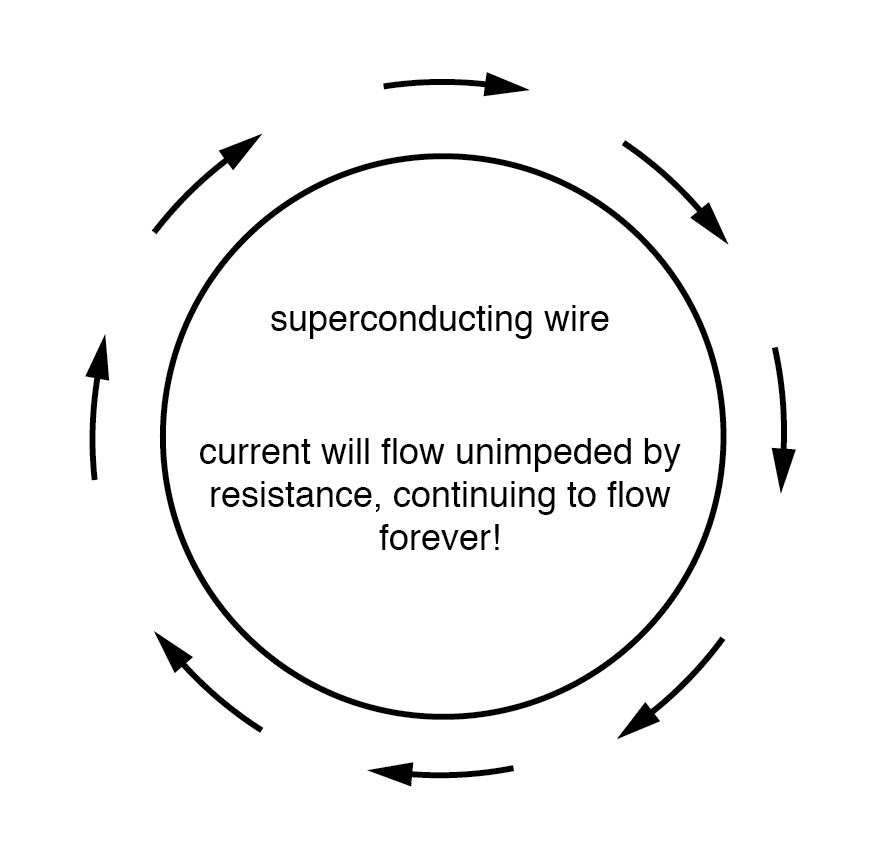
Zero resistance also means a superconducting loop can sustain a persistent current indefinitely without external power—essentially a perfect energy storage element. While this resembles perpetual motion, it does not violate thermodynamics because it stores, rather than generates, energy.
Another intriguing application is the Josephson junction, a superconducting “relay” that controls one current with another without moving parts. Its tiny size and ultra‑fast switching promise new computing architectures that could rival semiconductor transistors.
Key Takeaways
- Superconductors have absolute zero electrical resistance.
- All known superconductors require cooling below their transition temperature, which varies by material.
Related Worksheets
- Voltage, Current, and Resistance Worksheet
- Specific Resistance of Conductors Worksheet
Industrial Technology
- Specific Resistance Coefficients at 20°C – Comprehensive Material Reference
- Comprehensive Table of Temperature Coefficients of Resistance for Metals and Alloys
- Critical Temperatures of Elemental and High‑Temperature Superconductors (Kelvin)
- Superconducting Devices: Fundamentals, Applications, and Emerging High‑Temperature Technologies
- Mastering C# Arrays: Declaration, Initialization, and Operations
- C# Multidimensional Arrays: 2D Arrays Explained with Code Examples
- Mastering C Arrays: Declaration, Initialization, and Common Operations
- Mastering Java's NavigableSet Interface: Navigation, Sorting, and Practical Examples
- Mastering Java's ListIterator Interface: A Practical Guide
- Understanding Ceramic Heating Elements: How They Work and Why They're Superior