



GSMA Intelligence’s Peter Jarich: 5G Is Critical for Scaling IoT

During MWC 2021, Peter Jarich talks about the need for 5G and NB-IoT as critical components for massive IoT, the role of operators for digital transformation, private connectivity, and the upcoming standalone 5G networks.
Recently, GSMA Intelligence released their “Smart manufacturing: 5G engineers the future of IoT” report, where they identify the challenges of different industries to start or accelerate their digital transformation and benefit from Industry 4.0 applications.
According to Sylwia Kechiche, the author of the report, “Covid-19 has proved to be a catalyst for Industry 4.0; it has exacerbated existing challenges and pain points for manufacturers and accelerated the need for smart connectivity and digital transformation. […] To achieve their business transformation and digitisation goals, manufacturers require dedicated network resources.”
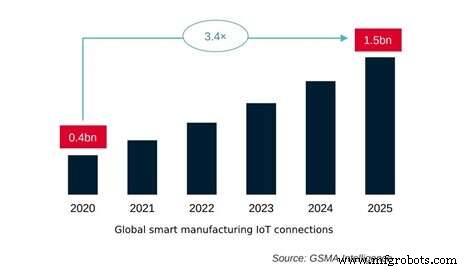
In the report, there are several key connectivity elements for industries to consider to achieve their digital transformation goal: Massive IoT, the role of 5G, private networks, and edge computing.
During MWC 2021 in Barcelona, we had the opportunity to talk with Sylwia Kechiche and Peter Jarich, Head of GSMA Intelligence, during the show. The following is an interview with Jarich, where he gives an overview of the different technologies and operators’ challenges to implementing them.
You can watch our MWC interview with Peter Jarich below. A full transcript, edited for clarity, follows after the video.
IoT Times: Peter, thank you so much for being with IoT Times today. It is great to meet you in person this year.
We are back on the road for MWC. How do you feel being back in business at MWC Barcelona, and how do you think the industry is reacting to the show?
Peter Jarich: I think you hit all the key notes in just the way you asked the question, right? Part of it’s just being back to business. Seeing all these people, many we know, many we don’t, and making those connections.
It’s been great to be here, and it’s been great to be back here in Barcelona. It’s a city that’s obviously important to all of us, we know. But in the last part, you talked about; there’s industry. I think that’s key because it’s impressive, at least from my perspective, the number of folks from the industry that I’ve had a chance to interact with here. It has been great because I think we know that it’s been a big focus for all operators to connect with the industry.
IoT Times: Anything you can take from the show so far?
Peter Jarich: I think it’s pretty clear, from what we’ve seen here at the show and, with a hybrid show, you’ve got the virtual component. So some of it, we probably knew ahead of time. And I think you see some really crucial trends, which include a lot of focus on OpenRAN, a lot of emphasis on Edge, but a lot of focus, as I mentioned, on the enterprise and industries, right?
And, how do we bring those things together? How do you connect together the network transformation that operators are going through with the needs of industries? How do you tailor those solutions to them? And how do you make sure you explain to them what you can do?
I think for many of them, they hear that 5G might be important, but they’re not sure why. So making that connection for them, I think, is more important than ever, and I think we see that here.
IoT Times: Talking about industrial IoT, industrial applications on networks. Today, most connections are not critical IoT. They are mostly sensors, monitoring devices, etc. Why do you think 5G could play a significant role in massive IoT?
Peter Jarich: I think there are two parts that are important. One, we’ve got to remember that even if the vast majority of IoT connections may not require critical connectivity, those that do will need that.
To enable those high-value, important critical connectivity use cases, you will need capabilities like 5G. But the other part, I think you’re right. Obviously, the vast majority of devices, sensors, low-cost devices for applications that are not critical, there you need scale. And 5G is essential for enabling the IoT to scale.
We’ve seen that from the LTE side of things. We’ve also seen the move towards something like NB-IoT as part of the 5G family. And I think that to make IoT successful, it’s going to require that scale.
It will require going to low-cost devices, and those use cases where maybe it’s not saving tens of thousands of dollars. Still, it’s helping to digitize, make the digital transformation for industries, and it’s that scale is probably more important.
IoT Times: Private networks! There is a lot of buzz around those. Companies such as Nokia are pushing this concept forward. We haven’t seen a lot of that from the operators’ side.
What do you think will be the role of the ISPs, the carriers, in digital transformation for industries that require their own network?
Peter Jarich: It’s a great question. At GSMA Intelligence, we’ve been looking a lot at private wireless and private networks, non-public networks, a lot of different things for them, in part because they encompass so many different trends.
There’s the question of how operators monetize these new connectivity technologies. There’s moving beyond connectivity. There are bits of OpenRAN in there and coverage. But to your question about the role of operators, I think, you know, this is a new space, but we’re seeing some exciting examples of what the role of operators could be, right?
For example, Verizon has talked about their work in the UK, enabling private connectivity for a port. Let’s think about that, right? This is Verizon out of their territory enabling this private connectivity, right?
So, you see that one of the things operators really know is how to launch networks. They know how to manage that spectrum. They know how to pull that all together. I think you definitely see this opportunity for them because they get that, right? They can make it easy.
Some enterprises may want to roll this out themselves. They may say, I’m big enough. I can handle this. I want to own that network. But for a lot of them, that’s not going to be the case. They’re going to need the support of someone who may own spectrum in a market, maybe not, but understands how to roll out networks and manage them. And operators are excellent at that.
IoT Times: When we talk about private networks and the need for exclusive connectivity in some areas, one of the key advantages of 5G is the possibility of network-slicing. This has been mentioned many times in the past few years, but operators are not taking advantage of that capability. They already have the network, and instead of adding another network [for private connectivity], they could do it through slicing. Why do you think they are not using it?
Peter Jarich: It’s a great question. So I’d challenge the notion that we don’t see much momentum around slicing because from an infrastructure vendor perspective, any vendor out there, and you’ll see a lot of this on the show floor here, has an end-to-end slicing demonstration. They’re excited to show what they can do about enabling end-to-end slicing.
Now, you might ask or say, well, that’s great that the vendors are doing that, but what about the operators? Right? That’s the real question. Where are operators with this?
It’s important to recognize that as much as 5G brings that, it’s enabled much more by standalone versus non-standalone. And so, right now, for most of the 5G networks, they are non-standalone. And when we get to standalone, it allows slicing in a way that you can’t do without standalone.
So what’s exciting about 2021 is, we’re beginning to see 5G standalone networks get launched. We’re starting to see a lot of operators who have a non-standalone network look at standalone 5G. So this is the year I think we start to see the operators get behind it, recognizing that this stuff takes time.
You’re 100 percent right. We’ve been talking about slicing for a while. But to get the standalone networks, to get the end-to-end slicing from the vendors, now that those pieces are coming together, this is the year; I think, when we start to see how slicing works.
Industrial Technology
- Scaling IoT Provisioning: Secure, Efficient Strategies for Device Onboarding
- The Rise of IoT: Why Security Must Be Built In from Day One
- From Pilot to Large-Scale Deployment: Scaling IoT for Real Business Impact
- IoT: Why Projects Fail and How to Prevent It
- Mastering IoT Adoption: A Proven Three-Step Blueprint
- 5 Proven Strategies for a Successful Connected Product Launch
- Mastering Business Intelligence: Crafting a Winning Strategy for Data-Driven Success
- Sprint and Ericsson Launch 5G-Ready IoT Edge Intelligence Platform
- IoT Adoption Slows as Companies Seek Targeted Solutions, Bain Report Finds
- Boost Your Revenue: 10 Proven Ways to Integrate AI into Your Sales Team