



Understanding FDM 3D Printers: Construction, Operation, and PDF Guide
This is The Mechanical post! and today you would be reading about What is 3D printing? What are its types? Advantages and limitations of 3D printing and much more…
To download the PDF on 3D printing click on the button at the end of the article!
What is 3D printing?
3D printing is an additive manufacturing process that helps make solid models with the help of a 3D printer. These solid models are first built in CAD software and then sent to the 3D printer for printing the part. As the name additive manufacturing suggests, layers upon layers of filament material are added to form a 3 Dimensional model.Who invented 3D printing?
The 3D printing technology was invented by Chuck Hull in the year 1983 and he is credited to be the inventor of the SLA 3D printing technology. Whereas, FDM 3D printing technology was invented by Scott Crump the founder of the company Stratasys.Types of 3D printing technology
The following are the types of 3D printing technology:- Fused deposition modeling (FDM)
- Stereolithography (SLA)
- Masked Stereolithography (MSLA)
- Selective Laser Sintering (SLS)
- Digital Light Processing (DLP)
- Multi Jet Fusion (MJF)
- Direct Metal Laser Sintering (DMLS)
- Electron Beam Melting (EBM)
- Laminated Object Manufacturing (LOM)
Today we’ll discuss in detail the most common type of 3D printing i.e. Fused Deposition Modelling (FDM)
What is FDM 3D printing?
The Fused Deposition Modelling (FDM) or Fused Filament Fabrication (FFF) is an additive manufacturing process wherein a plastic filament is heated and extruded through a nozzle layer by layer from the bottom up. As the plastic cools down, it solidifies, and thus the 3D printed part is obtained.
Main components of FDM 3D printer
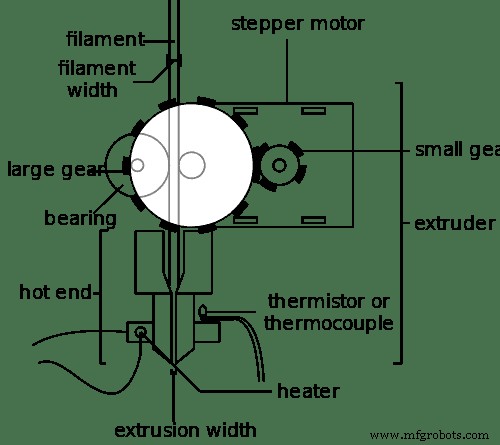
The FDM or FFF 3D printer has the following main components:
- Filament coil
- Extruder with a heating element
- Feeder
- Stepper motor mechanism
- Build platform
 |
| Image by – Lemio, GFDL, via Wikimedia Commons |
Filament coil
The filament coil is a wire spool made up of thermoplastics having a circular cross-section. The filament comes in a variety of colors.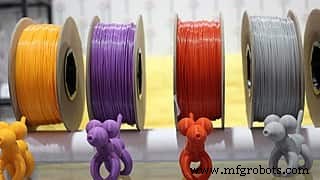 |
| Image by – Maurizio Pesce from Milan, Italia, CC BY 2.0, via Wikimedia Commons |
Extruder with heating element
The extruder with heating element causes the thermoplastic filament to soften up and then it is extruded through a nozzle.
Feeder
The Feeding mechanism is used to continuously feed the filament to the extruder.Stepper motor mechanism
A set o stepper motors are used to provide and control the movements of the extruder and the build platform in X, Y, and Z directions.Build platform
The build platform of the 3D printer is the place where the 3D part is printed upon.Working of Fused deposition modeling (FDM) printers:
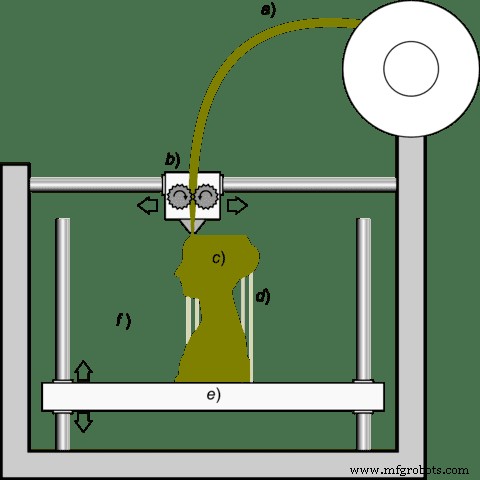 |
Image by – Paolo Cignoni, CC BY-SA 4.0, via Wikimedia Commons |
The part which is to be 3D printed is first designed in CAD software.
After that, it is exported as a .STL format file.
This .STL file is then sent to a slicing software for eg: Cura. In the slicer software, you can control the print parameters like the layer height, temperature of the filament, etc.
After setting the parameters, the file is then saved to an SD card and then inserted into the 3D printer. Or else some 3D printers can be directly connected via a USB.
Select the file in the 3D printer and set it accordingly.
The feeding mechanism of the 3D printer intakes the filament and sends it to the extruder where it is heated to the set temperature.
The filament is then extruded layer by layer onto the build platform. The stepper motors control the movement of the nozzle as well as the build platform accordingly.
Materials that can be 3D printed
The following are the commonly used materials for 3D printing:- Acrylonitrile butadiene styrene (ABS) plastic
- Polyethylene terephthalate (PET)
- Polycarbonate
- Nylon
- Carbon fiber
- Resins etc.
You might also like to read:
What is Abrasive jet machining (AJM)?What is Electric discharge machining (EDM)?
Extrusion process – detailed explanation
What is a CNC machine and what are its types?
Applications of 3D printing
The following are the applications of 3D printing:
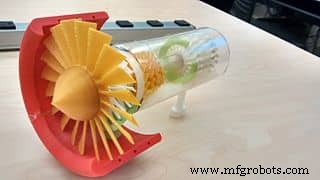 |
| 3D printed model of steam turbine | Image by – CMitchell, CC BY-SA 4.0, via Wikimedia Commons |
- 3D printing is used in the automotive industry from prototyping to printing spare parts.
- In the footwear industry, brands like Adidas, Nike, etc are making use of this technology for printing footwear.
- Now a days eyewear are also being 3D printed.
- 3D printing is used for medical purposes like printing of implants, the printing of crowns and dentures in the dental industry, robotic arms, etc.
- In the education industry, it is used to print 3D models for better understanding and teaching purposes.
- 3D printing is also widely used for prototyping purposes.
Advantages of 3D printing
The following are the advantages of 3D printing:
- High flexibility.
- Complex parts can be easily manufactured.
- Wastage of materials is reduced.
- Consistent quality of printed parts.
- Fast production rate.
- Changes can be easily made in the design.
Disadvantages of 3D printing
The following are the disadvantages of 3D printing:- The energy consumption of 3D printers is high.
- 3D printers are expensive with a high initial investment.
- For now, a limited number of materials can be printed.
- While 3D printing toxic emissions are produced.
- There are limitations on the finishes which can be obtained using 3D printing.
Looking for 3D printers to buy?
Are you looking to buy FDM 3D printers in India? then you might want to consider these 3D printers.If you click on the link below on mehanicalpost.site and decide to buy it, we may earn from qualifying purchases. Learn more
Conclusion
3D printing has the potential to revolutionize the manufacturing industry. 3D printing has a good scope in many sectors. 3D printing can be the manufacturing technology of the future. For now, the technology is comparatively expensive which is one of the major limiting factors, however, with advancement and more and more people getting familiar with it, this problem can be tackled.So that’s an overview of 3D printing.
Love reading The Mechanical post?
Let us know in the comments as well as spread the word among the fellow mechanical engineers with the social links given below.
Till then keep learning and reading The Mechanical post!
Industrial Technology
- Beyond Prototypes: Real‑World Innovations Made with 3D Printing
- Understanding 3D Printing: Principles, Types, and Key Applications
- Water Jet Machining: How It Works, Parts, Benefits, and Applications – PDF Guide
- Understanding FDM 3D Printers: Construction, Operation, and PDF Guide
- Abrasive Jet Machining: How It Works, Benefits, and Applications
- CNC Machines Explained: How They Work, Types, Benefits & Applications – PDF Guide
- PolyJet 3D Printing Explained: How It Differs from FDM and SLA
- Role of a 3D Printer Operator: Skills, Responsibilities, and Career Opportunities
- Understanding FDM 3D Printing: A Complete Guide
- Why 3D Printing Isn’t Dominating the Industry Anymore: Challenges and Future Outlook