



Abrasive Jet Machining: How It Works, Benefits, and Applications
This is The Mechanical post and today you will be reading about What is Abrasive jet machining? its construction, working, advantages, limitations and applications.
In the end, you can download the PDF by clicking on the button provided.
What is abrasive jet machining?
Abrasive jet machining is also known as AJM is a type of non-traditional manufacturing process which uses abrasive particles mixed with high-pressure gas to machine the workpiece.
The abrasive particles impact the workpiece surface with high velocity, resulting in the erosion of the workpiece material.
Abrasive jet machining is also known as Micro abrasive blasting, Abrasive micro blasting or pencil blasting.
The Abrasive jet machining process is quite similar to the Water jet machining process.
You might also want to read about another non-traditional machining process called the Electric discharge machining. Don’t worry the link would open up in a new tab so that you can continue reading this article.
What is an abrasive material?
Abrasives are hard materials that are used for machining and finishing purposes. The abrasive particles erode the workpiece material with the help of friction, caused by rubbing action between the workpiece and the abrasive particle.Common abrasive materials include aluminium oxide, silicon carbide, boron nitride, diamond etc. The shape of the abrasive used in the Abrasive jet machining process is generally spherical.
Common applications of abrasive particles include polishing, grinding, honing, drilling, cutting, lapping etc.
Working principle of Abrasive jet machining
The Abrasive jet machining works on the principle that a high-speed stream of gas and abrasive particles when concentrated at a point, results in the machining of the workpiece by erosion.Construction of Abrasive jet machining process
 |
| You are free to use this image, appropriate attribution with a link to the post is required. |
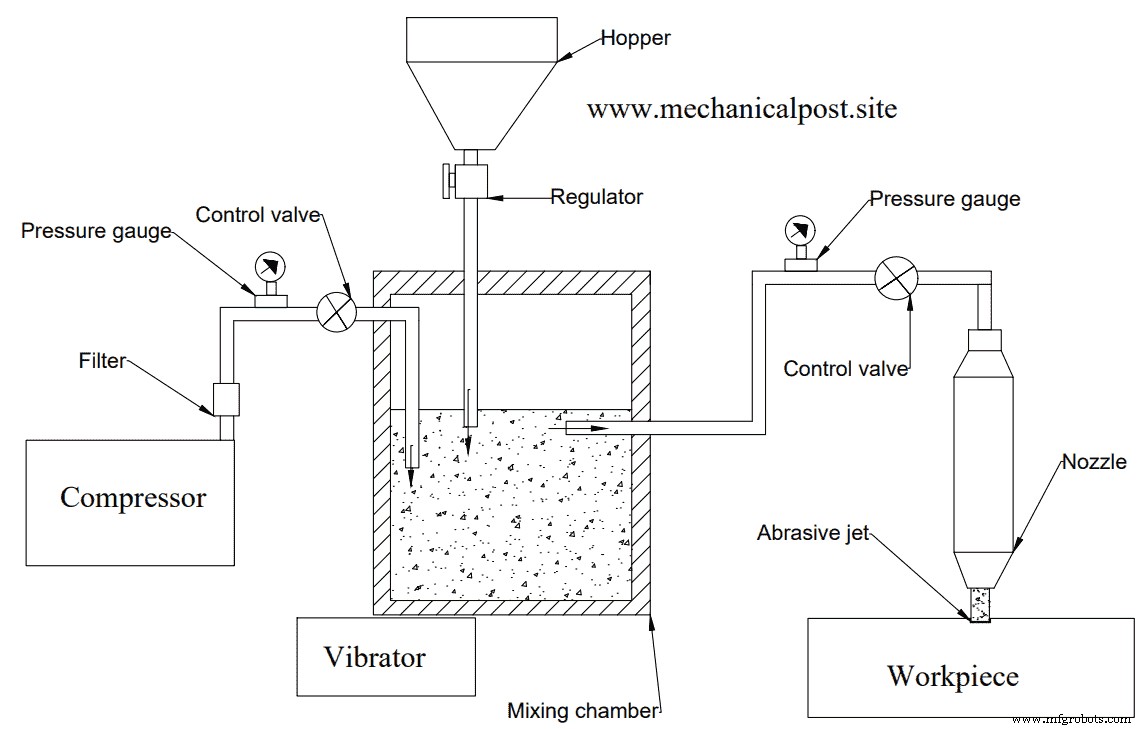
The following are the main components of Abrasive jet machining process:
- Air compressor
- Air filter
- Pressure gauge
- Control valves
- Hopper
- Mixing chamber
- Vibrator
- Nozzle
Air compressor
An air compressor is used to produce pressurized gas in the range of 25-130 psi. Inert gases or air or carbon dioxide is usually used for compression which is then passed through the air filter. The flow rate is around 30 litres per second.Air filter
The air filter is used to filter out dust particles or any other impurities which may have entered the compressor.Pressure gauge
A pressure gauge is used to read the exact pressure of the gas flowing. The most commonly used pressure gauge is the bourdon tube pressure gauge.Control valves
The control valves are used to control the flow of gas or abrasive mixture according to the working conditions.Hopper
The abrasive particles are fed to the mixing chamber via the hopper. The average size of the abrasive particle is around 0.025 mm. A regulator is placed below the hopper to control the flow of the abrasive particles into the mixing chamber.Mixing chamber
The mixing chamber is an airtight chamber wherein the pressurized air is properly mixed with the abrasive particles.Vibrator
The vibrator is used to properly mix the mixture and prevent settling of the abrasive particles at the bottom.Nozzle
The nozzle is used to concentrate the abrasive particle and gas mixture at a particular point. It converts the pressure energy of the gas into kinetic energy.The nozzle is made up of a hard material like tungsten carbide or sapphire to withstand the wear caused by the abrasives. The nozzle’s tip has a cross-section of about 0.05 to 0.2 sq mm.
Working of Abrasive jet machining
- The compressor compresses the air/inert gas to high pressure.
- This pressurized gas then passes through the air filter, where the air is filtered out.
- The gas enters the mixing chamber through the pipe.
- The pressure gauge and control valve help in regulating the airflow to the mixing chamber.
- Abrasive particles are fed into the mixing chamber via the hopper.
- The pressurized gas and the abrasive particles are thoroughly mixed together in the mixing chamber.
- This high-pressure mixture is then sent to the nozzle via a hose.
- Another pressure gauge is used to measure the pressure of the air-abrasive particle mixture.
- A control valve is present to control the flow rate of the mixture to the nozzle.
 |
| You are free to use this image, appropriate attribution with a link to the post is required. |
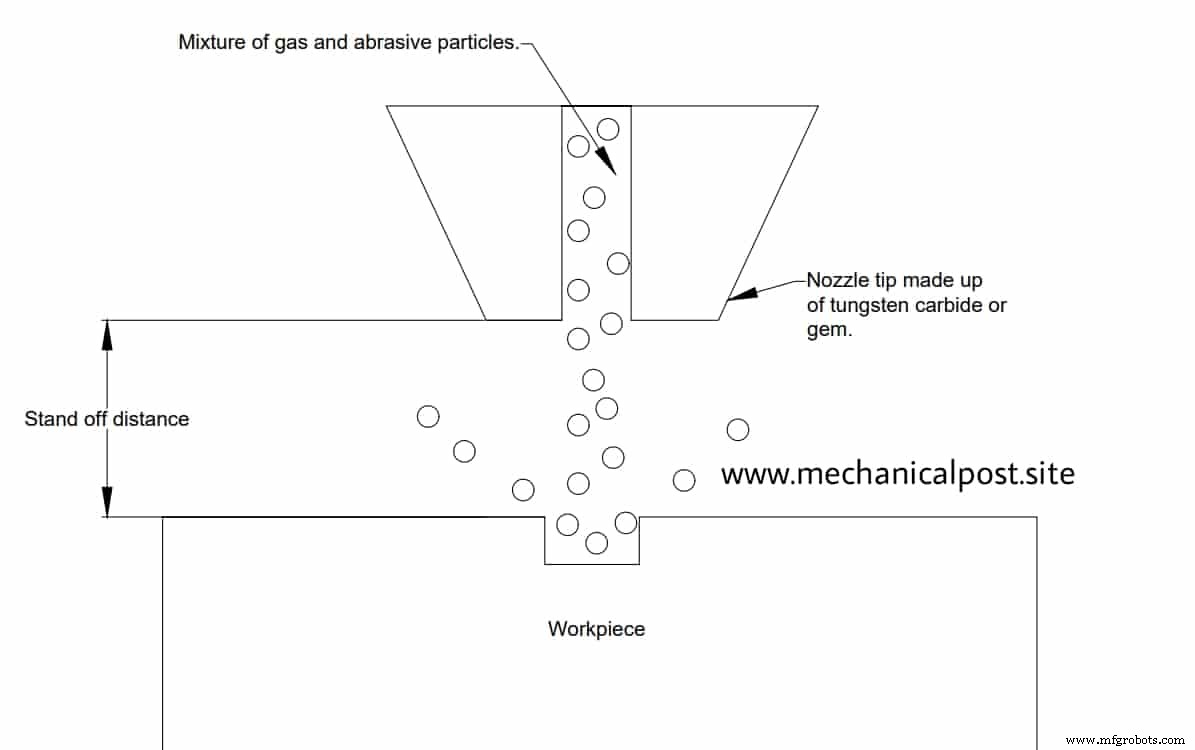
- The nozzle converts the high-pressure energy of the mixture into kinetic energy. As a result, the velocity of the mixture increases drastically inside the nozzle (about 150 to 300 m per second).
- This stream of abrasive particles is known as an abrasive jet.
- The standoff distance is usually around 0.25 mm to 20 mm.
- The abrasive jet erodes the workpiece material thus machining the workpiece.
- The high-velocity jet of gas takes away with it the abrasive particles and the eroded workpiece material.
- By regulating the control valve, the metal removal rate, surface finish and various other parameters can be controlled.
- This is how the Abrasive jet machining process works.
You might also like to read:
- What is CNC machining? and types of CNC machines.
- Rolling process – Definition, working, types, advantages & uses
- Pillow block bearing (pedestal bearing) – construction and uses.
- What is casting? detailed explanation
Applications of Abrasive jet machining process
The following are the applications of Abrasive jet machining process:- The abrasive jet machining process is used for operations like drilling, milling, honing, surface finishing etc.
- It is also used for fine drilling operations.
- The abrasive jet machining process is used for carving complex shapes on hard and fragile materials.
- Machining of semiconductor materials can be done using this process.
Advantages of Abrasive jet machining process
The following are the advantages of Abrasive jet machining process.- There is no direct contact between the tool and the workpiece.
- Good surface finish can be obtained.
- No heat damage to the workpiece.
- Hard materials can be easily machined.
- Complex shapes can be produced on the workpiece.
- Low initial cost.
Limitations of Abrasive jet machining process
The following are the limitations of Abrasive jet machining process.- The metal removal rate is low.
- Abrasive jet machining process cannot be used for machining of soft materials like aluminium.
- Post machining process, cleaning is required as the abrasive particles tend to get embedded in the workpiece.
- Once used abrasive particles, cannot be reused as they get deformed. This increases operating costs.
That’s an overview of Abrasive Jet machining. If you like this post or have any suggestions do let us know in the comments we would love to hear from you.
Also, do Join our Telegram channel to get notified whenever we come up with a new article!
We’ll be back soon with another interesting article till then Keep learning and read The Mechanical post!
Understanding FDM 3D Printers: Construction, Operation, and PDF Guide
Electric Discharge Machining (EDM): Process, Benefits, and Applications
Industrial Technology
- EDM Machining Explained: Construction, Principles, and Modern CNC Integration
- Water Jet & Abrasive Water Jet Machining: Principles, Process, Equipment, Applications, Pros & Cons
- Abrasive Jet Machining Explained: Principles, Equipment, and Pros & Cons
- Abrasive Jet Machining: Components, Mechanics, and Practical Uses
- Water Jet Machining: Principles, Benefits, Drawbacks, and Applications
- Abrasive Jet Machining: How It Works, Benefits, and Applications
- Water Jet Machining: How It Works, Parts, Benefits, and Applications – PDF Guide
- Ultrasonic Machining (USM): Parts, Process, Applications & Benefits – PDF Guide
- Understanding FDM 3D Printers: Construction, Operation, and PDF Guide
- Electric Discharge Machining (EDM): Process, Benefits, and Applications