



Electric Discharge Machining (EDM): Process, Benefits, and Applications
Today at the Mechanical post we’ll see What is electric discharge machining? its construction, working, applications, advantages, and limitations.
You can download the PDF or take a print out by clicking on the button given at the end.
What is electric discharge machining?
Electric discharge machining is also known as EDM which is a type of non-traditional machining process. EDM uses an electric spark to remove a small amount of material from the workpiece, thus, resulting in the machining of the workpiece.The EDM is used for machining very hard materials which would not have been possible using traditional machining processes like lathe, milling machines, etc. It is also known as spark eroding or spark machining.
Principle of electric discharge machining
The electric discharge machining works on the principle of workpiece erosion due to the spark discharge between the tool and the workpiece.2 electrodes namely the anode (+ve terminal) and the cathode (-ve terminal) are used to produce an electric spark when brought close enough. A voltage of about 20,000 to 100,000 volts is applied.
When both electrodes are brought close together i.e. around 0.05mm to 0.005mm an intense spark is produced resulting in a lot of heat generation.
When both the electrodes are made up of the same material then the anode erodes faster, thus the workpiece is connected to the anode.
The tool is made of the shape of the impression required to be produced on the workpiece. The anode and cathode both are immersed in a dielectric fluid for efficient working.
Construction of Electric discharge machining
 |
| Frank50 s, CC BY-SA 4.0, via Wikimedia Commons |
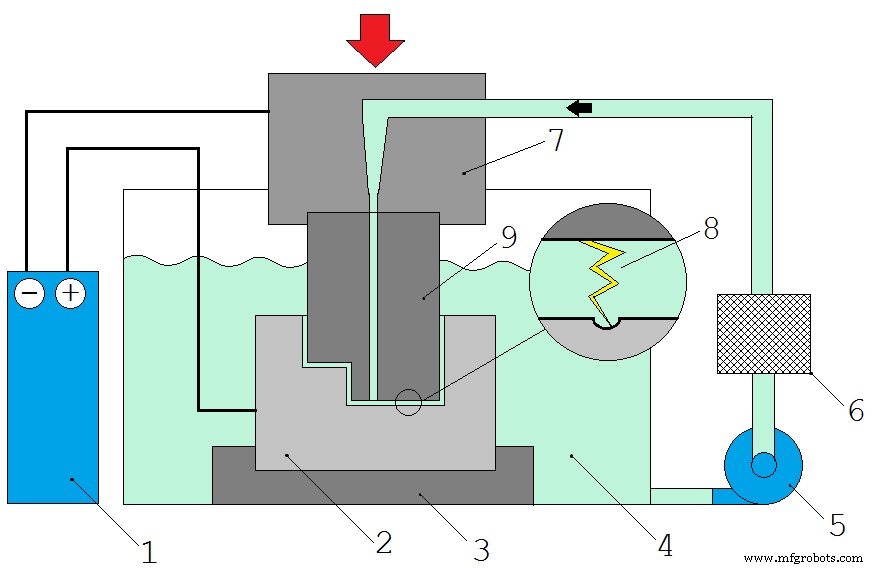
- DC pulse generator
- Workpiece
- Fixture
- Dielectric fluid
- Pump
- Filter
- Tool holder
- Spark
- Tool
DC pulse generator
The function of the DC pulse generator is to convert the AC supply into a high voltage DC supply which is capable of producing the spark.Workpiece
The material on which the machining is to be performed is the workpiece. The workpiece is connected to the positive terminal of the DC pulse generator.Fixture
The fixture is used to hold the workpiece in place. The fixture can be a magnetic table, chuck, or a vice.Dielectric fluid
The dielectric fluid acts as an insulator until the breakdown voltage is attained and acts as a conductor once the breakdown voltage is attained. The dielectric fluid carries away the molten metal and cleans the spark gap. It also acts as a coolant by cooling the tool and the machined surface.Distilled water, paraffin oil, silicone oil, etc are the types of liquids used as dielectric fluid.
Circulating Pump
The circulating pump is used to circulate the dielectric fluid throughout the system.Filter
The filter is used to filter out the small metal particles or other foreign particles which come into the dielectric fluid during circulation.Tool holder
The tool holder is used to hold the tool firmly. It also houses the servo motor mechanism which is used to provide feed and maintain a constant gap between the tool and workpiece.Tool
The tool is made in the shape of the impression to be produced onto the workpiece. The tool is connected to the negative terminal of the DC pulse generator to become a cathode. The tool is a good conductor of electricity along with a high melting point.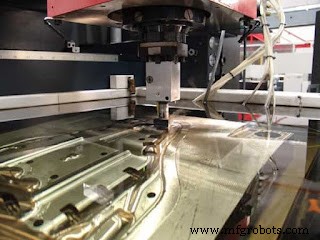 |
| NezzerX at English Wikipedia, Public domain, via Wikimedia Commons |
Working of Electric discharge machining
- The tool and the workpiece are both immersed in the dielectric fluid and separated by a small gap in between known as a spark gap.
- When the power supply is turned ON, thousands of sparks are produced. However, the duration of each spark is very short.
- The sparks cause the nearby dielectric fluid to ionize, due to which the dielectric fluid acts as a conductor.
- The spark causes intense heat generation due to which the workpiece material gets melted.
- This molten material is carried away by the flow of dielectric fluid, thus cooling the workpiece and tool.
- The dielectric fluid is then filtered and then recirculated.
- As the material is removed the servo motor provides suitable feed to constantly maintain the spark gap.
- This is how the material is machined using the electric discharge machining process.
You might also like to read:
- What is extrusion? detailed explanation with PDF
- Rolling process – working, types, advantages, and applications with PDF
- What is GMAW or MIG welding? with PDF
Advantages of electric discharge machining
The advantages of electric discharge machining are as follow:- EDM can be used to machine any type of material.
- Complex shapes that are difficult to produce using conventional machining processes can be produced using EDM.
- Machining with very tight tolerances is possible.
- A good surface finish is obtained.
- As there is no contact between the tool and workpiece, mechanical stresses are not developed.
 |
| Qw5646, CC BY-SA 3.0, via Wikimedia Commons |
Limitations of electric discharge machining
The following are the limitations of electric discharge machining:- High power consumption.
- The material removal rate is less.
- Sharp corners cannot be produced.
- EDM can be only used for electrically conductive materials.
- There is a formation of overcut.
- Tapered holes are produced.
Applications of electric discharge machining
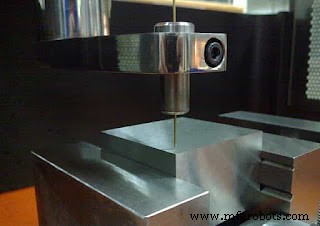
The following are the applications of electric discharge machining:- It can be used to produce very small holes.
- By using a rotary spindle, threads can be produced.
- It is also used for gear manufacturing.
- It is also used in the aerospace industry for machining.
- EDM is also used for manufacturing extrusion dies, stamping tools, etc.
We recommend watching this animated video (not sponsored):
That’s an overview of Electric discharge machining. If you like this post or have any suggestions do let us know in the comments we would love to hear from you.
Also do consider subscribing by clicking the subscribe button and never miss a post by us!
We’ll be back soon with another interesting article till then Keep learning and read The Mechanical post!
Abrasive Jet Machining: How It Works, Benefits, and Applications
Comprehensive Guide to CNC G‑Codes & M‑Codes – Downloadable PDF Included
Industrial Technology
- Electric Discharge Machining (EDM): Mechanics, Principles, and Circuit Design Explained
- Electrical Discharge Machining (EDM): The Ultimate Guide to Precision Metal Fabrication
- Electrical Discharge Machining (EDM): Principles, Process, Equipment, Pros & Cons Explained
- Water Jet Machining: Principles, Benefits, Drawbacks, and Applications
- Ultrasonic Machining (USM): Core Components, Principles, Pros & Cons, and Practical Applications
- Ultrasonic Machining: Principles, Process, and Key Advantages
- Water Jet Machining: How It Works, Parts, Benefits, and Applications – PDF Guide
- Ultrasonic Machining (USM): Parts, Process, Applications & Benefits – PDF Guide
- Abrasive Jet Machining: How It Works, Benefits, and Applications
- CNC Machines Explained: How They Work, Types, Benefits & Applications – PDF Guide