



Industrial Automation 4.0: Unlocking Efficiency and Innovation
Are you excited that the future of American manufacturing is looking brighter due to reshoring? We think it’s great too, but have you noticed something different? Manufacturing has changed. There are new technologies and jargon, such as talk of Industry 4.0, robots, co-robots, and the Internet of Things (IoT).
While the U.S. was sidelined by offshoring, other countries were advancing automation technologies to capture maximum efficiencies. American manufacturers will need to play catch-up in order to continue growing and speeding re-shoring opportunities.
If you want to become globally competitive and move into more efficient automation equipment or systems, you will need at least a basic understanding of industrial automation as it stands today. Understanding options, terminology, and components will make it easier to create initial plans and budgets that can be discussed in greater detail with team members and automation solution specialists.
To get you up to speed, here is a basic overview of industrial factory automation in the age of connectivity.
Table of Contents
What is Industrial Automation?
Types of Industrial Automation
How is Industrial Automation Achieved?
Manufacturing Production and Industrial Automation Systems
Why American Manufacturers Need to Automate
Automation in Industry 4.0
Arriving at an Industrial Automation Solution
What is Industrial Automation?
You are not alone in your search for manufacturing efficiencies. Since before the first industrial revolution, industry leaders have created specialized machinery that can produce faster and more precisely than a human with a hand tool. Historically designed to operate independently with minimal human intervention, today’s industrial automation systems can communicate and work in sync with the assistance of industrial control systems and network connectivity.
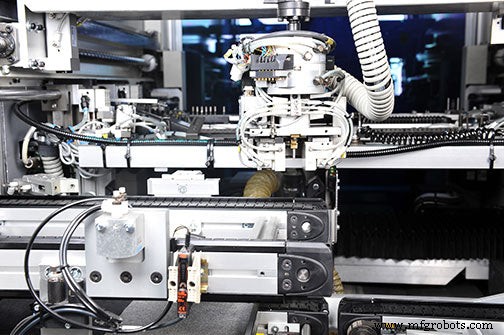
You will find examples of industrial automation equipment where products or components are machined, manufactured, packaged, and/or assembled. With automation principles and standards, you can expect automated machinery to be placed in a system configuration that most efficiently moves components from one stage to the next.
Types of Industrial Automation
Manufacturers are automating jobs that require endurance or precision, or those that are boring, repetitive and/or require little creativity or specialized talent. Decreasing robot costs and increasing labor costs are encouraging automation in the U.S. With robot prices expected to fall by upwards of 65% over the next five years, automation is predicted to rise steadily. If you haven’t already done so, investing in a data communications infrastructure may be one of your biggest challenges. Trending factory automation relies on the ability of machine networks to communicate and enact tasks on schedule.
What are the common types of factory automation?
- Simple tooling
- Assembly
- Inspection
- Materials handling
How is Industrial Automation Achieved?
Industrial control systems are the mechanism (or brain) behind automated machine independence and motion. This is the technology that allows for industrial processes to be automated. The primary make-up of a control system is the control loop. Examples of control systems range from the very simplest, a discrete controller, to the complex SCADA system which manages all levels of a business’s manufacturing processes and geographical locations.
Types of industrial control systems:
- SCADA system - a computer system that controls and monitors plant processes
- Proportional-integral-derivative controller (PID) –controls a system based on set-point and measured value
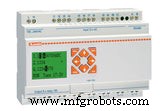
- Programmable logic controllers (PLC) – an easily programmed, rugged industrial computer with a single microprocessor used to control motors and other machinery in a factory setting using logic
- Programmable automation controllers (PAC) – similar to a PLC, but contains multiprocessors and is capable of multitasking
- Distributed control systems (DCS) – controls many nodes in a system through multiprocessors with advanced capabilities including many I/O points
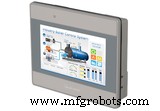
- Human-machine interface (HMI) – allows you to interact with a machine and quickly view the status of machine processes
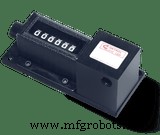
- Discrete controller - simple on and off control, examples are timers, counters and thermostats
|
PLC |
HMI |
Counter |
How industrial automation works:
Stage 1 - The industrial control system (listed above) works in conjunction with the drive controller.
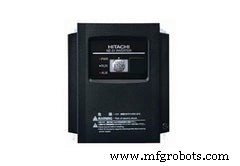
Common drive controllers include:- Variable frequency drive – an AC motor controller that uses frequency and voltage to control speed and torque electric motor
- Stepper drive – a driver circuit that controls the stepper motor with current delivered in pulses and phases
- Analog-servo – this device controls the speed of the servo motor through on and off voltage signals or pulses
- Digital-servo – like the analog-servo, but capable of delivering a much higher rate of pulses per second
|
|
Stage 2 - The drive controller directs the actuator which imparts motion.
Common actuator types include:
- Hydraulic actuator – fluid pressure moves a piston through a tube to build torque
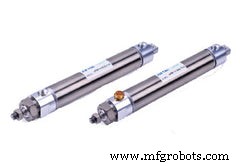
- Pneumatic actuator – Air or gas pressure is used to control speed and torque
- Electric actuator (AC, DC, Linear, Servo, Stepper) – powered by a motor, electrical energy is converted to mechanical torque
- Mechanical actuator – using simple mechanisms, a rotary motion is used to create a linear motion
|
Pneumatic Actuators |
Industrial automation continuous processes:
- Feedback sensors (encoders or resolvers) collect data from the load and send it back to the controller.
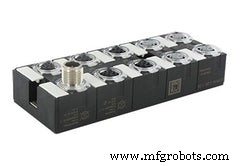
- Fieldbus and ethernet connections support the exchange of information between basic field devices and can transmit up to the enterprise level.
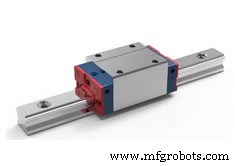
- Working in conjunction with automated controls are mechanical devices including bearings, gearboxes, screws, wheels, axles, cams, and linkages.
|
Fieldbus System |
Linear bearing and rail |
-
In addition to the electromechanical and mechanical devices, fluid powered machine devices are also utilized in industrial machinery. When electromechanical methods fail to provide practical solutions, fluid power is introduced. Fluid power is typically driven by electronics and controlled by sensors and valves.
Fluid Power Technologies
Industrial Technology
- Industrial Automation: How Smart Control Systems Transform Manufacturing
- IoT and Industry 4.0: How the Fourth Industrial Revolution Is Shaping Manufacturing
- From Fixing to Running: Elevating Industrial Maintenance Strategy
- Industrial Automation 4.0: Revolutionizing Production Efficiency
- Why the Automation Industry Matters in Industry 4.0
- Mastering Press Automation: Techniques, Safety, and Efficiency
- Understanding Industrial Automation: Enhancing Efficiency & Quality in Manufacturing
- Automation Types: Boosting Productivity, Quality, and Safety Across Industries
- How Industrial Automation Boosts Productivity and Quality in Modern Manufacturing
- Revolutionizing Manufacturing: The Power of Industrial Automation