



Power Factor Improvement: Methods, Benefits, and Trade‑Offs
Methods for Power Factor Improvement
The following devices and equipment are used for Power Factor Improvement.
- Static Capacitor
- Synchronous Condenser
- Phase Advancer
1. Static Capacitor
We know that most of the industries and power system loads are inductive that take lagging current which decrease the system power factor (See Disadvantages of Low Power factor) . For Power factor improvement purpose, Static capacitors are connected in parallel with those devices which work on low power factor.
These static capacitors provides leading current which neutralize (totally or approximately) the lagging inductive component of load current (i.e. leading component neutralize or eliminate the lagging component of load current) thus power factor of the load circuit is improved.
These capacitors are installed in Vicinity of large inductive load e.g Induction motors and transformers etc, and improve the load circuit power factor to improve the system or devises efficiency.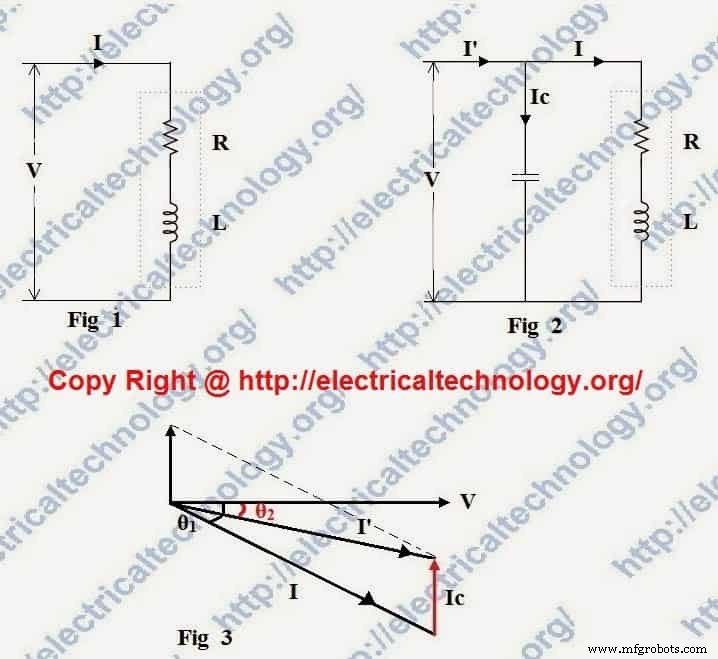
Suppose,here is a single phase inductive load which is taking lagging current (I) and the load power factor is Cosθ as shown in fig-1.
In fig-2, a Capacitor (C) has been connected in parallel with load. Now a current (Ic) is flowing through Capacitor which lead 90° from the supply voltage ( Note that Capacitor provides leading Current i.e., In a pure capacitive circuit, Current leading 90° from the supply Voltage, in other words, Voltage are 90° lagging from Current). The load current is (I). The Vectors combination of (I) and (Ic) is (I’) which is lagging from voltage at θ2 as shown in fig 3.
It can be seen from fig 3 that angle of θ2 < θ1 i.e. angle of θ2 is less than from angle of θ2. Therefore Cosθ2 is less than from Cosθ1 (Cosθ2> Cosθ1). Hence the load power factor is improved by capacitor.
Also note that after the power factor improvement, the circuit current would be less than from the low power factor circuit current. Also, before and after the power factor improvement, the active component of current would be same in that circuit because capacitor eliminates only the re-active component of current. Also, the Active power (in Watts) would be same after and before power factor improvement.
Advantages:- Capacitor bank offers several advantages over other methods of power factor improvement.
- Losses are low in static capacitors
- There is no moving part, therefore need low maintenance
- It can work in normal conditions (i.e. ordinary atmospheric conditions)
- Do not require a foundation for installation
- They are lightweight so it is can be easy to installed
- The age of static capacitor bank is less (8 – 10 years)
- With changing load, we have to ON or OFF the capacitor bank, which causes switching surges on the system
- If the rated voltage increases, then it causes damage it
- Once the capacitors spoiled, then repairing is costly
2. Synchronous Condenser
When a Synchronous motor operates at No-Load and over-exited then it’s called a synchronous Condenser. Whenever a Synchronous motor is over-exited then it provides leading current and works like a capacitor.
When a synchronous condenser is connected across supply voltage (in parallel) then it draws leading current and partially eliminates the re-active component and this way, power factor is improved. Generally, synchronous condenser is used to improve the power factor in large industries.
Advantages:- Long life (almost 25 years)
- High Reliability
- Step-less adjustment of power factor.
- No generation of harmonics of maintenance
- The faults can be removed easily
- It’s not affected by harmonics.
- Require Low maintenance (only periodic bearing greasing is necessary)
- It is expensive (maintenance cost is also high) and therefore mostly used by large power users.
- An auxiliary device has to be used for this operation because synchronous motor has no self starting torque
- It produces noise
3. Phase Advancer
Phase advancer is a simple AC exciter which is connected on the main shaft of the motor and operates with the motor’s rotor circuit for power factor improvement. Phase advancer is used to improve the power factor of induction motor in industries.
As the stator windings of induction motor takes lagging current 90° out of phase with Voltage, therefore the power factor of induction motor is low. If the exciting ampere-turns are excited by external AC source, then there would be no effect of exciting current on stator windings. Therefore the power factor of induction motor will be improved. This process is done by Phase advancer.
Advantages:- Lagging kVAR (Reactive component of Power or reactive power) drawn by the motor is sufficiently reduced because the exciting ampere turns are supplied at slip frequency (fs).
- The phase advancer can be easily used where the use of synchronous motors is Unacceptable
- Using Phase advancer is not economical for motors below 200 H.P. (about 150kW)
Power Factor Improvement in single phase and three phase star & delta connections
Power factor improvement in three phase system by connecting a capacitor bank in (1). Delta connection (2). Star Connection)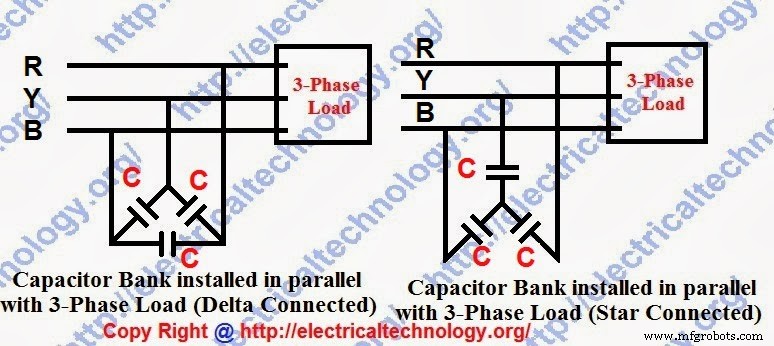
- Power Factor Improvement in single phase and three phase star delta connection
You may also read about;
- Power Factor
- Active, Reactive, Apparent and Complex Power. Simple explanation with formulas.
- Causes of low Power Factor
- Disadvantages of Low Power Factor
- Advantages of Power factor improvement and Correction
- How to Calculate the Suitable Capacitor Size in Farads & kVAR for Power factor Improvement (Easiest way ever)
- How to Convert Capacitor Farads into kVAR and Vice Versa (For Power factor improvement)
Industrial Technology
- Calculating Power Factor in AC Circuits: Theory, Impact, and Practical Correction
- Practical Guide to Power Factor Correction in AC Systems
- Powder Metallurgy: Process, Benefits, and Drawbacks
- Water Jet Machining: Principles, Benefits, Drawbacks, and Applications
- Ultrasonic Machining (USM): Core Components, Principles, Pros & Cons, and Practical Applications
- Low Power Factor Explained: Key Causes & How to Fix Them
- Industry 4.0: Benefits, Risks, and Implementation Challenges
- AI: Benefits, Risks, and Industry Impact
- Injection Molding: Benefits, Drawbacks, and Industry Insights
- Die Casting: Key Benefits and Drawbacks Explained