



Consequences of Connecting a Battery to an AC Power Source
What will Happen if We Connect a Battery with an AC Source?
We know that a battery can’t store AC instead of DC as an energy storage device. So never ever try to connect a battery to the AC supply at home, lab or elsewhere. Now lets see what happens if you connect a 12VDC battery to the 110/230V and 12V AC?
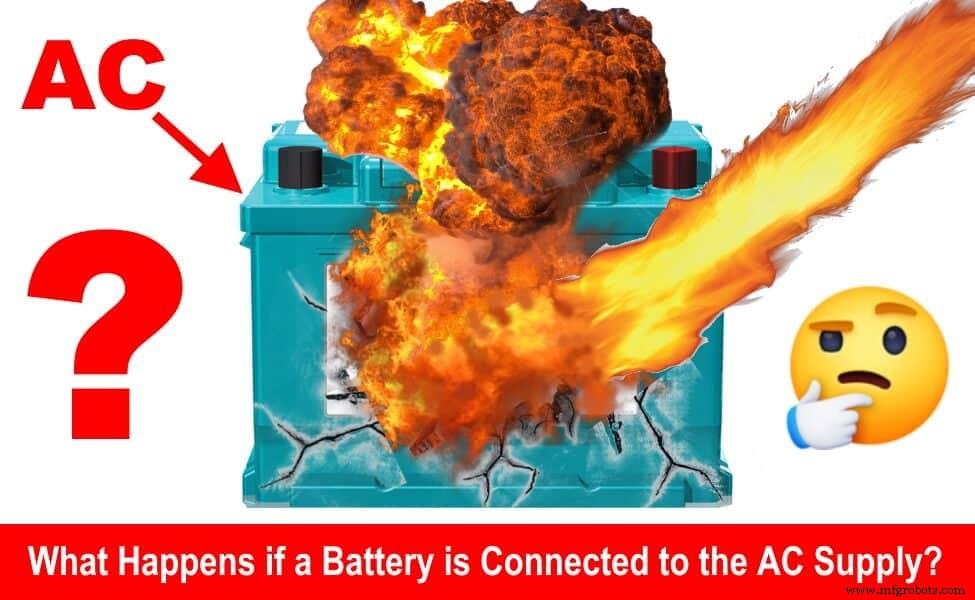
Connecting a 12V DC Battery to 110V or 230V AC
If we connect a battery with an AC source (say 120V or 230V AC from a wall plug), It may heat up and explode with a boom having risk of serious injuries and hazardous fire. The reason is that AC supply has frequency (50Hz in UK and 60Hz in the US) i.e. the direction and magnitude of AC supply changes multiple times in a second according to the rate of frequency.
This way, the battery will charge in the first half cycle and discharge in the second half cycle of AC supply. Now, the battery will charge and discharge simultaneously 50 or 60 times in one second. This continuous process will heat up the battery plates due to frequent charging and discharging actions.
As the battery is unable to change its terminals i.e. positive and negative terminals according to the supply voltage as they are changing continuously. For this reason, we can’t store AC (having different frequency and magnitude) in the battery instead of DC (having one direction with zero frequency). Keep in mind that same like a battery, a transformer also can’t be connected to the DC supply.
- Related Post: What Happens to the Battery with Reverse Polarity Wiring Connection
Connecting a 12V DC Battery to 12V AC
Lowering the level of AC voltage doesn’t mean that it will act like a DC or charge the battery. The same charging and discharging and frequent chemical reactions will occur on both terminals of the battery with no storage charge at all.
Keep in mind that the 12V AC is not equal to the 12V DC. It is in terms of RMS value which means a value of 12V AC will generate the same heat in case of 12V DC. But there is no concept of Peak and Peak to Peak values and frequency in DC supply.
For example:
- 12V DCRMS = 12V ACRMS = 16.97 AC VPeak
But
- 12V ACRMS = 16.97 AC VPeak ….. (VPeak = √2 x VRMS or VPeak = 1.414 x VRMS)
Or
- 12V ACRMS = 33.94 AC VPeak-to-Peak ….. (VPeak = 2 x VPeak or VPeak = 2.828 x VRMS)
Same is the story for electric current as above mentioned for voltage.
It mean, the DCRMS = 12V ACRMS is 16.97 AC VPeak or 33.94 AC VPeak-to-Peak. In other words, the value of AC voltage may higher than the DC having the same RMS values. For this reason, a DC equipment should not be connected to the AC supply and vice versa. In simple words, A battery is DC operated device and should not be connected with AC source of supply.
Good to know: The battery electrodes are known as Anode and Cathode. In terms of batteries, Anode is always Negative “-” (having more electrons) while Cathode is Positive “+” (having less number of electrons).
- Related Post: How to Calculate the Battery Charging Time & Battery Charging Current – Example
Cautions:
- Hazardous chemical reaction takes place in the battery to convert the chemical energy in the form of electrical energy, therefore, always wear safety glass and rubber gloves and other safety measures while working around the batteries and related hazardous equipment.
- Never ever connect the AC source to the DC equipment and vice versa (expect the universal motors which operate on both AC and DC supply but please read the user manual guide provided by the product manufacturer before doing so.
- The author will not be liable for any losses, injuries, or damages from the display or use of this information or if you try any circuit in wrong format. So please! Be careful because it’s all about electricity and electricity is too dangerous.
Video:
The following video shows battery blast & expulsion while connected to the direct wall plug (AC Voltage).
Note: Graphic Content. Viewer Discretion is Advised
Conclusion:
- Q: Can a battery be connected to the AC supply?
- Ans: No and only No! Please don’t do that at any cost.
Related Posts:
- Why Battery rated in Ah (Ampere hour) and not in VA.
- AC or DC – Which One is More Dangerous And Why ?
- Series, Parallel and Series-Parallel Connection of Batteries
- Difference Between a Battery and a Capacitor
- What Happens When an AC Line Touches a DC Line?
- Why Do Electronic Circuits Use DC Current instead of AC?
- Can We Use AC Circuit Breaker for DC Circuit & Vice Versa?
Industrial Technology
- Understanding the PN Junction: From Structure to Diode Behavior
- Connected Manufacturing: What It Is & Its Key Benefits
- Navigating Supply Chain Challenges During Chinese New Year
- 2020 Supply Chain: Future Trends Revealed by Industry Leaders
- Localizing Battery Supply Chains: Enhancing Security, Sustainability, and Cost Efficiency
- Charting the Path to Fully Integrated Digital Supply Chains
- Impact of Reverse Polarity Wiring on Battery Health
- Understanding Supply Chain Management: Key Concepts & Benefits
- The Modern Manufacturing Process: Key Techniques and Innovations
- Understanding Battery Trays: Purpose, Features, and Benefits