



Revolutionizing Industrial IoT Through Digital Twin Integration
The Industrial Internet of Things (IIoT) uses intelligent sensors and actuators that monitor, collect, analyze and share data. IIoT along with Industry 4.0 has increased the use of smart machinery that uses sensors to automate processes and increase efficiency by reducing human interference. The huge amount of data generated by these sensors is used to gain important insights into the industrial processes. Different AI/ML-based models are trained on this data and the output of these models is in the form of upgrades and changes that could be made to the system to improve efficiency. The implementation of these upgrades and changes into the actual system involves the risk of failure or damage to mission-critical systems and processes. Failure of the mission-critical systems can lead to a lot of damage to both the industry and the general public. Also, essential services like transmission systems cannot be directly upgraded or changed without making sure the change won’t cause the system to collapse. This is where Digital Twin steps in to help the industries implement these changes in a safer and more efficient way.
A Digital Twin can be understood as a proxy for the physical system in a digital world. It is a digital replica of the assets that a particular industry has. The link that joins the physical attribute to the digital one is called the digital thread. The data collected from different sensors and actuators in the industrial setup is used to build a digital replica, which gives the user access to the physical asset’s structure, context, and behavior. The past and present conditions of the system can be observed and on the basis of it, the future behavior can be predicted if the upgrades or changes are made to it. This not only saves time and money but also prevents any damage to the actual systems. Digital twins enable continuous process improvements, design improvements, efficient operations, predictive maintenance, and conditional states of the machines.
How Digital Twin is transforming Industries
Industry 4.0 is all about automation and digitization through the faster collection, processing, and management of data. Edge sensors are replacing the conventional sensor technology in order to facilitate the faster processing and quicker sharing of data. Technologies like 5G are slowly picking pace to improve data transfer speed and connectivity between different nodes. Integrating such technologies still have different challenges like high investment cost, compatibility of sensors, data security, and scalability. These challenges make it difficult for business owners to invest huge sums of money in digitization.
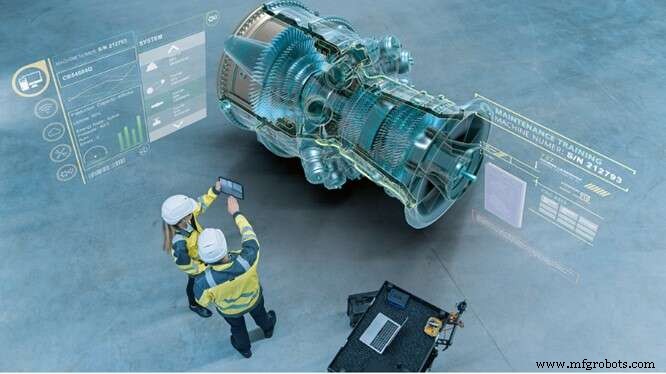
A majority of the above shortcomings are solved by Digital Twin technology. An existing physical setup is converted into a digital form that is connected to the real-world machine through the digital thread. With the help of AI/ML models, the complete working of the machine could be mapped into a digital form by taking in data from the sensors, past statistics, and open-sourced data. This proxy machine is used to predict the way the actual machine would respond when changes are made to it. Hence to integrate newer technologies like edge sensors and 5G compatibility, experiments are conducted in the virtual world and only the best solution is implemented in the real world. The complete process saves time, and cost and also creates a digital copy of the machine which can further be used for digitization.
Digital twins are being used in a variety of industries, including manufacturing, energy, transportation, and construction. Different manufacturers and service providers involve digital-twin to build a proxy of aircraft engines, locomotives, offshore platforms, and wind turbines. Companies in these sectors are investing in digital twins to optimize the operation and maintenance of these products.
Digital Twins provide industries with exceptional value in three key areas. The first is to drive improvements into the manufacturing process. Right from prototyping and designing to physically manufacturing the product, companies can continuously monitor the actual and expected output and make changes in order to make a near-perfect product. Manufacturing operations can be optimized by predicting line failures and taking the necessary steps to achieve the required target.
The second area is preventive maintenance where the digital twin can be used to analyze the past data and take in real-time inputs from the actual system to predict failures and suggest preventive maintenance to prevent failures. Technicians can remotely analyze and make preventive adjustments and when physical adjustments are required, technicians can remotely analyze and order parts beforehand to save time.
The third area is developing new products and entering new markets based on the usage of existing products and services by customers. Digital twins help to provide insights into how products are being used by customers and what changes could or should be made in new product design and manufacturing to improve market penetration, capture newer markets and improve customer satisfaction. This can significantly reduce the amount spent by companies on market research and customer feedback.
What lies ahead for digital twin and IoT
Digitally twinning an airplane engine or a complex machine from a manufacturing unit is not the end but just the start of the revolution that the technology is about to bring. Advances in Edge computing and powerful edge devices are being deployed in industries that are connected by advanced network systems like private 5G can make interconnections of digital twins possible. The result would be a complete chain of connected pieces of equipment making a digital factory.
For example, Singapore has created a complete digital twin of the city to track traffic, pollution, climate, and city layouts so city managers can test accessibility options, see the potential impact of new construction, manage emergency responses, and monitor city health. Meanwhile, doctors are creating patient-specific Digital Twins of lungs to help make decisions about ventilator use when treating COVID-19 patients.
While still an emerging technology, there’s no doubt that Digital twins are the future. They have endless applications across departments operations, maintenance, finance, sales, and marketing to access a unified source of real-world data to predict maintenance, improve design, understand usage, and adjust pricing.
Industrial Technology
- How Industrial IoT Sensors Drive Modern Factory Efficiency
- Accelerating Digital Transformation: Cisco & IBM’s Edge‑to‑Cloud IoT Platform
- Industrial IoT: Driving Efficiency and Resilience in Supply Chains
- Harnessing Industrial IoT for Growth: Beyond Cost Savings
- Industry 4.0: Leveraging IoT to Transform Manufacturing
- Industrial IoT and the Digital Twin Revolution: Transforming Manufacturing
- Industrial IoT: A Strategic Imperative for Modern Manufacturing
- How Nexus Integra Drives Digital Transformation in Industry: Insights from IoT Now Interview
- Seamless OT‑IT Integration: Modern Industrial Software Connects Smart Sensors to Enterprise Systems
- Harnessing Digital Twin Technology to Boost Manufacturing Efficiency and Cost Savings