



Choosing the Ideal Adhesive for Barcode Labels: A Practical Guide
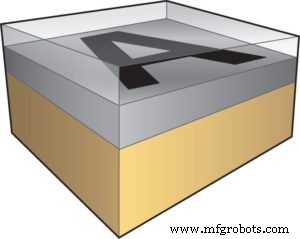
Cross-section of a Metalphoto Barcode Label with Adhesive
When deciding on adhesive-backed barcode labels, you want the adhesive to be reliable. Its job is to consistently attach the label to an asset for that asset’s entire lifespan. So choosing the right adhesives for your barcode labels is key and requires some consideration. In what environment will the label reside (indoors or outdoors)? On what type of surface will the label be placed (smooth metals or rough plastics)? Answering these questions can help you decide the proper adhesive for your barcode label application.
It is important to understand the concept of surface energy when considering the surface where the label will be placed. 3M offers the information below, which states that adhesives work because there is a molecular force of attraction between unlike materials. The strength of attraction is dependent upon the surface energy of the material. The higher the surface energy, the better the molecular attraction. The lower the surface energy, the weaker the molecular attraction.
With greater molecular attraction, the contact between an adhesive and surface is increased. In other words, a high surface energy material allows the adhesive to better flow, ensuring a stronger bond.
For example, think about a car that has not been waxed for a long time. When water hits the surface, it forms puddles. An unwaxed car surface displays high surface energy — the molecular attraction allows the water to flow. In comparison, water beads up into small drops on a freshly waxed car. This is an example of low surface energy — the liquid (or adhesive) does not flow.
Metals and plastics such as PVC, polyester, epoxy, polycarbonate, fiberglass and acrylic have a high surface energy. Materials with low surface energy include plastics such as polystyrene, polyethylene, polypropylene and Teflon®.
Determining the surface energy of your application can help you select the appropriate adhesive for your labels. When you work with Camcode, we can help you with each and every step of your adhesive selection process. From application environment to surface energy, we can guide you to the appropriate adhesive so that your label remains attached to the asset for the life of the asset.
To ensure your label remains properly adhered on any surface, keep the following tips in mind:
- The surface must be dry and free of contaminates, dirt, particles, etc.
- Firm pressure must be applied to increase the flow and contact of the adhesive with the surface.
- Adhesives will meet maximum holding power after 72 hours. Do not use the label before that time.
- Labels should be stored at 72°F (22°C) and 50% relative humidity. Storing labels at higher or lower temperatures may not provide the level of adhering performance you desire.
For more information, check out our Instructions for Adhesive Barcode Label Application and Storage.
If you need additional help determining which adhesive is right for your application, contact Camcode. Our experts can review your application requirements and help you find the exact label and adhesive combination for your project.
Durable Asset Tag Solutions from Camcode:
- UID Labels
- Warehouse Floor Labels
- Industrial Labels
- Silver Foil Label
- Asset Label
- Property Tags
- UID Registry Service
- Warehouse Sign
- Warehouse Aisle Signs
- Warehouse Barcode Labels
- Hanging Signs
Industrial Technology
- Choosing the Ideal Material for Your Handwheel: A Practical Guide
- Selecting the Ideal Metal for Your Custom Enclosure or Part: A Practical Guide
- Selecting the Ideal Material for CNC Machining: A Practical Guide
- Selecting the Ideal Pneumatic Actuator: A Practical Guide for Reliable Automation
- Selecting the Ideal Crane for Your Construction Project: A Practical Guide
- Choosing the Right Inventory System for Your Warehouse: A Practical Guide
- Choosing the Ideal Warehouse Labels: Boost Productivity & Safety
- Selecting the Right Barcodes for Your Facilities Management Software
- Selecting the Ideal LED Driver for Your Lighting Projects
- Choosing the Right Air Filter: A Practical Guide for Optimal Compressor Performance