



CNC Turning vs CNC Milling: How to Choose the Right Process
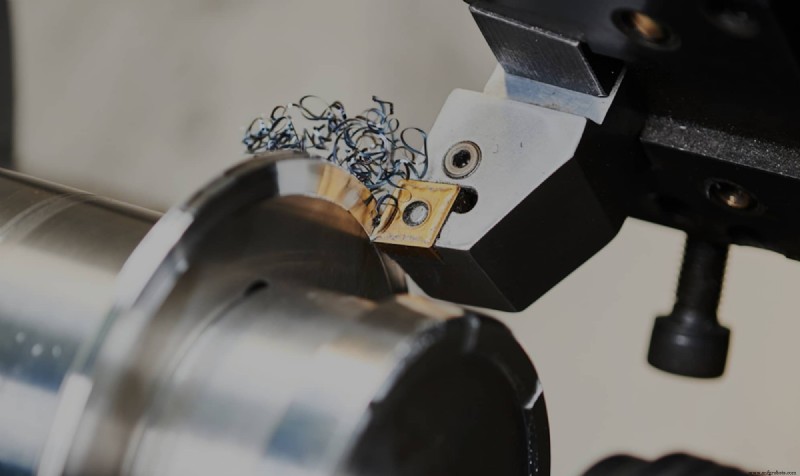
Computer Numerical Control (CNC) machining is a traditional manufacturing method that creates parts by removing material from a solid block, known as the workpiece or blank.
However, the term “CNC machining” can actually refer to a number of processes, each of which uses different tools and machines to shape the desired part. CNC milling, for example, uses rotary cutters and perpendicular motion to remove material from the face of the workpiece, while CNC drilling allows engineers to create holes and shapes into the blank with precise diameters and lengths.
Many CNC manufacturing processes involve applying spinning cutting tools to a fixed workpiece, but CNC turning is a machining method that works the other way around. By rotating the blank rather than the tool, this process enables the efficient production of a wide variety of cylindrical or oblong parts. Here’s what engineers and product teams need to keep in mind.
How CNC turning works
Generally, CNC turning produces parts by moving a cutting tool along the external surface of a rapidly spinning workpiece. This process creates a helical toolpath and results in highly axisymmetric parts. When applied to a blank’s internal surfaces, this same cutting action is known as “boring” — together, turning and boring comprise the larger subset of CNC processes known as CNC lathing.
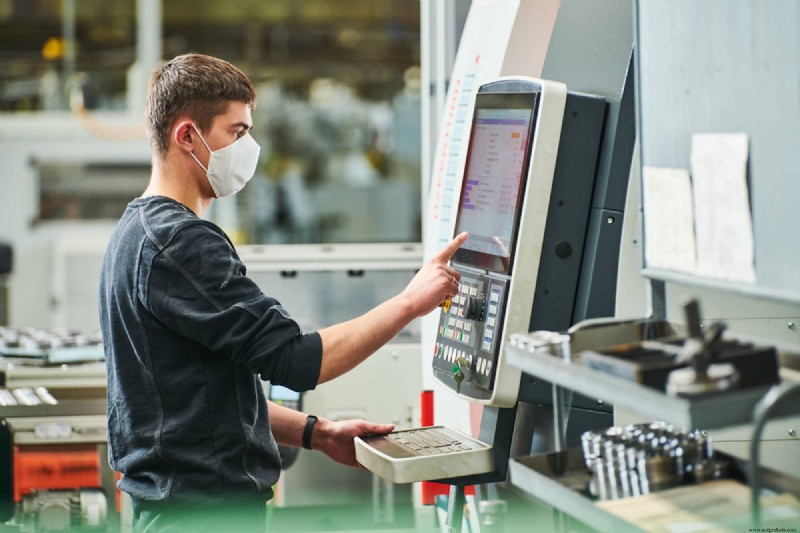
While some of the smaller details vary by model and manufacturer, most CNC turning machines contain a similar set of parts. The ones most relevant to production include:
- The chuck or collet: The chuck grips the workpiece and holds it firmly in place. Chucks can feature either a hard or soft jaw. Collets are typically used for smaller blanks.
- The spindle: The spindle is the CNC turning machine’s rotating axis, which receives instruction from the CAM file regarding appropriate RPM.
- The cutting tools: A tool turret carries the various cutting tools required for production and allows the machine to change tools as needed.
During production, the workpiece is inserted into the chuck, the spindle begins to rotate, and the cutting tools are applied to the piece’s surface to shape the part geometry.
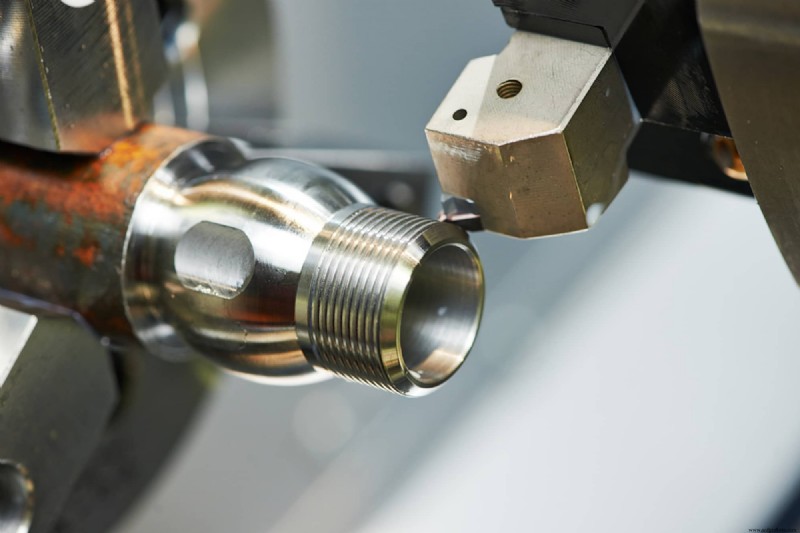
Workpieces used in CNC turning are typically long and cylindrical, but may be square or hexagonal depending on part design. Hex brass ball valves, for instance, begin as hexagonal bars and are lathed on either side of the nut to create threads.
Key considerations for producing parts with CNC lathes
Whereas conventional lathe machines typically only allow for tooling along two axes (turning centers, however, will likely have some Y-axis capabilities), CNC turning machines allow for cutting operations to occur along three, four, or five axes. A few of these additional operations include:
- Straight or cylindrical turning: This process can be used to create uniform cuts into the workpiece diameter and remove large amounts of material.
- Taper turning: Taper turning produces a cylindrical shape with smooth decreases in diameter (similar to an hourglass shape).
- Grooving: This process employs a shaped tool to produce narrow cavities in the workpiece.
- Knurling: This technique involves cutting a serrated pattern of straight, angled, or crossed lines into the workpiece, giving the part additional grip.
- Threading: This produces the threads seen on nuts and screws that allow objects to fasten together and can be applied to relatively large or small geometries.
- Parting: Parting is used to cut the completed part from the original workpiece.
CNC turning is generally well suited for prototyping and low-volume production. However, when determining whether CNC lathe turning is the most cost-effective method of producing a part, one factor that needs to be taken into consideration is the outer diameter (OD) of the piece. This is because CNC turning machines have a maximum OD for bar-feed capable part production, and any part with an OD over the set limit will need to be chucked individually, which can drive up both production time and costs.
Another element to keep in mind is the CNC tools themselves. Many of these are cylindrically shaped with a limited cutting edge, which inherently determines how cuts can be made to the workpiece. This also means that design elements like internal corners will have a radius, regardless of how fine or small the size of the cutting tool. CNC turning is well suited for creating undercuts (also known as neck or relief grooves). These are common on cylindrical turned parts and would be very cumbersome to manufacture on a CNC milling machine. If specialized cutting tools are called for, it’s important to remember that these present their own set of challenges. For instance, tools with longer shafts — which are useful for reaching deeper parts of workpiece cavities — increase the risk of vibration, less-accurate cuts, and poor surface finish.
When to consider CNC milling instead of CNC turning
While CNC turning offers unparalleled efficiency for producing parts with revolved profiles — such as bolts, ball bearings, and washers — it is not optimal for creating non-axisymmetrical pieces.
CNC milling — commonly used for automotive, aerospace, and furniture manufacturing applications, as well as in the production of robots and industrial-grade machinery — can also be used in tandem with CNC turning to add design features, such as flat faces, that are impossible to achieve otherwise.
Fast Radius can get you started with CNC turning
In order to take full advantage of the benefits of CNC turning, product teams and engineers must familiarize themselves with a number of critical design and manufacturing considerations, including the part’s OD and the production run volume.
Partnering with an on-demand digital manufacturer like Fast Radius can be the ticket to faster, more effective design and production. Our team of experts not only help to optimize part design for CNC turning, milling, or whatever combination of manufacturing processes is most efficient and cost-effective for a particular project — we also help to streamline supply chains and reduce operational risk for our customers. Contact us today to discover how we’re redefining what’s possible with modern manufacturing.
To learn more about advanced CNC machining — including five common CNC myths to be aware of and how to reduce machining expenses — as well as our other manufacturing capabilities, visit the Fast Radius learning center.
Ready to make your parts with Fast Radius?
Start your quoteIndustrial Technology
- CNC Milling Explained: Process, Benefits, and Industrial Applications
- CNC Prototype Machining: A Complete Guide to Rapid, Precise Prototyping
- CNC Milling vs. CNC Turning Explained: Which Method Suits Your Project?
- Master CNC Machining Tolerances: Precision, Cost, and Design Guidelines
- Launching a CNC Shop: A Complete Guide to Building a Successful Business
- CNC Machining Explained: The Ultimate Guide for Modern Manufacturing
- Comprehensive CNC Milling Guide: Techniques, Materials, and Best Practices
- Comprehensive Guide to Milling Machines: Functions, Operations, and Applications
- Comprehensive Guide to CNC Machines: Features, Benefits, and Applications
- Mastering Form Milling: Your Complete Guide to Precision CNC Metalworking