



Mastering Form Milling: Your Complete Guide to Precision CNC Metalworking
For expert manufacturers, understanding every metalworking process and implementing them into the shop’s workflow can be an exercise in frustration. After all, there are numerous genres of metalworking and within those categories, there are exceptionally specific tasks: each designed to produce the needed result in the most efficient (while accurate!) way possible. We’re specialists in CNC milling operations, but even milling is no exception to this rule: indeed, there are many specific types of milling operations. Machining complex pieces with specialized curves is a relentlessly tricky undertaking—that’s where form milling comes in.
What is Form Milling?
Form milling is a type of CNC operation which is ideal for shaping irregular contours including curves and sometimes straight lines. All this is done in a single cut using form milling cutters. These cutters are shaped with special irregular contours, so they can be concave, convex, or any other shape they need to be to get the job done. Because of how specialized the form milling process is, though, it may be worth knowing that the machining speed of form milling can be 20 to 30% slower than in regular milling.
Let’s talk more about these cutters because they are rather unique. Form milling cutters simply don’t have a singular look. And when you think about it, this makes a lot of sense: since form milling is made to produce very specific parts, they need to be designed with the end result in mind. The teeth of the cutter need to be shaped in the opposite way of the final product—so if the workpiece needs to be shaped with a convex edge, the cutter’s teeth need to be in a concave alignment.
Again, depending on need, the cutters can be made from alloy steel, solid or brazed carbide, or HSS.
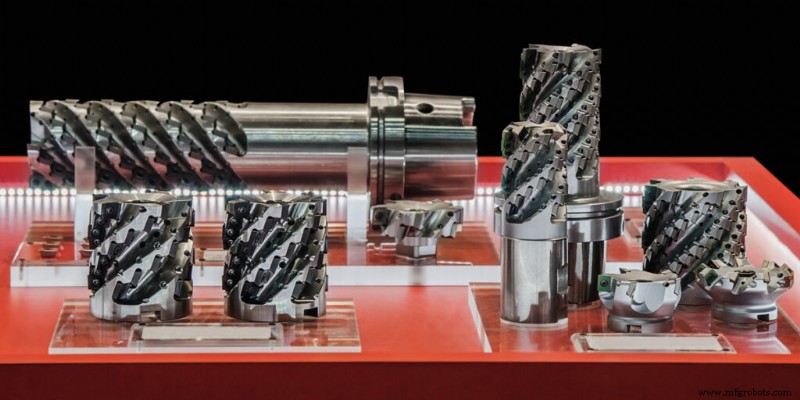
Form milling cutters are created with special irregular contours, to produce very specific parts.
What is Form Milling Used For?
Common operations for form milling operations include milling half-round recesses, beads, and quarter-round radii. Intricate patterns and/or complex surfaces such as helical gears can also be achieved.
Typical machining processes utilizing our form milling cutters include:
- external rotary milling of threads on fittings made of difficult-to-turn materials
- internal thread form milling on neck ring molds for the glass container industry
- internal rotary recess form milling, groove milling, full radius milling, chamfering, bore milling, thread milling, and face milling
- internal ball nut track milling using a Gothic Arch form cutter
Advantages of Form Milling?
One of the biggest advantages of form milling and where you’re likely to use it most is when there’s a situation in which you need to mill or manufacture many times. If you’ve got different radii, form milling allows for the combination of tools so you can be more efficient in your process. So, if you’re working on an irregularly shaped part which requires a radius, a form tool will help you achieve the needed spec.
Though the price of form milling can be off-putting, it’s crucial to remember that it is an important contributor in time-saving, maintaining accuracy, and actually reduce overall costs because the parts only need to be milled once rather than being worked and reworked several times.

Industrial Technology
- Mastering Laser Cutting: Precision, Power, and Practical Guidance
- Shore Hardness Demystified: A Complete Guide for Engineers & Designers
- Process Cooling Explained: Benefits, Methods, and Industrial Applications
- AM Loop Antenna Guide: Boost Signal Quality and Reduce Noise
- RK3399 Review: Key Features, Performance, and Why It Beats Raspberry Pi
- Mastering MFD Capacitors: Key Insights & Applications
- Mastering STL Files: A Complete Guide for 3D Printing
- Hot Stamping 101: The Complete Guide to Elegant Metal Foil Design
- Comprehensive Guide to Milling Machines: Functions, Operations, and Applications
- The Complete Guide to Plywood: Properties, Uses, and Selection Tips