



Wrench Time: A Practical Guide to Measuring and Improving Maintenance Efficiency

Wrench time—often called tool time—has sparked debate among maintenance leaders. Some argue it’s too difficult to capture accurately and overlooks valuable non‑wrench activities, while others see it as a powerful lever for uncovering operational inefficiencies.
In practice, the truth lies somewhere in between. When measured correctly and interpreted in context, wrench time can illuminate real opportunities for improvement. This article explains what wrench time is, how to measure it reliably, common reasons for low values, and when a study is worth conducting.
- Define wrench time and its scope
- Outline four measurement methods from basic to advanced
- Identify typical causes of low wrench time and offer solutions
- Discuss when a wrench‑time study is appropriate
What Is Wrench Time?
Wrench time tracks the minutes a technician actually holds a tool and performs hands‑on maintenance. It excludes activities such as retrieving tools or parts, reading work orders, traveling to the asset, breaks, idle time, and instructions. These actions are essential to maintenance but are not part of the direct work time.
Because wrench time ignores many value‑adding tasks, it is not a comprehensive productivity metric on its own. High wrench time does not guarantee quality or timeliness of work.
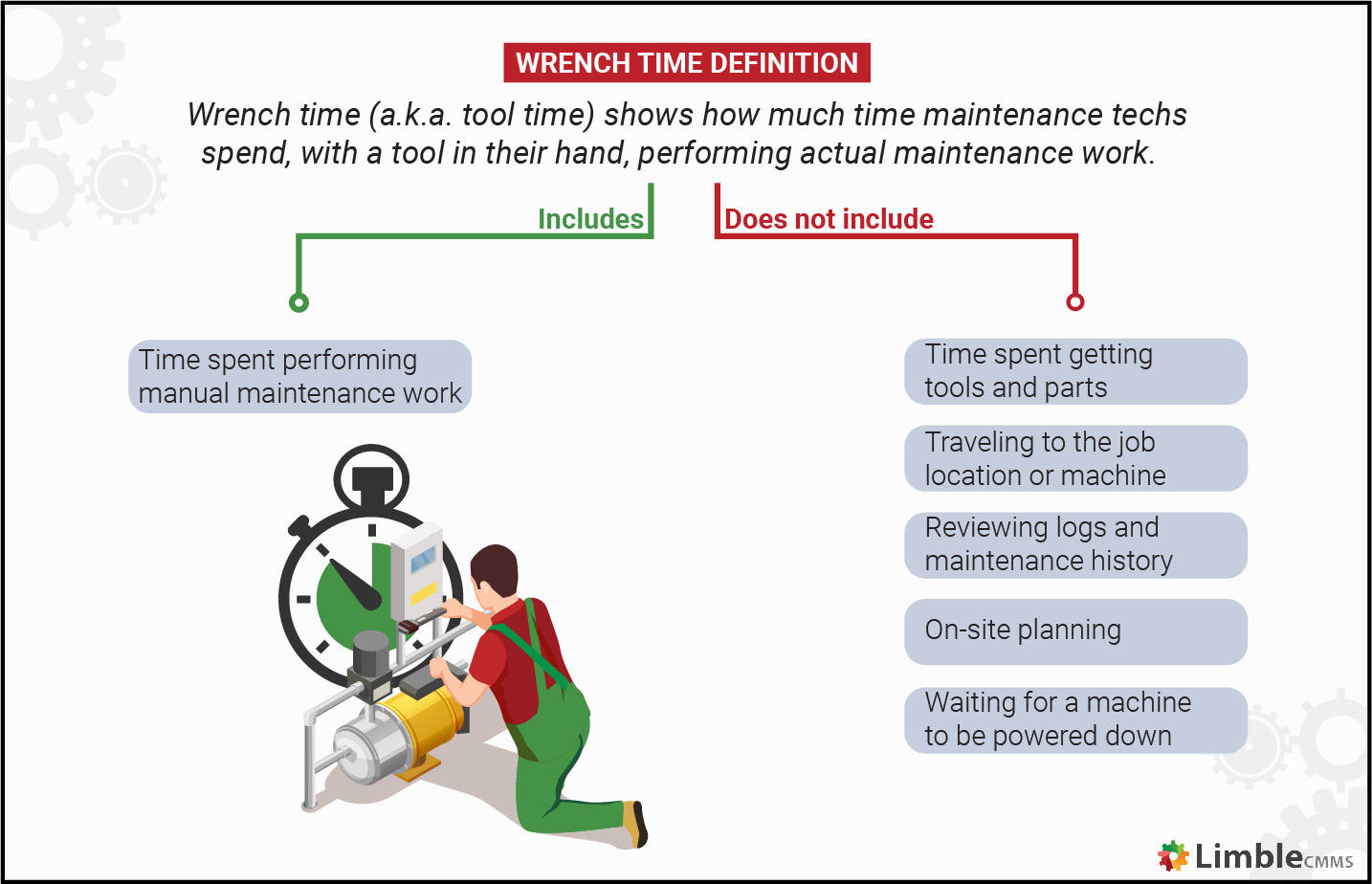
Moreover, even a high wrench‑time figure can mask inefficiencies such as extended travel, frequent task switching, or repeated part shortages. Therefore, wrench time should be paired with other KPIs that capture quality, schedule adherence, and overall workflow effectiveness.
Four Ways to Measure Wrench Time (From Least to Most Reliable)
1. Self‑Reporting
Technicians log their own wrench time. While this requires no extra investment, it suffers from two key issues:
- Inconsistent understanding of what counts as wrench time.
- Potential bias—techs may over‑report to protect their hours or pay.
2. DILO (Day In Life Of)
Observers shadow selected technicians for a full shift. Challenges include:
- Single days may not represent typical operations.
- Hawthorne Effect—observed staff may work harder than usual.
3. Work Sampling
Observers periodically check the floor and record whether technicians are engaged in maintenance. Limitations are:
- Technicians outside the observer’s line of sight (traveling, in storage, on break) are missed.
4. Statistical Observation
This method offers the most robust data. By systematically observing each technician across a broad time frame, you achieve a statistically sound sample. For example, as noted by Doc Palmer in Plant Services Blog:
“Most plants can, over the course of about a month, conduct a reasonable study that might be representative of the ongoing plant using a single day each week for observations. For example, the observer could use Monday the first week, Tuesday the second week, etc., through Friday the fifth week. Going down through names on a set roster and making two observations each half‑hour over the course of eight‑hour days would provide 160 observations and margin of error of plus or minus 7%. Thus, a plant at 35% wrench time would know if it is between 28% and 42% and probably not at 55% (or 80%). A plant that improved to 50% wrench time would know if it is between 43% and 57% and probably not a typical plant at 35%.”
Implementing a mobile CMMS streamlines scheduling, tool/part visibility, and real‑time updates—critical for accurate data collection.
Common Causes of Low Wrench Time & How to Fix Them
1. Poor Planning & Scheduling
- Tools and parts unavailable.
- Weak communication leads to wasted travel and re‑runs.
- Assets not ready (cleaning, lock‑out, safety checks).
Solution: Use a mobile CMMS to pre‑populate work orders with required tools, parts, and asset locations. Leverage drag‑and‑drop scheduling, real‑time alerts, and push notifications for priority changes.
2. Excessive Reactive Maintenance
While reactive work may reduce routine tasks, it introduces frequent interruptions, part shortages, and disorganization. Transition to preventive or condition‑based maintenance, supported by a CMMS that schedules tasks proactively.
3. Waiting on Spare Parts & Tools
Limited inventory or poor stocking can force technicians to idle. Adopt best practices for inventory control and align work schedules with tool availability.
When to Run a Wrench‑Time Study
Weigh the benefits of identifying workflow gaps against the effort required for accurate measurement. A study is worthwhile when:
- Your maintenance team spends a disproportionate amount of time in non‑wrench activities.
- You suspect that improving tool/part access could unlock significant productivity gains.
- You have a robust CMMS that can capture detailed time data.
Take Action—Measure Correctly or Not at All
Accurate measurements are essential for meaningful insight. Low wrench‑time figures point to workflow inefficiencies; high figures indicate room for even greater productivity. A mobile CMMS can deliver real‑time visibility, checklists, and historical data to support continuous improvement.
Want to dive deeper? Leave a comment or email us for tailored guidance.
Equipment Maintenance and Repair
- Pigment Dispersions: A Comprehensive Guide to Safety, Performance, and Choosing the Best Indian Manufacturers
- Building Maintenance Mastery: Expert Insights on Safety, Cost‑Effectiveness, and Compliance
- Expert Guide to Plastic Stamping: Process, Materials, and Benefits
- Round Steel Bars: Key Properties, Applications, and Selection Guide
- Master IoT-Enabled Maintenance: Expert Strategies for Asset Health Monitoring
- Mastering Laser Cutting: Precision, Power, and Practical Guidance
- The Ultimate Guide to Anodizing Aluminum: Enhancing Strength, Durability, and Design
- Understanding Hydraulic Cylinder Drift: Causes, Prevention, and Solutions
- The Complete Guide to Maintenance Work Orders: Boost Asset Reliability & Reduce Downtime
- Master Predictive Monitoring: The Complete Guide to Proactive Maintenance