



Maximizing Value: Calculating ROI for Process Analyzer Technology
Calculating the ROI of a Process Analyzer
Karim Mahraz, Swagelok Product Manager, Analytical Instrumentation
It’s no secret that process analyzers are more expensive than other measuring devices within your sampling system. Some organizations and procurement managers require justification for such expensive equipment in the form of a return-on-investment (ROI) analysis. Fortunately, much of the current process analyzer technology delivers a truly amazing ROI. However, some can result in a negative ROI due to poor system designs.
To calculate the ROI of your process analyzer technology, you will need to gather the upfront cost of purchasing an analyzer and the ongoing cost of ownership to understand your anticipated expenses. Then, note the expected benefits and resulting savings the analyzer enables—including improved production outputs and reduced downtime. Based on this analysis, your plant should ideally be able to report something like: “This analyzer saves us $1,000 per day!”
Every analyzer measurement aims to ensure that the desired amount of on-spec product is being produced safely and at the lowest cost. Multiple analyzers, operating either manually or automatically, will help your plant achieve this goal across three key categories: safety and environment, process control and quality assurance. Each one of these categories has its own unique implication on your ROI analysis.
Safety and Environment
The safety of people in and around the plant is the highest priority for fluid processing plants. Process analyzer technology measures conditions that might endanger equipment and the people nearby. Fast analytical data may be one of the only ways to avoid a potential violent chemical reaction that could rupture a pipe or vessel and endanger personnel. This aspect alone may justify the expense of a quality process analyzer – or even several analyzers.
Additionally, you must adhere to federal and local environmental compliance requirements. For example, continuous emissions monitoring systems (CEMS) and effluent water analyses are legally required in most locations. To comply with these regulations, your plant must install safety and environmental monitors regardless of their cost and ROI.
Process Control
Process analyzers help plants remain profitable by enabling the fine-tuning of process streams to ensure high-quality products. Current market conditions often dictate a plant’s process control philosophy. When demand is soft, and the plant is running at below maximum capacity, process control focuses on minimizing production costs – including energy consumption and waste – while maintaining the desired quality. When demand is high, and the plant can sell as much as it produces at a good price, throughput is far more important.
Under any market condition, a product that exactly complies with customer specifications is the expectation. The cost of creating poor product is enormous, so plants always need to make product that’s at or better than specified to ensure sales.
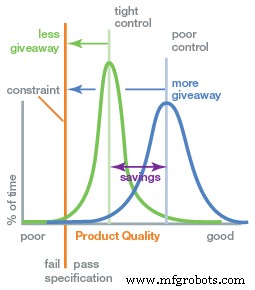
Control systems aim to reduce ‘giveaway’, the cost of producing too high of quality, by reducing random product quality variations. The chart above illustrates the concept. When product quality variations are large (blue curve), the plant produces a higher average quality, for fear of making an off-spec product. Achieving this additional quality will either increase the cost of production, reduce throughput, or both. Analytical measurement and control help to reduce the quality variation (green curve), so operators can drive the average quality down closer to the specification limit, thus making their product more efficiently or more copiously.
The ROI of a process analyzer used for control is calculable from the value of increased throughput in a seller’s market or the reduction in operating costs in any market.
Quality Assurance
The accuracy of process analyzer measurements can be vital to a producer’s bottom line. A wrong analysis could be catastrophic. Imagine a bad product sent to a customer or a perfectly good product rejected, dumped or sent back for reprocessing just because an analyzer is out of calibration. You can calculate the tangible loss from the latter scenario based on plant data, but the cost of losing a customer due to an off spec product could be a significant hit to the business and could have significant ramifications on your business. A process analyzer that helps to mitigate either scenario can easily justify its expense and continued cost of ownership.
Understanding the Costs
Before deciding on an analyzer purchase, count every associated expense. This includes the upfront cost of acquisition, installation and startup as a capital investment. Your ROI is then the net cash stream over the lifetime of the equipment.
Some typical capital investment costs associated with analyzers include:
- Sample conditioning systems
- Rack, panel, open shelter or HVAC analyzer housings
- Probes, pumps and field stations
- Installation, including fast loops and disposal arrangements
- Startup and commissioning
- Initial spare parts stock
The table below provides a general estimate of the costs associated with various kinds of analyzers installed in air-conditioned analyzer houses. The cost categories average about 20% each:
General Cost Estimate for Analyzers Installed in Air-Conditioned Houses
|
Cost Category |
Cost |
Quick Estimate Categories |
||
|
Analyzers |
20% |
Material Costs (Analyzer costs x3) |
Fully-Commissioned System (Analyzer costs x4) |
Full Involvement (Analyzer costs x5) |
|
Sampling System |
20% |
|||
|
Analyzer House |
20% |
|||
|
Installation & Start-up |
20% |
|||
|
Project Management |
20% |
|||
|
Project Cost |
100% |
|||
For a quick estimate, add up your analyzer costs and multiply by three for the material costs, by four for the cost of a fully-commissioned system or by five if including project management from your site. This method works well for a variety of analyzers, including gas chromatographs. However, your estimate will come out high if you’re using an expensive NMR analyzer and low for a bunch of inexpensive analyzers like oxygen, pH and conductivity analyzers.
If you need to present a case for purchasing a new analyzer, you can calculate the ROI using a simple spreadsheet function. Many plants will anticipate a 50% ROI or higher. Make sure your findings are defendable and that you truly understand the benefits obtained from the analyzer. A dissenting measurement could be a future insurance policy. Its purpose may be to flag an unlikely, but conceivable, plant upset, which could potentially save your plant a fortune.
Need additional help calculating the investments fluid system components and processes? Learn how Swagelok’s expert evaluation and advisory services can help save your plant money. Contact your local authorized Swagelok Sales and Service Center to request an evaluation.
Industrial Technology
- Maximizing ROI with Real‑Time Location Systems (RTLS) in Healthcare
- Additive Manufacturing Explained: From Design to Finished Part
- Laser Cutting: Precision, Versatility, and Key Benefits for Modern Manufacturing
- The Modern Manufacturing Process: Key Techniques and Innovations
- Metallization Explained: Benefits, Process, and Applications
- 50 Years of Process Analyzer Training: 5 Key Lessons Revealed
- Choosing the Right Sand: Key Types for Superior Sand Casting
- Comprehensive Guide to CNC Milling: From Design to Production
- The Future of Autonomous Vehicles: Technology, Challenges, and Innovations
- Streamlined Powder Coating Lines: Efficient, Durable, High-Quality Finishes