



Why Industry 4.0 Must Be on Every CEO’s Strategic Agenda
Industry 4.0: The Fourth Industrial Revolution Is Already Here
Industry 4.0 is no longer a distant vision; it’s reshaping global manufacturing today and will accelerate in the coming years. Customer expectations, IoT, sensors, 3D printing, cloud, and connected devices are the main catalysts driving value chains toward full digitisation.
Digital Business Models: A Manufacturing Perspective
In a conventional model, machines operate in isolation with isolated software control. A digital business model interconnects every stage—sales, production planning, control, material management, and after‑sales—into a seamless, data‑driven workflow. This integration delivers real‑time transparency to customers while enabling manufacturers to optimise processes effortlessly and improve overall efficiency.
Such tangible benefits demonstrate that Industry 4.0 is a concrete, not a speculative, transformation. It should occupy the top of a CEO’s agenda for three compelling reasons.
1. Industry 4.0 Will Reshape Corporate Strategy
No manufacturing firm will escape the influence of Industry 4.0. It will redefine corporate strategy and operational models. Transitioning to a fully digitised enterprise is a long, capital‑intensive journey that demands organisational commitment at every level.
A recent PwC & Strategy® survey of 235 German industrial companies asked: How advanced is digitisation today? What benefits can be realised? What hurdles must be overcome? The results—now published—highlight the scale of the opportunity.
2. Industrial Manufacturers Are Poised to Invest Big
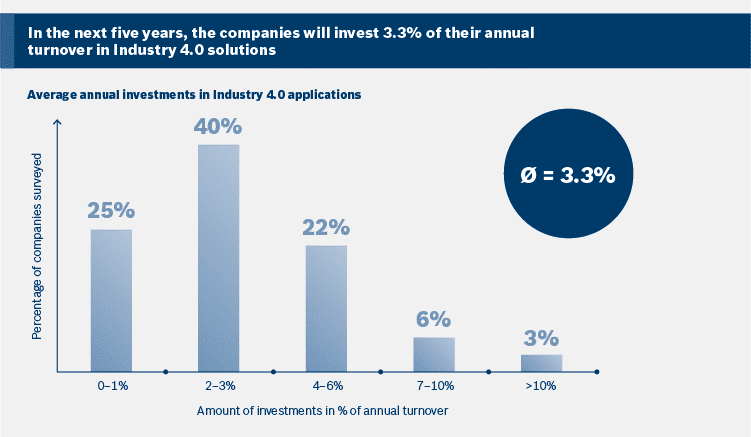
The same survey revealed that German firms plan to allocate an average of 3.3 % of their annual turnover—about €40 billion—to Industry 4.0 initiatives over the next five years. Across Europe, the projected investment reaches roughly €140 billion annually. Such commitment reflects the urgency with which top management recognises the transformation.
Source: PwC
Rapid Digitisation of Supply Chains
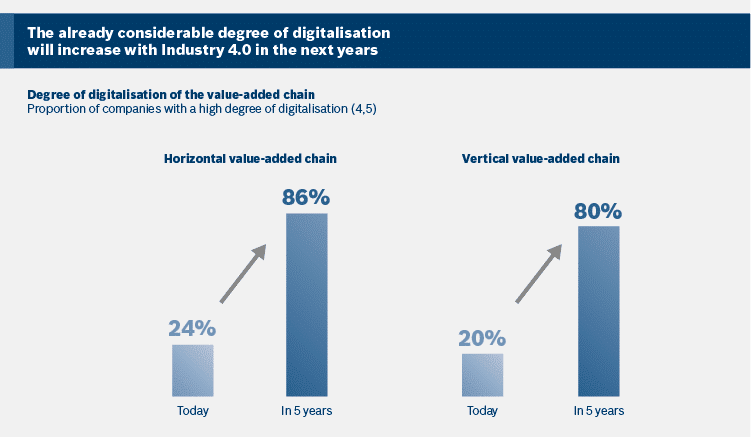
The survey was striking: only 24 % of firms reported a high level of digitisation today, but by 2020 this figure is projected to exceed 80 %. This acceleration signals both significant change and immense opportunity.
Industry 4.0 Promises Efficiency and Revenue Growth
Clients often ask for concrete ROI figures. The survey shows that digitising production can raise efficiency by an average of 18 % over five years and cut costs by up to 14 % by 2020.
Source: PwC
3. Industry 4.0 Places the Customer at the Core
By redefining the entire value chain, Industry 4.0 shifts the focus to customers and their evolving demands. Collaboration across partners becomes essential. The survey identified this collaboration as the key driver for adopting Industry 4.0.
Today, synchronising product flows is hampered by inconsistencies—mislabelled parts, non‑standardised data, and siloed systems. Cloud‑based solutions enable secure, standardised data exchange, harmonising end‑to‑end processes. The result is a supply chain that responds swiftly to customer needs, delivers customised products, and enhances the overall service experience.
Opportunities Outweigh Threats
Challenges exist: high upfront costs, unclear business cases, lack of industry standards, data security concerns, and a shortage of skilled talent. Nevertheless, the benefits—enhanced traceability, quality improvement, cost reduction, and new digital business models—surpass the risks.
Integrating planning and control across the value chain unlocks flexibility, responsiveness, and the potential for new revenue streams. It is up to senior leadership to harness these opportunities.
What is your experience with Industry 4.0? How close is your organisation to becoming a fully digital enterprise? I welcome your insights.
Industrial Technology
- Why Marine Industries Are Embracing Composites: 3 Key Benefits
- CNC Machining: Key to Precision in Medical Equipment Manufacturing
- Unlocking Efficiency: Why Aluminum Producers Should Embrace IoT
- Industry 4.0 & Sustainability: Navigating Environmental Challenges
- Industry 5.0: Redefining Manufacturing for the Future
- US Manufacturing Faces Downturn: Causes and Implications of the Current Recession
- The Benefits of Augmented Reality in Industry 4.0
- Why Operators Drive Industry 4.0 Success
- How Industry 4.0 Revolutionizes Manufacturing: Benefits & Opportunities
- CNC Machining: Key to Robotics Manufacturing Success