



Metal Casting Unveiled: Four Core Methods & Design Essentials
Metal casting has evolved from ancient sword‑making to the backbone of modern high‑performance components, powering everything from wind turbines to aerospace parts. For engineers, mastering the nuances of each casting route—and the design rules that accompany them—is key to delivering robust, cost‑effective solutions across the supply chain.
What Is Metal Casting?
At its core, metal casting is the art of pouring molten metal into a precisely engineered mold that defines the final part’s shape. As the metal cools and solidifies, it adopts the mold’s geometry, producing a near‑net‑shape component ready for downstream processing.
While casting offers remarkable versatility, it comes with strict engineering constraints. All alloys contract during solidification, typically 0.3%–1% depending on the metal. Engineers must calculate these shrinkage rates ahead of time and incorporate them into tooling design to maintain dimensional accuracy.
Step‑by‑Step: The Core Metal Casting Process
Regardless of the specific variant, every casting operation follows a common workflow. Below is the canonical sequence that most foundries employ.
Step 1: Pattern Creation
A pattern—a faithful replica of the desired part—forms the foundation for the mold cavity. Patterns can be permanent (steel or aluminum) for high volumes or flexible (wax, wood, or plastic) for low‑run or prototype work.
Step 2: Core Fabrication
For hollow or internal geometries, a core is inserted into the mold cavity. The core can be sacrificial (loam, ceramic) or permanent (metal), and its shape defines the voids in the final cast.
Step 3: Mold Construction
Mold fabrication is tailored to volume and part requirements. High‑volume runs use CNC‑machined tool steel dies, while low‑volume or prototype parts rely on sand molds packed around the pattern.
Step 4: Metal Pouring
Metal is heated to a fully liquid state and introduced into the mold. The filling method—gravity, pressure, or centrifugal—dictates the part’s density, surface finish, and dimensional fidelity.
Step 5: Part Extraction
Once the metal has solidified, the part is removed. Sand molds are single‑use and must be destroyed; steel dies are opened to release the part and reset for the next cycle.
Step 6: Post‑Processing
Castings rarely arrive ready for assembly. Typical post‑processing steps include flash removal, heat treatment, and CNC machining to meet precise tolerances and surface specifications.
The Four Main Metal Casting Processes
While dozens of specialized casting methods exist, four dominate industrial production.
1. Die Casting
Die casting uses durable tool steel molds and high‑pressure injection to produce complex, net‑shape parts with tight tolerances (±0.05 mm) and superior surface finish. Though upfront tooling costs are high, the method excels for high‑volume, lightweight structures in aluminum and magnesium.
2. Gravity Casting (Permanent Mold)
Gravity casting employs reusable metal tooling (typically cast iron) and relies on natural gravity to fill the cavity. The metal is pre‑heated to avoid premature solidification. It balances the precision of die casting with lower tooling costs, making it suitable for medium‑volume production.
3. Investment Casting (Lost‑Wax)
Investment casting starts with a wax or resin pattern that is coated in ceramic. After the wax is burned out, molten metal fills the ceramic shell. The process yields high‑dimensional accuracy (±0.1 mm) and excellent surface quality, ideal for aerospace and high‑performance components.
4. Sand Casting
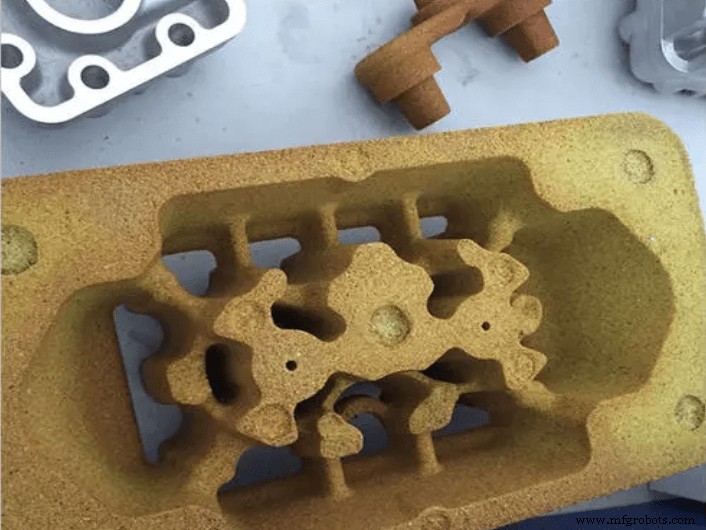
Sand casting is the most economical route, using sand mixed with binders (clay or chemical). It can accommodate extremely large parts and complex geometries but typically offers lower dimensional precision (±0.5 mm). The method remains essential for low‑volume or prototype production.
Pros & Cons: Why Choose Metal Casting?
Key Benefits
- Large‑scale capability: cast components can exceed the size limits of CNC or forging.
- Thick‑walled geometries: cast parts can maintain structural integrity without delamination.
- Monolithic consolidation: one‑piece castings eliminate costly welding or bolting.
- Tribological performance: cast metals provide excellent bearing qualities for heavy‑load applications.
- Light‑alloy compatibility: aluminum and magnesium castings reduce weight without compromising strength.
- Material versatility: a single foundry can process both ferrous and non‑ferrous alloys.
Core Limitations
- Defect susceptibility: porosity, shrinkage cavities, and slag inclusions require vigilant quality control.
- Dimensional tolerance: typically less precise than subtractive CNC machining.
- Labor intensity: traditional sand casting demands substantial manual work.
- High production minimums: die and permanent mold tooling necessitate large order quantities.
Other Advanced Casting Variations
Beyond the four main methods, specialized processes such as loam molding, shell molding, centrifugal casting, and continuous casting address niche requirements—for example, high‑speed cylindrical parts or raw mill stock production.
FAQ
Q1: How does sand casting differ from die casting?
A1: Sand casting uses a disposable sand mold and is cost‑effective for low volumes and large parts. Die casting employs durable steel dies, injecting metal under high pressure for tight tolerances and fast cycle times—ideal for high‑volume runs.
Q2: When should forging or CNC machining be preferred over casting?
A2: Choose forging when maximum structural integrity and impact resistance are needed; pick CNC machining for tight tolerances, sharp features, or low‑volume production. Opt for casting when complex internal cavities, monolithic consolidation, or thick‑walled geometry are required.
Related Articles
Industrial Technology
- Understanding Factorials: Definition, Examples, and Special Cases
- Building a Strong Security Culture Across Your Organization
- AI Breakthrough: Accurately Predicts 3D Structures of All Proteins from Their Sequences
- Additive Manufacturing: From Origins to Tomorrow's Innovations
- Understanding Conductors, Insulators, and the Science of Electron Flow
- Voltmeter IC: Precision Voltage Measurement Made Simple
- Understanding Metal Casting: Process, Benefits, and Applications
- 50 Proven Warehouse Automation Strategies for Boosting Efficiency & ROI
- LMS's ExporTech™: Pioneering Global Aerospace Fuel Solutions
- Mastering Ultrasonic Sensor Circuits: The Ultimate Guide