



Choosing the Right Microcontroller for High‑Performance Digital Signal Processing
How to Pick an MCU That Excels in DSP Tasks
Digital signal processing (DSP) has become a core capability in countless electronic products—from audio amplifiers to industrial control systems. Fortunately, many modern microcontrollers (MCUs) now offer the computational power, flexibility, and cost‑effectiveness required to implement DSP algorithms without resorting to a dedicated DSP chip or FPGA.
In this article, we examine the key attributes you should evaluate when selecting an MCU that will serve as both a system controller and a DSP engine. Our focus is on practical, engineering‑ready criteria: bit width, clock speed, arithmetic support, and overall performance metrics such as MIPS (millions of instructions per second).
Choosing the Right Bit Width: 8‑Bit, 16‑Bit, or 32‑Bit?
While 8‑bit MCUs are often adequate for simple control loops or low‑resolution data, DSP workloads typically involve large intermediate values and a high dynamic range. 16‑bit and 32‑bit devices are better suited for these scenarios because they can process wider data paths directly in hardware.
However, the bit width label can be misleading. A “32‑bit” MCU may feature 32‑bit registers and a 32‑bit ALU, but its memory interface, bus width, or peripheral protocols might still be 16‑bit. Evaluate the actual data path that will carry your DSP data; if you’re only ever handling small integers, an 8‑bit MCU could still deliver adequate performance.
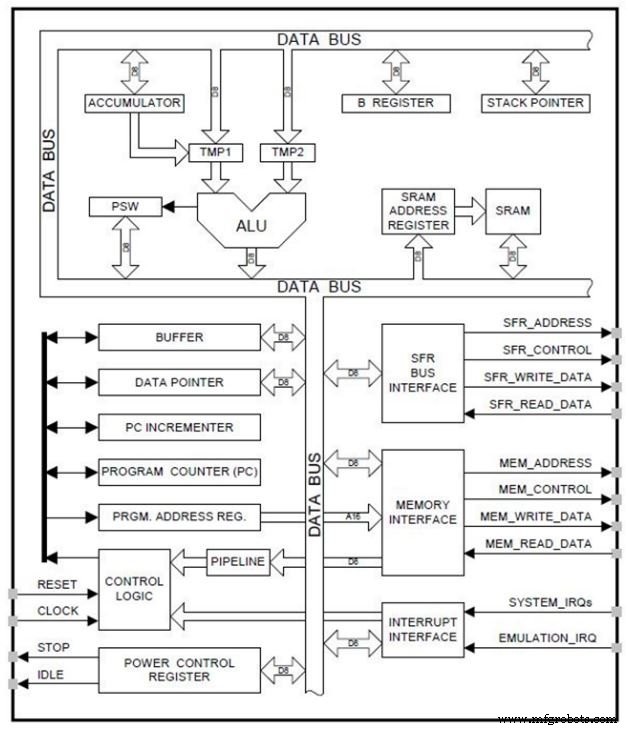
This modernized 8‑bit architecture, developed by Silicon Labs, illustrates that a 16‑bit or 32‑bit device does not automatically outperform an 8‑bit MCU in every case.
Clock Frequency and Instruction Throughput
Clock speed alone does not determine DSP capability. Performance depends on how many instructions a processor can execute per second, which is governed by both the clock rate and the average number of cycles per instruction. Pipelined architectures can reduce the average cycles, improving MIPS without raising the clock frequency.
When comparing MCUs from the same family, choose the higher clock. For devices with differing architectures, look for documented MIPS figures or the average cycles per instruction. These metrics provide a more reliable basis for estimating DSP throughput.
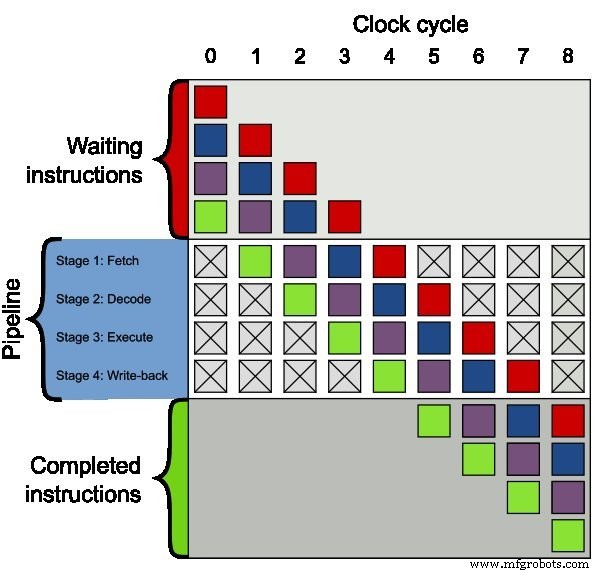
A pipelined design enables overlapping instruction stages, effectively boosting instruction throughput. See this article for more information.
Fixed‑Point vs. Floating‑Point Arithmetic
Most MCUs perform fixed‑point math, which is efficient for integer‑based DSP routines. If your application requires high‑precision or dynamic range, a floating‑point coprocessor (FPU) can simplify development and improve numerical stability.
Examples include the NXP LPC3180FEL320, a 16/32‑bit ARM MCU with an FPU delivering up to 220 MIPS, and the STM32 series from STMicroelectronics, many of which also incorporate FPUs. For many typical DSP tasks, compiler‑generated floating‑point code on a fixed‑point MCU is sufficient, but an FPU can reduce latency for intensive calculations.
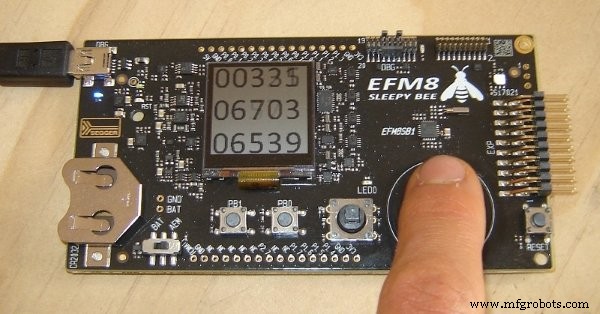
In my circular‑touch‑sensor project, floating‑point math was rarely needed—standard compilers handled most calculations efficiently on a fixed‑point MCU.
Recap
When selecting an MCU for DSP work, prioritize:
- Data path width (16‑bit or 32‑bit for most DSP workloads)
- Clock speed and MIPS or cycles per instruction metrics
- Presence of an FPU if high‑precision floating‑point is required
We’ll explore peripheral features that complement DSP performance in the next article of this series.
Intro to Microcontrollers Series
- What Is a Microcontroller? An Introduction to the Central Component in Countless Electronic Devices
- How to Choose the Right Microcontroller for Your Application
- How to Read a Microcontroller Datasheet: Introduction and First Steps
- How to Read a Microcontroller Datasheet: Exploring the Hardware
Industrial Technology
- Selecting Microcontroller Peripherals for High‑Performance DSP Projects
- Selecting the Perfect Abrasive for Metal Fabrication: A Practical Guide
- Choosing the Right Filling Sensor: Accuracy, Reliability & Profitability
- Choosing the Right Inventory System for Your Warehouse: A Practical Guide
- Choosing the Right Computer for Your Family: A Comprehensive Guide
- Choosing the Ideal Solder for Circuit Boards: A Professional Guide
- Selecting the Ideal LED Driver for Your Lighting Projects
- Intel Edison IoT: Selecting the Right Mini‑Computer for Your Prototype
- Choosing the Right Automation Project: A Strategic Guide
- Choosing the Right Logo and Character Design for Your Prototype