



How 5G Release 16 Will Revolutionize Location Accuracy
3GPP Release 16 promises cheaper, more reliable high‑precision location services by harnessing new signal characteristics and integrating diverse non‑cellular technologies, opening the door to hybrid positioning.
When we tap a GPS coordinate on our phone, we are presented with a statistical estimate. That value represents a probability—often 50%—that the device is within a specific radius, such as 1 meter, of the reported position. How much trust we place in that figure depends on how the underlying data is generated and verified.
Global Navigation Satellite Systems (GNSS)
GNSS has long been the gold standard for accurate positioning, but the growing appetite for safety‑critical, high‑precision applications demands robust confidence metrics and fallback options when satellite signals falter.
Cellular modems already provide coarse positioning by triangulating cellular signals. Leading manufacturers, like u‑blox, have offered hybrid modules that combine GNSS with cellular data to extend coverage and reliability.
5G positioning—an often overlooked facet of the 5G ecosystem—is now being standardized by the industry‑driven 3GPP. This organization, which unites seven technical bodies and hundreds of corporate members, is steering 5G positioning toward the needs of diverse verticals.
A Brief Look Back
Positioning has been integral to cellular networks from the outset, originally used to route calls to the correct base station. Regulatory demands for emergency services in 1999 and the EU in 2002 accelerated the evolution of cellular location services, a progression that 3GPP has continually refined.
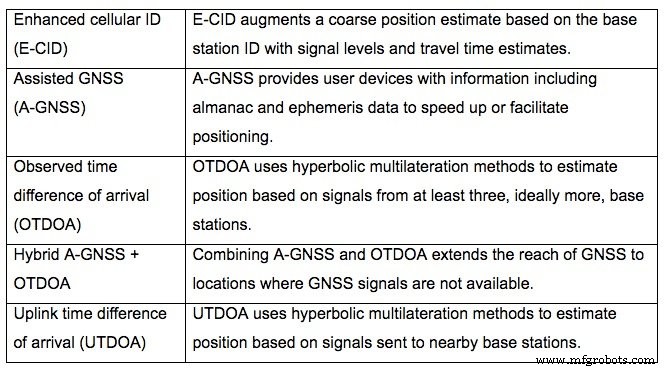
Today’s 4G LTE infrastructure offers a suite of location methods—cell‑ID, enhanced cell‑ID, TDOA, and more—each with varying accuracy and coverage. The accompanying table (see Figure 1) summarizes these techniques.
Table 1. The Main 4G LTE Location Services
New Use Cases and Demands
Beyond regulatory mandates, a growing cohort of hardware makers, space agencies, and operators is demanding sub‑meter precision to enable next‑generation services. Applications range from autonomous vehicles and UAVs to smart cities, wearables, and AR.
5G promises a blend of absolute and relative positioning, each accompanied by a quantified confidence level. Key performance indicators—horizontal/vertical accuracy, relative accuracy, time‑to‑first‑fix, velocity precision, power consumption, latency, and security—are still being refined in Release 16.
Figure 1 illustrates the stringent accuracy targets for three verticals—UAV missions, IIoT tracking, and autonomous vehicle navigation—drawing on 3GPP TR 22.872 and related studies.
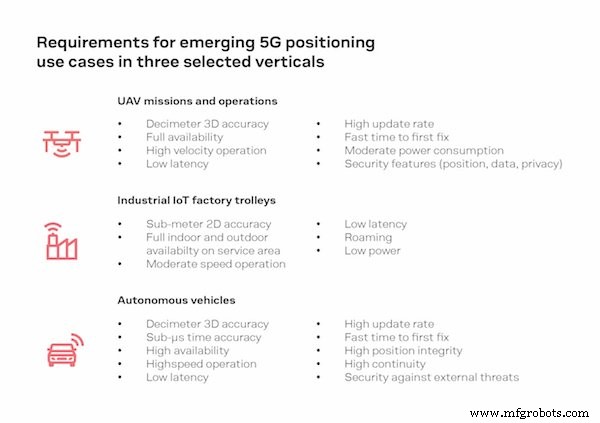
Figure 1. Requirements for emerging 5G positioning use cases in three selected verticals.
How the New Generation of GNSS Receivers is Changing Positioning
Modern GNSS receivers now tap multiple constellations—GPS, GLONASS, Galileo, BeiDou—and, in many cases, regional augmentation systems. Multi‑constellation, multi‑band devices (e.g., u‑blox F9) can acquire more satellites, even in urban canyons, improving both accuracy and time‑to‑fix.
Dual‑band receivers mitigate ionospheric delays by exploiting frequency diversity, reducing average errors from ~2.5 m to under 1 m in open sky conditions. Commercial correction services, including differential and RTK, further push accuracy toward the centimeter level.
Emerging broadcast‑based correction schemes aim to deliver high‑precision data over entire regions via Internet or satellite, reducing cost while maintaining accuracy.
GNSS still struggles indoors and in tunnels and suffers from a cold‑start delay of several seconds. Assisted GNSS (A‑GNSS) and inertial navigation systems (INS) can bridge these gaps, especially in automotive contexts.
How 5G Will Bring New Improvements to Cellular‑Based Positioning
5G New Radio, defined in 3GPP Release 15, is already rolling out in non‑standalone and standalone configurations worldwide. Although the first commercial 5G deployments began in 2019, high‑precision positioning standards will be introduced in Release 16, slated for late 2019 with 2020 deployment.
Operators view 5G as a revenue driver across three core scenarios: eMBB (enhanced mobile broadband), uRLLC (ultra‑reliable low‑latency communications), and mMTC (massive machine‑type communications). Each scenario demands tighter accuracy, lower latency, and higher reliability.
- eMBB: higher frequencies and larger bandwidths deliver faster data.
- uRLLC: critical for autonomous vehicles and V2X applications.
- mMTC: supports the growing IoT ecosystem.
Cellular positioning will leverage uplink and downlink signals, enhanced cell‑ID, TDOA, and potentially sidelink device‑to‑device techniques. 5G’s wider bandwidths, especially in mmWave bands above 24 GHz, sharpen time resolution and mitigate multipath interference.
Higher frequency deployment leads to denser base‑station networks and advanced antenna arrays with beamforming, improving delay, angle‑of‑arrival, and angle‑of‑departure measurements. In some cases, a single base station may suffice for accurate localization.
Ubiquitous High‑Precision Positioning Will Require Hybrid Approaches
No single technology can guarantee the stringent accuracy required across all environments. GNSS excels outdoors but falters indoors; 5G shines in both indoor and outdoor contexts. Hybrid solutions that fuse GNSS, cellular, Wi‑Fi, Bluetooth, terrestrial beacons, and inertial data provide the redundancy and integrity needed for high‑confidence positioning.
3GPP’s study scope explicitly includes GNSS, terrestrial signals, and short‑range wireless, targeting Release 16 specifications by Q1 2020.
Challenges Set for the 3GPP
Delivering cellular‑based positioning within 5G’s diverse signal landscape demands complex integration and rapid infrastructure deployment. The industry must collaborate across GNSS, cellular, satellite, and short‑range domains to produce solutions that surpass the sum of their parts.
u‑blox’s expertise in GNSS, short‑range wireless, and cellular technologies positions it uniquely to accelerate 5G hybrid positioning, fostering innovation and unlocking new applications.
This article was co‑authored by David Bartlett, Senior Principal Engineer, Product Center Positioning at u‑blox.
References
- 1) FCC 911 and E911 Services
- 2) Summaries of EU Legislation: Affordable telecommunications services – users' rights
- 3) "Evolution of Positioning Techniques in Cellular Networks, from 2G to 4G," Rafael Saraiva Campos, Hindawi, 2017
- 4) UE is short for User Equipment
- 5, 6) 3GPP TR 22.872 V16.1.0 (2018‑09), Technical report, 3rd Generation Partnership Project; Technical Specification Group Services and System Aspects; Study on positioning use cases; Stage 1, (Release 16)
- 7) High precision positioning for Cooperative‑ITS (HIGHTS), Project deliverable D2.1: Use cases and Application Requirements (May 1, 2015)
- 8) Report on Road User Needs and Requirements, Outcome of the European GNSS’ USER Consultation Platform, European Global Navigation Satellite Systems Agency (GSA) (October 18, 2018)
- 9) System architecture milestone of 5G Phase 1 is achieved, 3GPP, (December 21, 2017)
- 10) Top 5G phones: every 5G phone announced and still to come in 2019
- 11) AT&T Names 99 New 5G Evolution Markets
- 12) Carrier heads commit to ‘Korea 5G Day’
- 13) Whitepaper on New Localization Methods for 5G Wireless Systems and the Internet‑of‑Things, COST Action CA15104, IRACON; Pedersen, Troels; Fleury, Bernard Henri
Industry Articles are a form of content that allows industry partners to share useful news, messages, and technology with All About Circuits readers in a way editorial content is not well suited to. All Industry Articles are subject to strict editorial guidelines with the intention of offering readers useful news, technical expertise, or stories. The viewpoints and opinions expressed in Industry Articles are those of the partner and not necessarily those of All About Circuits or its writers.
Industrial Technology
- How 5G Will Transform Industrial IoT: Unlocking Faster, Safer, and Smarter Factories
- Elevating Maintenance: Aligning Strategy, Building Trust, and Driving Business Value
- IR Sensor 2.0: Driving the Next Wave of IoT Innovation
- Exploring 6G: The Future of Ultra-Fast Connectivity
- Revolutionizing Mobile Healthcare with Blockchain: Enhanced Data Ownership & Security
- Electric Trucking: Driving Environmental Change
- Elevate Employee Performance: Proven Strategies to Improve Worker Training
- Boost Manufacturing Efficiency: Proven Strategies for Peak Performance
- Mastering Industrial Procurement: From Brand Awareness to Purchase Order
- Maximize Efficiency: Proven Strategies to Boost Fluid System Performance