



Understanding Millimeter‑Wave Technology: Fundamentals, Propagation, and Real‑World Applications
What Are Millimeter Waves and How Do They Compare to Lower‑Frequency Bands?
Millimeter waves, or mmWaves, are a segment of the electromagnetic spectrum with wavelengths between 1 and 10 mm, corresponding to frequencies of 30–300 GHz. The International Telecommunication Union designates this band as Extremely High Frequency (EHF). The core physics is simple: as the wavelength shrinks, the frequency rises proportionally (f = c/λ).
Figure 1 shows where the mmWave band sits relative to the rest of the spectrum and highlights several key applications—from 5G mobile radios to automotive radar and airport security scanners.
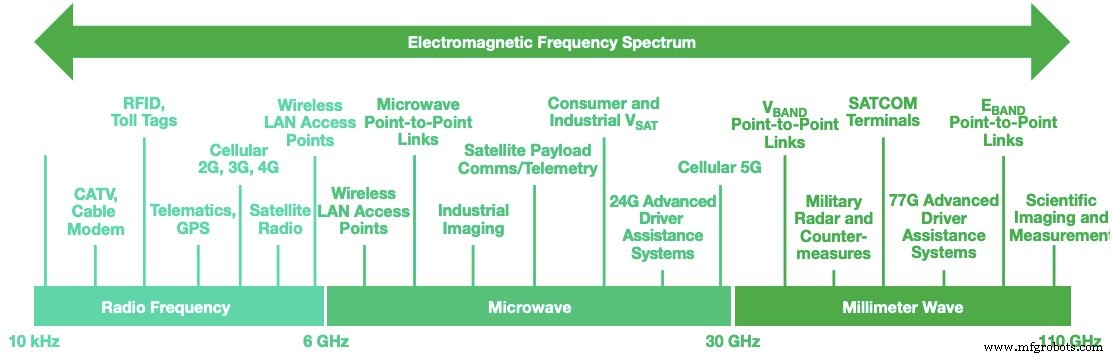
Figure 1. Millimeter‑wave spectrum overview. Image courtesy of Analog Devices
With the fundamentals in place, let’s explore how mmWave signals travel.
Propagation Characteristics of Millimeter Waves
Millimeter‑wave propagation differs markedly from lower frequencies. The main traits are:
- High free‑space path loss (FSPL)
- Significant atmospheric attenuation
- Diffuse reflections
- Limited penetration into solids and foliage
Each characteristic has both challenges and opportunities, as we’ll detail below.
Free‑Space Path Loss
FSPL grows sharply as wavelength shortens. The exact relationship is:
$$FSPL = \left( \frac{4\pi d}{\lambda} \right)^2$$
where d is the link distance in metres and λ is the wavelength in metres. Reducing λ by a factor of ten boosts FSPL by a hundredfold, far exceeding the loss seen in conventional FM or Wi‑Fi bands.
In decibels, the equation is often written as:
$$FSPL\;(\text{dB}) = 20\log_{10}(d) + 20\log_{10}(f) + 92.45$$
A convenient online calculator for FSPL can be found here.
Atmospheric Attenuation
Oxygen and water vapour molecules absorb energy at specific mmWave frequencies, creating pronounced loss peaks. Figure 2 illustrates the most severe attenuation, notably the 60 GHz oxygen line, and shows how rain adds broadband loss across the entire spectrum.
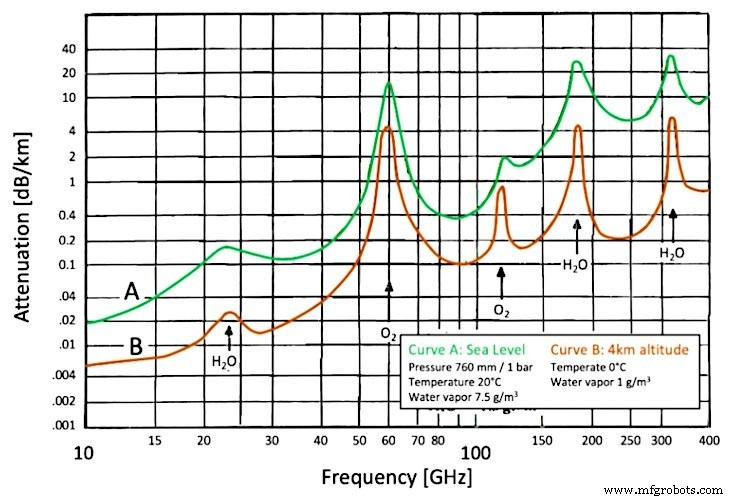
Figure 2. Atmospheric attenuation versus frequency and elevation. Image courtesy of 5G Americas
Diffuse Reflection
Unlike longer wavelengths that reflect specularly, mmWaves interact with rough surfaces, scattering energy in many directions. This diffuse behavior reduces the power that reaches a receiver, making line‑of‑sight links the norm.
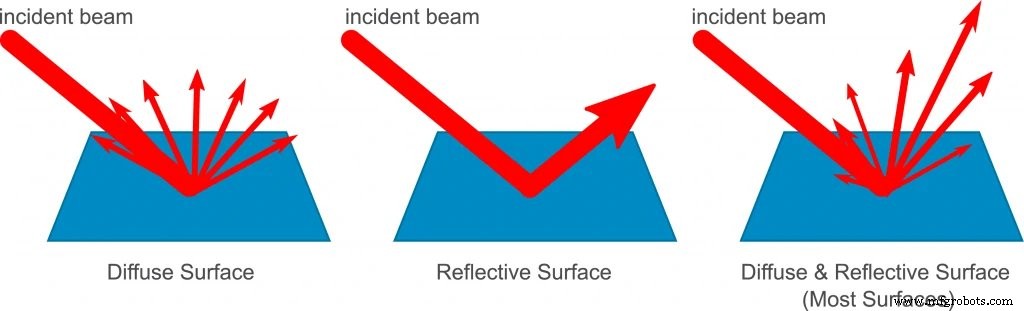
Figure 3. Diffuse versus specular reflection. Image courtesy of Hermary
Limited Penetration
Short wavelengths also mean shallow penetration. Typical building materials show 1–6 dB / cm loss, and a 70 GHz signal can lose five times more power traversing brick than a 1 GHz signal. Outdoor foliage likewise blocks mmWaves, reinforcing their line‑of‑sight nature.
Advantages of Millimeter‑Wave Frequencies
While the propagation challenges can seem daunting, they unlock powerful advantages in many domains:
- Extremely wide bandwidths for high data rates
- Inherently low latency for time‑critical traffic
- Compact antennas enabling dense arrays and beamforming
- Intrinsic spatial isolation that reduces co‑channel interference
- High resolution for radar and imaging
Wide Bandwidths and High Data Rates
5G New Radio (NR) can allocate up to 400 MHz of contiguous bandwidth above 24 GHz, compared with only 100 MHz below 6 GHz. This extra room translates directly into peak data rates that can exceed 10 Gb/s in practice. Emerging silicon carbide (SiC) and gallium nitride (GaN) technologies are making mmWave RF components more affordable, pushing these speeds into everyday devices.
Low Latency
Because data can be transmitted in shorter bursts, mmWave links naturally exhibit lower one‑way latency. For industrial automation, autonomous driving, and augmented reality, this latency advantage is critical for safety and responsiveness.
Small Antennas and Beamforming
The shorter wavelength shrinks the physical size of each antenna element. Automotive radar, for example, moved from 24 GHz to 77 GHz, shrinking array area by more than a factor of nine.
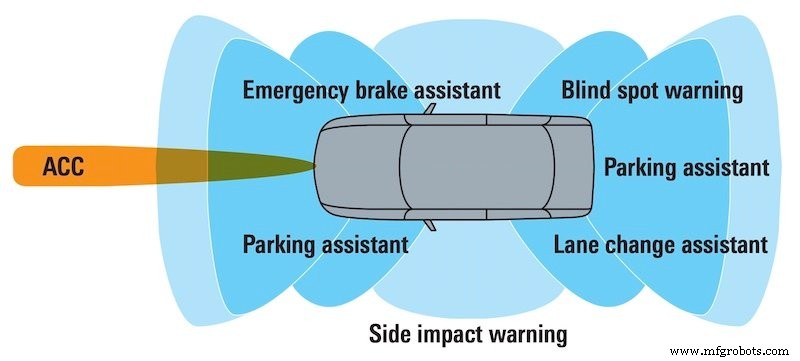
Figure 4. Relative antenna array sizes for 24 GHz and 77 GHz. Image courtesy of Texas Instruments
Large, dense arrays are also central to 5G Massive MIMO, where dozens of elements steer narrow beams toward each user, boosting signal quality and extending range.
Spatial Reuse through Limited Range
The short reach of mmWaves allows many small cells to coexist with minimal interference. Adaptive beamforming further isolates each cell, enabling a higher density of users per spectrum unit.
Higher Radar Resolution
Higher frequencies give finer wavelength, which improves Doppler resolution and distance precision. This makes mmWave radar ideal for automotive collision avoidance, drone navigation, and detailed mapping.
Applications of Millimeter‑Wave Technology
Radar
From aerospace to autonomous vehicles, mmWave radar offers unparalleled range, speed, and resolution. The Doppler shift is inversely proportional to wavelength:
$$\Delta f = \frac{2V_{\text{rel}}}{\lambda}$$
Thus a 77 GHz radar can resolve relative velocities down to a few centimeters per second, far exceeding legacy 24 GHz units.
Figure 5. Millimeter‑wave radar in autonomous vehicles. Image courtesy of Rohde & Schwarz
Telecommunications
Satellite links have long exploited mmWave bands for their bandwidth and beamforming benefits. Terrestrial networks are now adopting the same advantages:
- 5G NR and IEEE 802.11ad (WiGig) deliver multi‑gigabit per second throughput.
- Beamforming and Massive MIMO enable dense, low‑latency connectivity in dense urban settings.
- Compact antennas fit on smartphones, smart TVs, and gaming consoles.

Figure 6. Adaptive beamforming supporting stationary and mobile users. Image courtesy of Fujitsu via Phys.org
Security Scanners
Airport and event security scanners use a 70–80 GHz band, emitting only ~1 mW. The waves penetrate clothing, reflect off the skin, and return to a dense array of antennas, creating high‑resolution images that reveal concealed items. Their low power and shallow penetration make them safe for human exposure.

Figure 7. Millimeter‑wave body scanner system. Image courtesy of Rohde & Schwarz
Other Emerging Uses
Beyond the applications above, mmWave technology is being explored for:
- Radio astronomy
- Soil moisture monitoring
- Snow and ice cover mapping
- Adverse‑weather radar augmentation
- Wind‑speed estimation
- Targeted medical therapies
Conclusion
Millimeter‑wave technology, with its unique propagation behavior and high‑bandwidth potential, continues to reshape fields from autonomous driving to next‑generation mobile networks. Engineers must balance the inherent losses with advanced beamforming, adaptive modulation, and careful spectrum planning to fully harness its benefits.
Industrial Technology
- Understanding Square Wave Signals: Fundamentals and Applications
- Post‑Pandemic Manufacturing Technology Investments: Seizing Growth Opportunities
- Wave Energy Innovators Secure €500k EEA Grant for Composite-Based Technology
- Essential PCB Layout Design: Master the Foundations
- Wave vs. Reflow Soldering: Key Differences & How to Choose the Right Process
- Understanding Grinding Wheels: Key Components and Applications
- Understanding the TIP120 Transistor: Basics, Features, and Applications
- Understanding Printed Circuit Boards (PCBs) – A Comprehensive Overview
- Exploring 3D Printing Technologies: SLA, SLS, FDM, DLP, MJF, PolyJet, DMLS & More
- Lincoln Electric Power Wave Technology Delivers Superior, Consistent Weld Quality