



Mastering Gate Driver Power Architecture for EV Half‑Bridge Converters
Power Conversion in EVs: The Half‑Bridge Focus
Electric vehicles rely on a network of power conversion stages—high‑voltage DC‑DC converters, traction inverters, and battery chargers—all of which transform energy from one form to another. Central to each stage is the half‑bridge topology, where a high‑side and a low‑side power device toggle the load between the positive and negative high‑voltage rails.
The Half‑Bridge Configuration
In a half‑bridge, gate drivers must energize the gate of each switch quickly and precisely. For IGBTs, the gate‑to‑emitter voltage (VGE) must exceed a threshold to turn the device on; for SiC FETs, the gate‑to‑source voltage (VGS) performs the same role. Although this article focuses on IGBT half‑bridges, the same principles apply to SiC designs.
Figure 1 illustrates a half‑bridge built with IGBTs and one with SiC FETs, both driven by isolated gate drivers. Isolation protects the low‑voltage controller from the high‑voltage environment and ensures reliable operation.
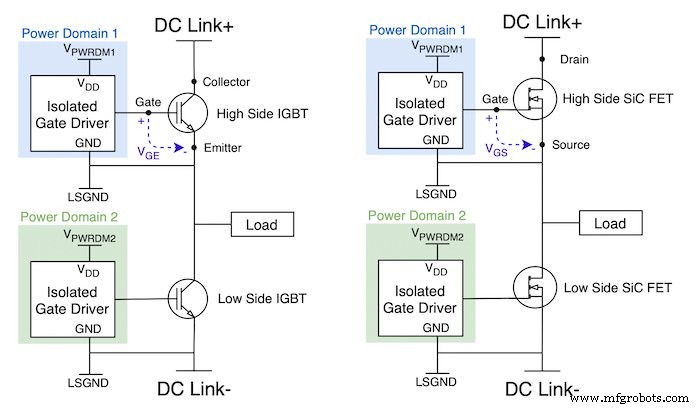
Figure 1. Half bridges with isolated gate drivers and IGBT/SiC FET switching devices
For a low‑side gate driver, the output stage is tied to the negative high‑voltage rail (DC Link–), using a dedicated VDD supply for the gate. This creates a positive VGE relative to the emitter. The high‑side driver, however, must reference its ground to the emitter of the high‑side device; otherwise it would float and fail to drive the gate. Consequently, high‑side drivers require a separate power domain.
Multiple Half‑Bridge Topologies
Complex converters often employ several half‑bridges. A three‑phase traction inverter, for instance, contains six power devices grouped into three half‑bridges—one per phase. Low‑side devices share a common DC Link– emitter, allowing a single power domain for their drivers. High‑side emitters, however, connect to the individual phase voltages, necessitating three distinct power domains, as shown in Figure 2.
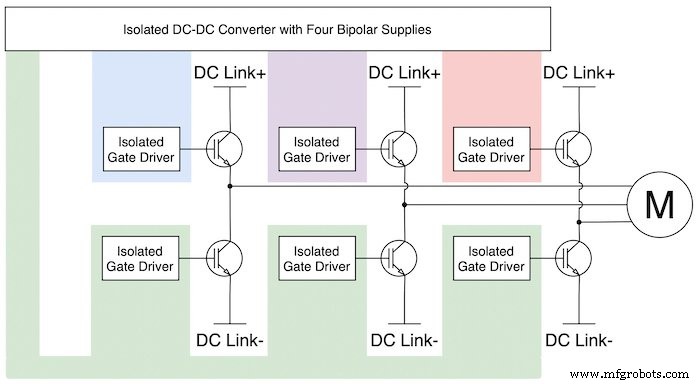
Figure 2. Three‑phase system with a single DC‑DC converter
A common solution is to power all drivers from one DC‑DC converter that supplies multiple rails. While cost‑effective, this approach can introduce long traces, board‑layout complexity, and EMI coupling between high‑ and low‑side rails—issues that become acute in high‑frequency SiC designs.
Separating the DC‑DC converter into multiple independent units mitigates these challenges. Each driver receives a clean, tightly regulated rail, reduces trace lengths, and minimizes inter‑domain noise, enabling higher switching frequencies and optimal efficiency. This modular architecture is also easily reused in other topologies such as full‑bridge converters.
Integrated DC‑DC in Gate Drivers
To balance cost and performance, many manufacturers embed a DC‑DC regulator directly into the gate driver. Silicon Labs’ Si828x family, for example, offers versions with and without an integrated regulator, reducing board space and component count while maintaining robust power delivery. Figure 3 demonstrates a three‑phase inverter that uses four independent power domains and gate drivers with integrated DC‑DC converters.
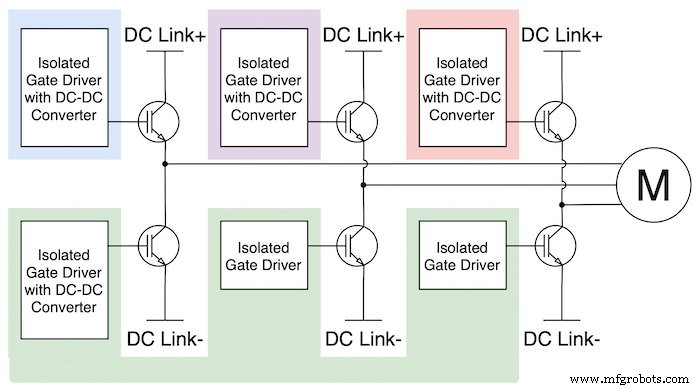
Figure 3. Three‑phase system using gate drivers with integrated DC‑DC controllers and four independent power domains
As EV power electronics evolve—faster switching, higher voltages, more complex topologies—gate driver power domain architecture remains a critical factor for achieving low loss, high reliability, and cost efficiency.
Industry Articles are a form of content that allows industry partners to share useful news, messages, and technology with All About Circuits readers in a way editorial content is not well suited to. All Industry Articles are subject to strict editorial guidelines with the intention of offering readers useful news, technical expertise, or stories. The viewpoints and opinions expressed in Industry Articles are those of the partner and not necessarily those of All About Circuits or its writers.
Industrial Technology
- Understanding the NOT Gate (Inverter) in TTL Circuits
- Understanding the Buffer Gate: Amplification and Signal Integrity in Digital Circuits
- Demystifying the XOR Gate: The Exclusive‑OR Function in Digital Logic
- Silicon‑Controlled Rectifiers (SCRs): Design, Operation, and Practical Applications
- Ensuring Electrical Safety: Grounding, Polarized Plugs, GFCIs, and AFCIs
- How Modern MCAD & ECAD Transform Design: From Legacy Hurdles to Cloud Collaboration
- Mastering Threading: Overcoming Key Challenges for Superior Quality
- Industry 4.0 & Sustainability: Navigating Environmental Challenges
- Integrating the 5S Method into Industry 4.0: Overcoming Implementation Challenges
- AC-DC Converters: Your Reliable Source for Consistent DC Power