



Ensuring Electrical Safety: Grounding, Polarized Plugs, GFCIs, and AFCIs
In any power system, a reliable earth‑ground connection is essential for predictable and safe operation. Without it, the voltage between any circuit point and earth can vary unpredictably, creating a serious shock risk.
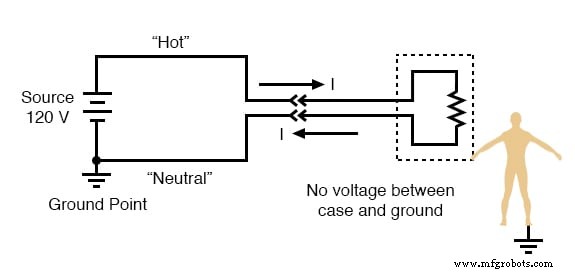
By grounding one side of the voltage source, we guarantee that at least one point in the circuit—called the neutral—is electrically common with earth. The other conductor, the hot (or live/active), remains at line voltage and poses a shock hazard unless it is disconnected from the source.
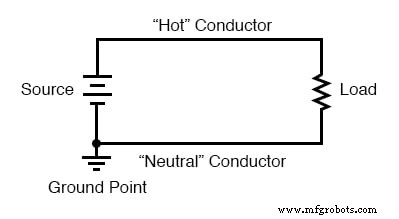
Grounding does not alter the electrical performance of the load; it exists solely to provide a safe touch point. In a two‑wire system, the neutral ensures that touching the grounded conductor will present no voltage to a human body.
In household wiring, appliances such as toasters illustrate the importance of isolating the hot conductor from the metal case. The internal conductors are wrapped in insulation and separated by plastic or rubber, so the case remains electrically isolated when the appliance is functioning correctly.
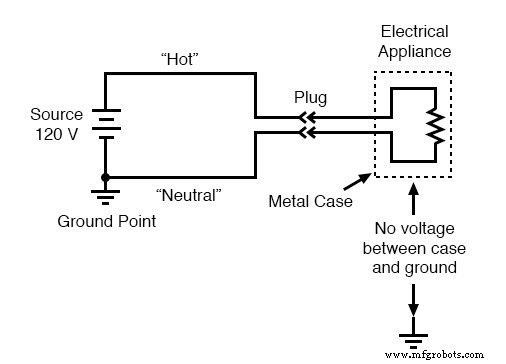
If a hot wire were to contact the case, the user would be exposed to line voltage. If the neutral wire contacts the case, no shock occurs because the case remains at earth potential. Engineers therefore design appliances to minimize the likelihood of hot–case contact.
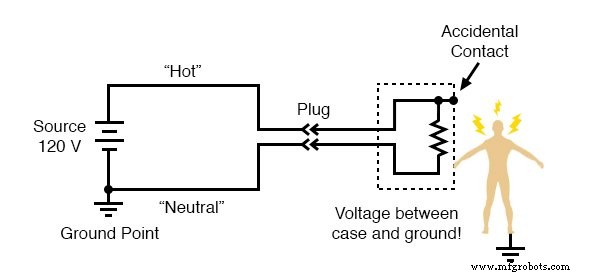
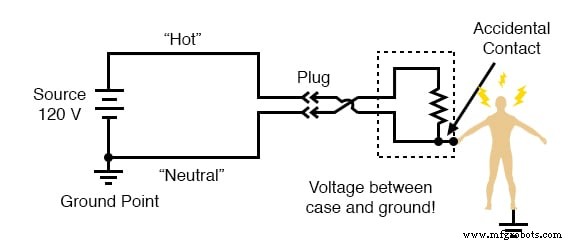
However, this safety margin depends on plug polarity. A reversible plug could swap hot and neutral, turning a safe configuration into a dangerous one. To eliminate this risk, appliances and receptacles use polarized plugs—one prong slightly narrower than the other—ensuring that hot and neutral remain fixed.
In addition to polarity, manufacturers may opt for double‑insulated appliances, where the metal case itself is non‑conductive, providing a second layer of protection. Alternatively, a three‑prong plug can connect the case to earth via a grounding conductor, ensuring that any accidental hot‑to‑case contact results in a short to ground and trips overcurrent protection.
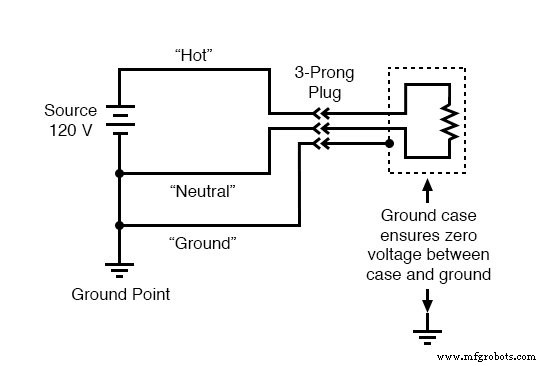
Removing the grounding prong or plugging a three‑prong appliance into a two‑prong outlet eliminates this safeguard, leaving the user vulnerable. If a two‑prong receptacle must be used, a two‑to‑three prong adapter with a grounded cover screw can restore safety.
Beyond appliance‑side measures, the power supply side offers an additional layer of protection through ground‑fault detection. A properly functioning circuit exhibits equal currents in the hot and neutral conductors. Any imbalance indicates leakage—typically through a person touching a live part—and should trigger an automatic disconnect.
Devices that monitor this current difference are called Ground Fault Circuit Interrupters (GFCIs) in North America, or Residual Current Devices (RCDs) elsewhere. GFCI receptacles feature unmistakable “Test” and “Reset” buttons and can be installed in any location where shock risk is high—kitchens, bathrooms, outdoors.
For fire prevention, the Arc Fault Circuit Interrupter (AFCI) detects high‑frequency, intermittent arcs that standard breakers miss. AFCIs protect against both hot‑to‑neutral and hot‑to‑ground arcs but do not address shock hazards, so GFCIs remain essential in wet areas.
While AFCIs reduce fire incidents, they can nuisance‑trip when large or brushed motors are present; thus, they are typically required only on bedroom circuits per the U.S. National Electrical Code.
Key Takeaways
- Grounding one side of the supply provides a guaranteed safe touch point.
- The neutral is the grounded conductor; the hot remains at line voltage.
- Appliance safety can be enhanced through polarized plugs, double insulation, and grounding conductors.
- GFCIs detect current imbalance and disconnect power automatically to prevent shock.
- AFCIs mitigate fire risk from arc faults but should be used alongside GFCIs where appropriate.
Further Resources
Industrial Technology
- Constructing a Reliable Low‑Voltage AC/DC Power Supply: Bridge Rectifier & Capacitive Filter
- Finding Antiderivatives of Exponential Power Functions
- Understanding Single‑Phase Power Systems: Efficiency, Safety, and Design
- Calculating Power Factor in AC Circuits: Theory, Impact, and Practical Correction
- Crowbar Circuits: How They Protect Against Overvoltage
- Reliable Emergency Light Circuit: Expert Step‑by‑Step Guide
- Piezo Drive Circuit Design: 4 Essential Technologies for Reliable Performance
- Overcoming Challenges in RF PCB Design: Proven Solutions for Reliable Performance
- Mastering PCB Design: A Comprehensive Guide for Professionals
- Designing a Compact Flyback Power Module for RFID Readers