



Concrete Dams: Design, Construction, and Impact
Background
Concrete dams come in four primary shapes: gravity, buttress, arch, and multiple‑arch. The gravity dam relies on its own weight to resist water pressure. Its triangular cross‑section features a base that is roughly three‑quarters the height of the structure. The buttress dam, while also using weight, incorporates narrow buttresses on the downstream side that transfer forces to a more compact foundation.
The arch dam exemplifies elegant engineering. Its narrow profile is curved so that the arch faces the water, directing the hydraulic thrust into the canyon walls. Concrete, which excels under compression but not tension, relies on this arch action to channel the load into the abutments. An arch‑gravity dam combines both concepts, presenting a broader arch that benefits from both weight and curvature. Multiple‑arch designs blend arch and buttress principles, using several arches supported by buttresses.
Concrete dams dominate hydroelectric generation because they accommodate sluice gates and other outlet structures that regulate water release. This allows operators to control flow for power, irrigation, or drinking water while maintaining ecological continuity downstream. Both concrete and fill dams incorporate emergency spillways to safely discharge flood waters, protecting the structure and its foundation from erosion.
Today, more than 40,000 large dams (≥45 ft/15 m) exist worldwide, and over half were built after 1960. Sixty‑two percent of these are in China, 16 % in the United States, 83 % are fill dams for storage, and the remaining 17 % are concrete or masonry with multiple purposes. Hydroelectric dams generate roughly 20 % of global electricity.
History
Although fill dams predate concrete structures, the oldest surviving dam is Sadd el Kafara, 32 km south of Cairo. Built between 2950 and 2750 B.C., it combines two masonry walls with a gravel core.
The Romans mastered masonry but rarely applied it to dams. The Proserpina Dam in Mérida, Spain, remains as a testament to Roman ingenuity. In 550 A.D., the Byzantines constructed what scholars believe to be the world’s first arch‑gravity dam, using Roman masonry arches as a template. During the Spanish conquest of Mexico, missionaries, many of whom were trained engineers, replicated Roman, Moorish, and Spanish dam designs for irrigation.
Europe saw limited dam construction until the Industrial Revolution, when abundant rainfall and the need for reliable water power spurred the adoption of masonry and concrete. The emergence of civil engineering in the 1850s brought Newtonian physics and other scientific theories into dam design, laying the groundwork for modern practices.
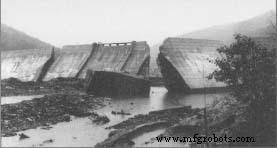 Remnants of the Austin, Pennsylvania dam after its 1911 failure.
The 1911 Austin, Pennsylvania disaster illustrates the consequences of design and construction lapses. A concrete dam owned by Bayless Pulp and Paper Mill, completed in December 1909, suffered contraction cracks in 1910. Despite repairs, the structure failed during a flood, releasing a torrent that destroyed the town and claimed up to 149 lives. Investigations revealed inadequate aggregate, poor curing in freezing conditions, and a disregard for engineer recommendations.
Raw Materials
Concrete dams rely on high‑quality concrete and steel reinforcement. Additional components include steel gates, tunnel liners, rubber waterstops, plastic joint fillers, electrical controls, siphons, valves, generators, and specialized instruments. Even Teflon sheeting is employed to line outlet structures, preventing turbulence and cavitation.
Concrete is produced by mixing cement, water, and aggregate (sand or gravel). Cement’s exothermic reaction generates heat, raising internal temperature. When the concrete cools, shrinkage can create cracks. Mitigation strategies involve low‑heat cement, temperature‑controlled placement, circulation of water through embedded pipes, and shallow, incremental pours. The concrete mix is tailored to the dam type—an arch dam demands a different composition than a massive gravity dam.
Design
Design hinges on purpose and site conditions. Overflow dams regulate water levels with sluice gates, spillways, or outlet tunnels, enabling power generation, navigation, and irrigation. Non‑overflow dams focus on storage for drinking water, irrigation, or power, using spillways only for emergencies. The choice of arch, gravity, or buttress depends on canyon width, depth, and geological factors.
Before construction, extensive feasibility studies evaluate water retention, economic viability, environmental impacts, and optimal size. Iterative design cycles involve geologists, seismologists, environmental scientists, geotechnical engineers, civil and structural engineers, hydrologists, mechanical and electrical engineers, and specialists in corrosion and material science. This multidisciplinary approach ensures safety for downstream communities and the structure’s longevity.
The Construction Process
- Divert or stop the streambed water using a coffer dam or temporary channel. Construction may begin several seasons prior, with final closure occurring at the last moment.
- Prepare a pristine foundation: excavate, clean, and repair the rock footprint and abutments. Install rock bolts, anchors, and netting as needed, and embed monitoring instruments for seepage, joint movement, and seismic activity.
- Construct wooden or steel forms along each section. Place and tie rebar, then pour or pump concrete in lifts of 5–10 ft (1.5–3 m) across sections of ~50 ft (15 m). Observation galleries allow inspection of interior conditions.
- Begin controlled reservoir filling as the dam rises. Temporary emergency spillways may be installed if construction spans multiple seasons. The upstream cofferdam is typically removed once sufficient water is stored.
- Add operational components—erosion protection, instrumentation, roads, and safety barriers—as the dam reaches the required elevation. Major dams, like Hoover, feature a full roadway along the crest.
- Finalize construction and commission the dam. Operational protocols, maintenance schedules, safety inspections, and monitoring programs are instituted to ensure continued performance.
Quality Control
Rigorous quality control is mandatory. From heavy equipment operations to public safety, every phase is supervised by local, state, and federal agencies—including Dam Safety Divisions, the U.S. Corps of Engineers, and the Department of Reclamation.
Byproducts / Waste
Dam construction generates minimal waste due to the high cost of materials and logistical constraints. Excavated soil and rock are typically reused elsewhere on the site, and cut‑away volumes are carefully balanced to avoid excess.
The Future
Concrete dams play a pivotal role in flood control, water supply, and clean energy. Yet they pose ecological and social challenges—altered ecosystems, sedimentation, habitat loss, and displacement of communities. The Three Gorges Dam controversy exemplifies the tension between human needs and environmental stewardship. Future projects must balance development with conservation, ensuring sustainable and resilient water infrastructure.
Manufacturing process
- Fill Dams: Design, Construction, and Future Outlook
- Concrete Beam Bridge: Design, Construction, and Future Trends
- Concrete Blocks (CMUs): History, Materials, Design & Modern Innovations
- Concrete: Composition, Production, and Future Innovations
- Preventing and Managing Rebar Corrosion in Reinforced Concrete
- Understanding Bituminous Concrete: Composition, Uses, and Benefits
- Understanding Concrete Beams: Structure, Strength, and Reinforcement
- Understanding Composite Beams: Strength and Performance Explained
- Concrete Cladding: Durable, Cost-Effective Exterior & Interior Finishing
- Concrete 3D Printing: Revolutionizing Construction with Precision Robotics