



Cork: From Ancient Stoppers to Sustainable Innovation
Harvested from living cork oak trees in a gentle, tree‑friendly process, cork is a naturally renewable material that can be re‑harvested for up to 150 years of productive life.
Background
Cork is a cellular material formed by dead cells on the outer bark of the cork oak (Quercus suber or Quercus occidentalis). Its honeycomb‑like structure creates vast empty space—about 625 million cells per cubic inch (40 million per cubic centimetre)—giving cork a density only a quarter of water. This unique cellular architecture makes cork an excellent cushion, thermal and acoustic insulator, fire‑retardant surface, and non‑slip flooring.
When subjected to 14,000 lbs/in² (96,000 kPa), cork regains 90 % of its original size within 24 hours. It resists dust, moisture, rot, insects, and wear, and its natural elasticity has even made it useful for polishing diamonds.
Applications span flooring, shoe insoles, roofing panels, gaskets, safety helmets, bottle stoppers, dartboards, bulletin boards, and the core of golf balls and baseballs. While synthetic substitutes exist for specific uses, cork remains the most versatile and sustainable choice.
History
Archaeological finds reveal cork stoppers in Egyptian tombs dating back millennia. Ancient Greeks used cork for fishing net floats, sandals, and stoppers; Romans employed cork for life jackets and storage vessels. By the 17th century, cork’s popularity as a bottle stopper spurred the cultivation of cork oak groves, especially in the Iberian Peninsula.
In 1892, William Painter patented the “crown cap,” a metal bottle cap lined with natural cork, which became the industry standard for nearly eight decades. Modern cork usage continues to evolve, with synthetic liners and high‑speed inspection systems now commonplace.
Raw Materials
Cork is harvested from mature cork oak trees, typically 40–60 ft tall with a trunk circumference of 6–10 ft. Portugal accounts for 30 % of all cork trees, producing half the world’s harvest.
First harvests occur around 20 years of age, producing low‑quality cork suitable for agglomerated products. Subsequent harvests happen every nine years, yielding 35 lb (16 kg) from young trees and up to 500 lb (225 kg) from mature trees. Each tree supplies cork for roughly 150 years.
During bottle stopper production, corks are conditioned in chemical baths—commonly chlorinated lime followed by oxalic acid, or hypochlorite neutralized by sodium oxalate—to remove impurities and enhance durability. Agglomerated cork production adds binders such as asphalt, rubber, gypsum, glue, or plastic to achieve desired flexibility and wear resistance.
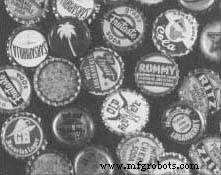 Bottle caps
Manufacturing Process
- 1. Using a specialized hatchet, harvesters slice the outer cork layer along the trunk base and just below the lowest branches, taking care not to damage the living bark. Vertical cuts divide the cork ring into panels, which are then stripped from the tree.
- 2. Planks are stacked outdoors to cure for weeks to months, allowing natural drying that reduces moisture by about 20 %.
- 3. Heated water baths in large copper vats remove tannins and soften cork, making it more pliable. Planks are submerged for 30–75 minutes under weight.
- 4. A hoe‑shaped knife removes the top 2 % of the plank—often 20 % of its weight—followed by additional drying in a dark cellar.
- 5. Planks are trimmed to uniform rectangles and sorted by quality. High‑grade material is reserved for natural cork products; lower‑grade material is ground for agglomerated cork.
Cork Cutting & Finishing
- 6. Slabs of desired thickness are steamed for 20 minutes, then cut into strips. Metal punches shape the strips into hollow cylinders for bottle stoppers.
- 7. Tapered stoppers are produced by rotating cylinders on a slanted conveyor past a rotating blade.
- 8. All stoppers undergo washing, bleaching, and sterilization in large vats, with wooden paddles circulating cleaning solutions.
- 9. After drying in a centrifugal dryer, stoppers may be stamped or sealed with paraffin or silicone, then packed in airtight bags. Sulfur dioxide is injected to maintain sterility.
Agglomerated Cork
- 10. Waste cork is shredded, washed, dried, and ground to a uniform particle size.
- 11. Particles are packed into molds and subjected to superheated steam (600 °F/315 °C) or baked at 500 °F (260 °C) for 4–6 hours, binding the material through natural resin activation.
- 12. For composition cork, granules receive a thin adhesive coating before being pressed into molds and slowly heated to set the binder.
- 13. Final products are cut into sheets, discs, or rolls as required by their end use.
Byproducts & Waste Management
Grinding waste cork produces fine powder that is incinerated to fuel the factory. Chemical byproducts—tannin, hard wax, resinous gum, and phonic acid—are recovered and repurposed in leather curing, paint manufacturing, metal adhesion, and plastic production.
Manufacturing process
- What is VMC Machining? An Expert Overview of Vertical Machining Centers
- Expert Guide to Aluminum Laser Marking: Precision, Durability, and Industry Applications
- MIG vs. TIG Welding: Selecting the Right Arc Welding Technique for Your Project
- Mastering SaaS Monitoring: Gain Complete Visibility of Your Cloud Applications
- The Art and Evolution of the Corkscrew: From Ancient Tool to Modern Engineering
- Cork: From Ancient Stoppers to Sustainable Innovation
- Nano‑Tree ZnO Nanowires Boost Dye‑Sensitized Solar Cell Efficiency
- Avient Launches Natural‑Looking TPE Wine Corks with New Special‑Effect Masterbatch
- Exploring IoT & Blockchain: From Tuna Tracking to Sustainable Palm Oil
- Understanding Pulpwood: Types, Harvesting, and Uses in Paper and Beyond