



Cough Drops Explained: History, Ingredients, and Production Process
A cough drop is a medicated lozenge designed to calm or suppress the cough reflex. Produced in a candy‑like process—ingredients are blended, cooked, cooled, and packaged—it entered the market in the 18th century and now represents a key segment of the $2 billion cough‑and‑cold industry.
Background
A cough is a protective reflex that expels irritants—dust, food, liquids, mucus—from the airways. The process unfolds in three stages: a deep inhale fills the lungs; the vocal cords close to seal the trachea; then the expiratory muscles contract, forcing the vocal cords open and ejecting the trapped air and debris.
Cold‑related coughs are either productive, clearing mucus, or nonproductive, driven by mild irritation. Cough drops target the latter, providing relief by soothing or suppressing the reflex.
Non‑prescription cough drops contain two main active components: expectorants and antitussives. Expectorants facilitate mucus clearance by modulating sensory nerves, though their clinical efficacy varies. Antitussives, meanwhile, act on the lungs, muscles, or central nervous system to dampen the cough reflex.
History
Ancient remedies for cough included syrups and herbal teas; an ancient Hebrew text even cites goat’s milk for this purpose. In the second century, Galen described an effective cough suppressant, predating modern formulations. The first hard candies appeared in the 4th century, but high sugar costs made them luxury items until the 18th century when widespread cultivation lowered prices.
While the active ingredients were known for centuries, the modern cough drop emerged in the 19th century. James Smith, a restaurateur, reportedly mixed the first batch in his kitchen after learning a formula from a journeyman. The Smith Brothers became the first mass‑produced brand in 1852, later adding a proprietary packaging design in 1872 to deter imitators. Menthol‑infused drops debuted in 1922, and manufacturers have since refined flavor and efficacy.
Raw Materials
Cough drops consist of a bulk candy matrix and a smaller portion of active ingredients. The matrix typically includes sucrose (sugar), corn syrup, acids, dyes, and flavors. Sucrose, sourced from sugarcane or beets, provides structure and sweetness. Corn syrup—composed of polysaccharides, dextrose, and maltose—controls crystallization and adds body.
Colorants are strictly regulated in the U.S.; common additives include Red 40, Yellow 5, Yellow 6, and Blue 1, as well as natural caramel. Flavoring agents—both artificial (e.g., methyl anthranilate) and natural (e.g., fruit extracts)—together with citric, lactic, tartaric, or malic acids create the desired taste.
Active ingredients vary but often include menthol or eucalyptus oil (volatile oils with expectorant or soothing properties), zinc (potentially reducing cold symptoms), vitamin C, and herbal extracts such as echinacea or ginkgo biloba. Peppermint oil, camphor, and sodium citrate may also be present.
Design
Cough drops, or lozenges, are hard candy pieces that release medicine slowly as they melt. Chemically, they are supersaturated solutions of water, sugar, and corn syrup. They may be opaque (grained) or clear (nongrained). Many varieties add ingredients to relieve congestion, freshen breath, or cater to children with reduced active content. Popular flavors include cherry, honey, and menthol.
The Manufacturing Process
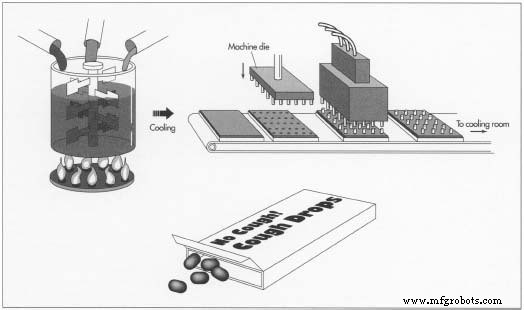
Much like the manufacture of candy, the basic steps in producing a cough drop are mixing, cooking, cooling‑working, forming, cooling, and packaging. Most manufacturers have an automated production line connected by a conveyor system.
Mixing
- Ingredients—sugar, corn syrup, water, and other components—are combined in a large stainless‑steel vat by compounding personnel.
Cooking
- Moisture is driven down to as low as 0.5 %. Batch cooking uses a direct‑fire cooker; semi‑continuous and continuous methods apply vacuum or scraped‑surface heat exchangers for speed and consistency.
Cooling and Working
- After cooking, the mass is transferred to cooling slabs with a circulating water system. Cooling makes the mixture plasticized and dough‑like.
- Additional ingredients are added, then the mass is pulled, twisted, and sized into cylindrical shapes before feeding into forming machines.
Forming
- The cylindrical mass passes through a die that cuts it into individual tablets of the desired shape.
Cooling and Packaging
- Formed drops are rapidly cooled on a conveyor with high‑velocity air jets to lock in shape.
- They are then individually wrapped in wax paper or placed in bulk wax‑coated boxes, often with a protective coating to prevent sticking.
Quality Control
Quality begins with ingredient inspection in a dedicated lab, evaluating appearance, color, odor, and chemical composition to meet specifications. Packaging is also tested for compliance.
Post‑production checks monitor appearance, flavor, texture, and odor. Sensory panels compare random samples against established standards, while instrumental measurements verify consistency.
The Future
While core recipes have remained stable, future advances will likely focus on faster, more efficient processing equipment and the integration of novel ingredients that offer additional health benefits. Vitamin C‑infused drops and other functional additives are already gaining traction, aiming to soothe coughs while mitigating broader cold symptoms.
Manufacturing process
- 2021–2022 Resin Market Outlook: Mixed Pricing Trends for Volume Resins
- Wittmann Group Unifies Brand, Phasing Out Battenfeld Name
- Detect Coughs with TinyML on Arduino Nano for Early Flu Detection
- Mastering Drop Hole Allowance for Dovetail Cutting
- Master Voltage Drop: Advanced Calculator, Practical Examples & NEC Guidelines
- Minimize Pressure Loss in Your Compressed Air System
- Cut Energy Bills: Expert Guide to Optimizing Piping for Compressed Air Efficiency
- Understanding Pressure Drop in Compressed Air Systems
- Beginner CNC Programming: Interactive Drag‑and‑Drop Game
- Calculating Pressure Drop in Hydraulic Fittings: A Practical Guide