



Concrete Blocks (CMUs): History, Materials, Design & Modern Innovations
Background
A concrete block, also known as a concrete masonry unit (CMU), is a core building material used to construct walls. These precast blocks are formed and hardened in a factory before being transported to a job site. Most blocks feature one or more hollow cavities, and their exteriors can be smooth or patterned to enhance visual appeal. In construction, blocks are stacked individually and bonded with fresh concrete mortar to create walls of any desired length or height.
Concrete mortar has been employed by engineers since Roman times, with evidence of its use in 200 B.C. Small precast concrete blocks appeared in the 37‑41 A.D. period under Emperor Caligula’s reign near modern Naples, Italy. After the fall of the Roman Empire, this technology waned until 1824, when English stonemason Joseph Aspdin invented Portland cement, a foundational component of contemporary concrete.
The first hollow concrete block was designed in 1890 by Harmon S. Palmer in the United States. A decade of experimentation led to a 1900 patent. Palmer’s blocks measured 8 in (20.3 cm) by 10 in (25.4 cm) by 30 in (76.2 cm) and were so heavy that they required a small crane for placement. By 1905, roughly 1,500 U.S. companies were manufacturing concrete blocks.
Early production was manual, yielding about ten blocks per worker per hour. Modern automated processes can produce up to 2,000 blocks per hour, dramatically improving efficiency.
Raw Materials
The standard concrete mix for blocks consists of Portland cement, water, sand, and gravel. This blend produces a light gray block with a fine texture and high compressive strength. Typical block weight ranges from 38‑43 lb (17.2‑19.5 kg). The mix for blocks contains a higher sand content and lower gravel and water percentages than general construction concrete, resulting in a dry, stiff mixture that retains shape after molding.
Replacing sand and gravel with granulated coal or volcanic cinders yields a cinder block—a dark gray, medium‑to‑coarse texture block with excellent sound‑deadening and higher thermal insulation. Cinder blocks weigh 26‑33 lb (11.8‑15.0 kg).
Lightweight blocks are produced by substituting expanded clay, shale, or slate for sand and gravel. These materials are heated to about 2,000°F (1,093°C), causing them to puff up and trap gases. Lightweight blocks weigh 22‑28 lb (10.0‑12.7 kg) and are typically used for non‑load‑bearing walls and partitions. Expanded blast furnace slag, pumice, and scoria are also common lightweight materials.
Admixtures—chemicals added to the mix—can adjust curing time, increase strength, or improve workability. Pigments may be incorporated for uniform color, and a baked‑on glaze (made with a thermosetting binder, silica sand, and pigments) can provide decorative finishes or chemical protection.
Design
Standardization of block sizes ensures uniform construction. The most common U.S. size is the 8‑by‑8‑by‑16 block, nominally 8 in (20.3 cm) high, 8 in (20.3 cm) deep, and 16 in (40.6 cm) wide. The actual block measures 7.63 in (19.4 cm) by 7.63 in (19.4 cm) by 15.63 in (38.8 cm), leaving room for mortar bead.
Manufacturers now offer variations for specialized applications. For example, a water‑repellent block incorporates a low‑absorption admixture, a beveled top edge to shed rain, and internal grooves that divert any leakage away from interior surfaces.
A split‑faced block features a rough, stone‑like texture on one face, giving the appearance of dressed stone while retaining the structural benefits of a standard block.
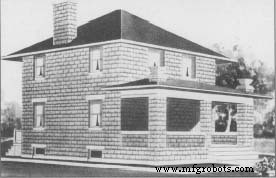 A Foursquare‑style house from the Radford Architectural Company’s 1908 catalog "Cement Houses and How to Build Them." The design could be built for approximately $2,250—significantly cheaper than traditional stone masonry. (From the collections of Henry Ford Museum & Greenfield Village.)
Concrete blocks first appeared in U.S. residential construction in 1837 on Staten Island, New York. They offered a cost‑effective alternative to stone or wood, especially in the Midwest where sand and gravel were plentiful. By the early 20th century, block‑constructed houses—ranging from Tudor to Bungalow—became popular. Many were finished with stucco or other cladding to emulate stone. The blocks were marketed as fireproof, vermin‑proof, and weather‑proof, and they continue to be used for garages, silos, and post offices.
Cynthia Read‑Miller
When designing a new block, manufacturers must balance aesthetic goals with production feasibility. Complex molds or additional steps can increase costs and reduce throughput, potentially outweighing the benefits of a novel shape.
The Manufacturing Process
Concrete block production follows four primary stages: mixing, molding, curing, and cubing. Some plants specialize exclusively in blocks, while others produce a range of precast products. Modern facilities can output 2,000+ blocks per hour.
Below is a typical workflow:
Mixing
- Sand and gravel are stored in piles and conveyed to storage bins as needed. Portland cement is kept in moisture‑protected silos.
- For each production run, precise amounts of sand, gravel, and cement are transferred to a weigh batcher.
- Dry materials are blended in a stationary mixer—either a planetary (pan) or horizontal drum mixer—during several minutes.
- Water is added, possibly pre‑heated or chilled. Admixtures and pigments are incorporated, then the mix is blended for 6‑8 minutes.
Molding
- Mixed concrete is fed via an inclined bucket conveyor to an elevated hopper, initiating the next mix cycle.
- Concrete flows into the block machine’s hopper and is forced into molds. Each machine can form up to 15 blocks simultaneously.
- Blocks are compacted by the weight of the upper mold head, aided by hydraulic pressure or vibration.
- Finished blocks are ejected onto a steel pallet and moved to a chain conveyor. In some setups, a rotating brush removes loose material from block tops.
Curing
- Stacks of blocks are transferred to a curing rack. Once full, the rack rolls onto rails and enters a curing kiln.
- Two main kiln types are used:
- Low‑pressure steam kilns: blocks stay for 1‑3 hours at room temperature, then steam gradually raises the temperature to 150‑165°F (66‑74°C) for standard blocks or 170‑185°F (77‑85°C) for lightweight blocks. Steam is shut off, and blocks soak for 12‑18 hours before drying in hot, moist air. Total cycle ≈24 hours.
- High‑pressure steam kilns (autoclaves): temperature reaches 300‑375°F (149‑191°C) with 80‑185 psi pressure. Blocks soak for 5‑10 hours, then pressure is vented, expediting moisture release. This method yields faster production at higher energy cost.
Cubing
- After curing, racks are unloaded, pallets are recirculated, and blocks are fed onto a chain conveyor.
- Split‑face blocks are first molded as joined halves; a splitter then fractures them to create the rough texture.
- Blocks are aligned by a cuber and stacked into cubes (3×6×3 or 3×6×4). Cubes are moved to storage by forklift.
Quality Control
Consistent monitoring ensures each block meets required standards. Raw materials are electronically weighed; sand and gravel moisture is measured via ultrasonic sensors, with water addition automatically adjusted. In extreme climates, water is pre‑conditioned with heaters or chillers.
Block dimensions are verified with laser sensors as they exit the mold. During curing, temperature, pressure, and cycle time are recorded and controlled to guarantee optimal strength.
The Future
Concrete blocks continue to evolve as architects and manufacturers explore new shapes and functions. Innovations aim to accelerate construction, reduce costs, and enhance durability and energy efficiency. Potential future designs include:
- Biaxial blocks—cavities running horizontally and vertically to facilitate plumbing and electrical conduits.
- Stacked siding blocks—three‑section units forming both interior and exterior walls.
- Heat‑soak blocks—integrated thermal storage to regulate indoor temperature across seasons.
Manufacturing process
- Concrete Dams: Design, Construction, and Impact
- Concrete Beam Bridge: Design, Construction, and Future Trends
- Concrete: Composition, Production, and Future Innovations
- F1 Teams Leverage Advanced Tooling Block Technology for Unmatched Performance
- Understanding Verilog Always Blocks: Syntax & Sensitivity Lists
- Verilog Initial Blocks: Purpose, Syntax, and Non‑Synthesizable Use
- Mastering Verilog Generate Blocks: Dynamic Module Instantiation & Conditional Design
- Understanding Bituminous Concrete: Composition, Uses, and Benefits
- Understanding Concrete Beams: Structure, Strength, and Reinforcement
- Concrete 3D Printing: Revolutionizing Construction with Precision Robotics