



Cultured Pearls: From Ancient Origins to Modern Mastery
Background
Pearls, revered for their rarity and luster, are not mined like conventional gems. They form inside oysters and other bivalve mollusks when an irritant is trapped in the soft tissue. To protect itself, the mollusk secretes a nacreous coating that layers over the irritant, creating a pearl.
Throughout history, pearls have symbolized wealth and elegance. In Japan, the ama divers—women renowned for their extraordinary lung capacity—are celebrated in folklore for retrieving pearl‑bearing oysters. French composer Georges Bizet immortalized pearl hunting in his opera The Pearl Fishers, depicting two lovers who dive in search of these treasures.
Modern techniques harness natural pearl‑forming processes to increase yield, a practice known as pearl culturing. This method extends nature’s ability, producing more pearls than would otherwise occur naturally.
History
From Cleopatra’s alleged experiment of dissolving a pearl in vinegar to the burial of Roman women with pearl adornments, the allure of pearls has persisted for millennia. The largest known pearl, weighing 454 carats, is roughly the size of a chicken egg. The famed "La Peregrina"—a 28‑carat gem that once graced Mary Tudor’s crown—was later owned by actor Richard Burton, who gifted it to Elizabeth Taylor.
In 1886, the "Great Southern Cross"—a perfect cross-shaped pearl over 1 cm long—was discovered in an Australian oyster. Such extraordinary finds underscore the natural wonder of pearls.
Although pearls are rare, pearl fishing has long been practiced in oyster‑rich waters worldwide. Only one in 30–40 shell‑fish typically produces a pearl, yet the surrounding mother‑of‑pearl lining remains valuable. Key pearl beds include Sri Lanka’s Gulf of Manar, coastal India, the Persian Gulf near Bahrain, the Red Sea, the Indian Ocean islands, Japan, Hawaii, and Western Australia.
French naturalist René Robert Bérenger first noted that the outer layers of a pearl mirror the interior layers of a mollusk’s shell. However, Japanese pioneers Tokichi Nishikawa and Tatsuhei Mise independently discovered the implantation technique in the late 19th century. Kokichi Mikimoto, a visionary from Toba, Japan, refined the method and introduced “shinju”—perfect saltwater pearls—in 1893. By 1905, he achieved commercial success, and a 1908 patent secured his process. Mikimoto’s farm, once housing 12 million oysters, produced three‑quarters of the world’s pearls. Today, his legacy endures on Mikimoto Pearl Island and the adjacent museum in Ago Bay.
Raw Materials
Cultured pearls are created using an oyster or mussel, a shell nucleus, a small mantle tissue sample from another oyster, and clean water. Different species yield varied pearl qualities: the akoya oyster from Japanese saltwater and the biwa mussel from Lake Biwa are renowned for their exceptional pearls. Freshwater pearls are often considered more “natural” because they rely solely on mantle tissue without a nucleus. All components are natural, but careful human intervention is essential to maintain optimal conditions over several years.
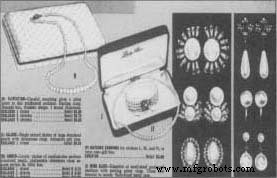 A costume pearl jewelry advertisement from Major’s Appliance Store Catalog, Inkster, Michigan, circa 1958‑59 (Henry Ford Museum & Greenfield Village).
For over 1,300 years, artisans have sought natural pearls for clothing and jewelry. Ancient gold rings set with natural pearls date back to 650 A.D., and Scottish freshwater pearls were prized for their unique shapes. Baroque pearls—large, irregular forms—were often enameled and set in gold, creating miniature sculptures.
To meet demand, the French pioneered imitation pearls in 1300 A.D., dipping hollow glass beads in acid to create iridescence and later coating them with "essence d’orient"—a silvery substance derived from fish scale linings.
When Kokichi Mikimoto introduced cultured pearls in the 1920s, a “pearl craze” ensued. By the 1950s, celebrities like Audrey Hepburn wore pearl earrings as a fashion staple.
Nancy EV Bryk
The Manufacturing Process
Implanting
- 1. The irritant—usually a shell bead from mussels such as the American pigtoe or washboard mussel—is surgically implanted into a young oyster. A single mussel shell can yield up to twenty beads, known as kaku in Japanese. These beads form the core of the pearl, while the nacreous coating remains relatively thin. In the United States, Tennessee’s rivers provide the mussels for bead production.
- 2. Baby oysters, or spat, are raised in hatcheries until about 60 days old. They then mature in ocean tanks—an approach called mariculture—for roughly three years before they are strong enough for implantation. In controlled farm settings, oysters are carefully opened, the bead and a small mantle graft are inserted, and the shells are resealed. The oysters are then returned to the water on plastic garlands or rafts.
Formation
- 3. While in the ocean, the pearl’s outer shell grows slowly, influenced by water temperature and chemistry. A porous conchiolin layer forms around the nucleus, beneath the nacre. Nacre consists of microscopic aragonite plates, giving cultured pearls a characteristic roughness when rubbed against the teeth—a test that distinguishes genuine pearls from imitations.
Harvesting
- 4. Oysters are harvested in winter, when colder water slows nacre deposition and enhances color, luster, and the pearl’s orient (light‑reflection quality). Culturing periods range from one to three years, and growth is monitored with X‑ray imaging. Once a pearl reaches the desired diameter, it is carefully extracted. Healthy oysters can be reseeded to grow larger pearls as they continue to age. The pearls then undergo processing, sale, or direct shipment to dealers and jewelers. Premium specimens often move through government‑regulated auctions before reaching the market.
Design
Despite the natural process, a wide spectrum of colors and shapes exists. In China, the twelfth‑century tradition of embedding tiny Buddha figurines in freshwater mussels led to pearlized Buddhas—still popular today. The same technique creates half‑pearls known as mabes, which are later mounted in jewelry settings.
Japanese pearls naturally range from pink to blue to greenish‑yellow. They are often bleached to lighten hue and remove surface stains. Color enhancement involves injecting dye into the porous conchiolin and drilling the pearl for even distribution. The most coveted designer pearls include large black pearls from Australia and the South Seas; a flawless black pearl can fetch up to $40,000 in the U.S. market. Other natural hues include silver‑to‑green “peacock” pearls and pristine white pearls.
Shape design also involves molding or cutting fresh‑water pearls. The resulting irregular forms are influenced by the mantle graft, reflecting the skill of the implanter.
Quality Control
Raising hatchery oysters in tanks can reduce their resilience, and pollution threatens both oyster health and pearl quality. Farmers meticulously clean and monitor their stock to prevent disease, and they often undergo governmental licensing to ensure responsible practices. Natural disasters like hurricanes may harm divers more than oysters.
Some industry secrets remain guarded; claims of dyeing or enhancement are disputed, and genetic engineering occasionally adjusts color traits. Shorter culturing times—sometimes under a year—yield thinner nacre layers, making pearls more susceptible to damage from perfumes and body fluids. Exporters and inspection agencies may discard substandard pearls, so buyers should exercise caution.
Byproducts and Waste
Mother‑of‑pearl shells, once pearls are removed, serve multiple purposes: decorative dishes, ornamental panels for jewelry, buttons, and furniture. When oysters fail to produce pearls, their meat is harvested, dried, and sold as a delicacy.
Flawed pearls unsuitable for jewelry are ground into calcium carbonate powder, which is used in medicine, cosmetics, and toothpaste—especially in Japan and China.
The Future
Cultured pearls remain a timeless luxury, but environmental concerns loom. Pearl‑bearing species thrive only in pristine marine or freshwater habitats, and pollution has reduced both the size and translucency of pearls. Sustainable aquaculture practices and stringent water quality monitoring will be essential to preserve the craft and ensure the continued allure of cultured pearls.
Manufacturing process
- What is VMC Machining? An Expert Overview of Vertical Machining Centers
- Expert Guide to Aluminum Laser Marking: Precision, Durability, and Industry Applications
- MIG vs. TIG Welding: Selecting the Right Arc Welding Technique for Your Project
- Comprehensive Guide to Laser Marking: Types, Benefits, and Applications
- Key Considerations for High‑Volume Swiss Machining
- CNC Prototyping Guide: Precision, Speed, and Cost‑Effective Production
- Expert Shaft Manufacturing: Precision Processes & Custom Solutions
- Fiber Laser Marking: Precision, Speed, and Versatility for Modern Industries
- Rhenium in Aerospace: The Strategic Metal Driving Jet Engine Performance
- Cultured Pearls: From Ancient Origins to Modern Mastery