



Dr. Richard Buswell Discusses Loughborough’s Breakthrough in Concrete 3D Printing
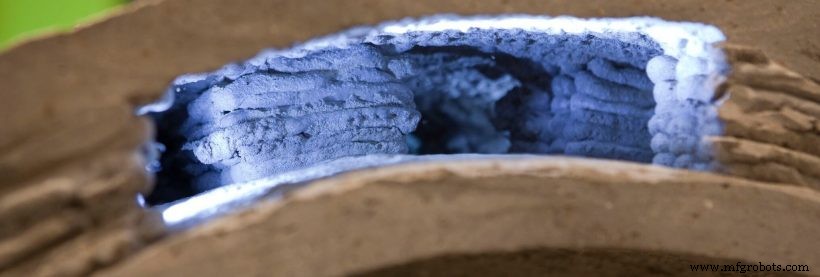
The University of Loughborough has been at the forefront of integrating additive manufacturing into construction for over a decade, leading the way with its pioneering 3D‑printed concrete process. Its School of Civil and Building Engineering collaborates closely with industry giants such as Skanska and the Manufacturing Technology Centre to validate the technology across a range of construction applications.
RP Platform had the privilege of speaking with Dr. Richard Buswell, whose research is redefining how concrete can be produced on site.
How did you originally become interested in 3D printing?
My PhD focused on building energy performance, but conversations between civil and mechanical engineering departments about additive manufacturing sparked my curiosity, leading me to join the emerging field.
Tell me a bit more about the research you’re doing into 3D printing at Loughborough at the moment…
We began scoping studies in 2004, but it was the 2006 EPSRC grant that gave us the resources to ask the core question: can additive manufacturing be applied to construction?
In 2011 we introduced our first concrete extrusion system, and since then we have worked with industry partners such as Hyundai and Skanska to move the technology from lab to site.
Proving viability in the laboratory is only the first step; commercial adoption requires real‑world testing.
How did you arrive at 3D printing concrete, as opposed to other materials?
Construction demands materials that are locally available, cost‑effective, and well understood. Concrete fits those criteria perfectly, and its rheology is already familiar to the industry through decades of spray‑concrete applications.
We leveraged existing knowledge on spray concrete to develop an extrudable mix that can be printed layer by layer, giving us the flexibility to produce complex shapes while maintaining structural integrity.
What has the uptake been like since then?
Interest has surged: 30–40 projects worldwide are exploring concrete 3D printing, ranging from on‑site wall extrusion to pre‑fabricated components that are assembled into buildings.
While a clear market hasn’t crystallised yet, the momentum is evident. Early adopters are proving the concept’s commercial viability, and once a dedicated business model emerges, broader adoption will follow.
At this point, what sort of applications are you envisaging for it?
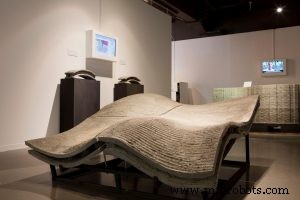
Our current portfolio includes a bespoke art installation and a range of architectural prototypes. The technology excels at producing curved panels and intricate geometries that would otherwise require costly moulds.
Beyond aesthetics, 3D printing aligns with the construction sector’s push toward automation, addressing labor shortages and safety concerns by reducing on‑site manual work.
What sort of wider trends towards automation are you seeing in the world of construction at the moment?
The industry is undergoing a transformation similar to the automotive shift toward automated assembly lines. By relocating tasks to controlled factory settings, we can reduce health and safety risks while boosting productivity.
Adopting automation requires careful planning across the entire construction process, but the long‑term payoff—greater safety, reduced labor costs, and higher quality—makes it a compelling proposition.
What’s coming up for 3D printing in the very near future that’s got you most excited?
International milestones—such as Winsun’s 3‑D printed houses—have captured global attention, and our RILEM committee work is advancing the fundamental science of concrete rheology for printing.
These developments signal a rapid acceleration toward commercial readiness, potentially bringing 3D‑printed components into mainstream construction within the next decade.
Loughborough 3D Concrete Printing
3D printing
- Concrete Dams: Design, Construction, and Impact
- Concrete Blocks (CMUs): History, Materials, Design & Modern Innovations
- Concrete: Composition, Production, and Future Innovations
- Interview with Dr. Billy Wu, Imperial College London: 3D Printing Innovation in Research & Education
- Interview with Professor Ian Campbell: Pioneering Design for Additive Manufacturing at Loughborough University
- Mar‑Bal’s University Outreach: Nurturing Talent & Driving Innovation Through Internship Partnerships
- Markforged Launches Additive Manufacturing University to Accelerate 3D Printing Expertise
- Markforged University Online: Your Path to Certified Additive Manufacturing Expertise
- How IoT Drives Competitive Edge: Interview with Dyer Engineering’s Digital Innovation Lead
- Concrete 3D Printing: Revolutionizing Construction with Precision Robotics