



Interview with Dr. Billy Wu, Imperial College London: 3D Printing Innovation in Research & Education

In this interview, Dr. Billy Wu of Imperial College London explores how 3D printing is transforming research, teaching, and entrepreneurship, and reveals his team's breakthrough metal printing technology.
Was there a specific moment where you decided 3D printing was something you wanted to pursue?

I currently teach at the Dyson School of Design Engineering at Imperial, where I’ve spent the last 12 years—from my undergraduate days to my present role. My background began in mechanical engineering, where I honed skills in machining, lathes, and precision engineering, emphasizing accurate drawings and tight tolerances.
During my PhD, the experimental nature of my work required rapid prototyping of numerous custom components. Although metal fabrication was possible, 3D printing offered a faster, more flexible solution, especially as printer costs fell. This experience cemented my appreciation for the speed and adaptability of additive manufacturing, a principle now central to Imperial’s design curriculum.
The 'fail fast' philosophy underscores the value of rapid iteration: without the time‑consuming lead‑time of traditional machining, a design can be evaluated, revised, and re‑printed within days, making it ideal for both research and pedagogy.
Our facilities now encompass a diverse portfolio of printers: FDM, polymer jetting, and composite systems capable of carbon‑fiber reinforcement, alongside a dedicated metal additive manufacturing lab that produces high‑performance parts for orthopaedic implants, aerospace applications, and more.
How did you move from using 3D printing solely for your own research to using it with students across the whole university?
I play a key role in managing the Imperial College Advanced Hackspace, a campus‑wide resource that removes access barriers. By offering free, on‑demand 3D printing to any Imperial student, we’ve democratized rapid prototyping and fueled a surge in student‑led projects.
Our joint MSc in Innovation Design Engineering with the Royal College of Art attracts roughly 60 % of graduates who go on to launch their own startups. These students prototype ideas, pitch at events like the Venture Capitalist Challenge, and even crowdfund through Kickstarter.
The college has recognised the value of rapid manufacturing, prompting further investment in these capabilities.
What’s the learning curve like when students try this for the first time, especially when it comes to making their files printable?
Students come with varying levels of CAD experience, but many still approach 3D printing as a direct replacement for conventional machining. This mindset limits the technology’s potential. To unlock true innovation, designers must adopt ‘design for additive manufacturing’ principles, such as optimisation algorithms that automatically generate lightweight, load‑bearing structures.
While 3D printing accelerates the build stage, pre‑processing—including model repair, support generation, and slicing—can be time‑consuming. Automating these steps through computer‑assisted design reduces cost and unlocks further efficiencies.
Since 3D printing launched at Imperial, what have been some of the real success stories you’ve seen?
One standout project involved a student, Markus Kayser, who designed a ‘solar sinterer’ for use in remote environments. By focusing sunlight onto sand, the device melts the material, allowing the creation of glass‑like structures—everything from bowls to architectural elements—using only locally sourced resources.
These innovations illustrate the circular economy principle: by producing parts on‑site, we reduce shipping costs and waste, a concept central to future mining and construction projects.
My research group is pioneering new additive manufacturing processes. We recently published a paper on a desktop‑scale metal printer that mimics FDM. The method uses electroplating—applying voltage in a metal bath—to deposit metal layer by layer, while reversing the potential allows selective corrosion, enabling both additive and subtractive shaping.
For instance, in a space‑flight scenario, this reversible process could 3D print a spanner and then recover the metal for reuse, creating a true closed‑loop manufacturing cycle.
The technique also supports multiple metals, opening doors to printing electronic circuits and smart sensors. We foresee future parts embedding strain sensors or automated valves, essentially turning components into intelligent devices.
As design tools mature, we anticipate a shift from static 3D objects to dynamic 4D structures that adapt over time.
With all this new technology in development, how do you see things evolving across the industry over the next few years?
It’s important to recognise that 3D printing encompasses a broad spectrum of technologies. Gartner’s Hype Cycle indicates we’re still near the peak of inflated expectations, just before the trough of disillusionment. FDM, SLS, and DMLS are approaching the plateau of productivity, while niche fields like bioprinting remain highly hyped but are gradually finding specialised roles.
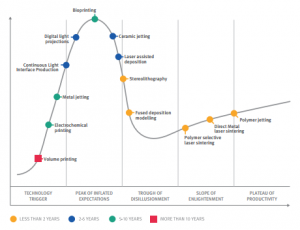
By focusing on applications where additive manufacturing offers distinct advantages—such as rapid tooling, complex geometries, and material optimisation—industry will continue to mature and deliver tangible value.
For more information on Imperial’s design engineering initiatives, visit Imperial College Design Engineering.
3D printing
- AWS Practitioner Interview: Expert Q&A for Aspiring Cloud Professionals
- Azure Developer Interview: Expert Q&A & Career Tips
- Azure Administrator Interview Questions & Answers – Expert Guide
- Dr. Richard Buswell Discusses Loughborough’s Breakthrough in Concrete 3D Printing
- Dr. Alvaro Goyanes of FabRx on 3D‑Printed Medicines: From Innovation to Personalised Care
- Dr. Bastian Rapp on 3D‑Printed Microfluidics: Advancing Biotech with NeptunLab
- Felix Ewald, CEO of DyeMansion, Discusses Innovations in Powder-Based 3D Printing Post-Processing
- Imperial College Unveils Desktop Metal Printer Blending Electroplating and Additive Manufacturing
- London, Ontario: A Thriving Hub for Manufacturing Excellence
- Why 3D Printing Skills Are Essential for Design & Manufacturing Students