



Concurrent vs. Sequential Engineering: Choosing the Right Approach for New Product Development
Concurrent and Sequential Engineering
Concurrent and sequential engineering are two main product design workflow approaches companies to follow on the interaction between functional teams to share information during the 8 stages of new product development.
Any product development is time-consuming, and the technology involved to create modern-day products are very complex. Companies can no longer rely on a few engineers to design, develop, and then launch them. The industrial revolution and subsequent continuous technological advancements in many areas have forced people to specialise in a field, which has made companies hire specialised employees. Modern-day new product development is a multi-disciplinary process and relies on functional teams such as, industrial designers, product designers (mechanical, electrical and software engineers), manufacturing, marketing personnel, etc., to get the product to market. Challenges facing NPD are ample. Hence, NPD fails more often than it succeeds.
How well different functional teams interact with each other when (at what stages of the development) they communicate and how well they share information would make a huge difference in their quest for a successful product. This is because these factors, in turn, affect the development time, product cost and quality of the product.
What is Sequential Engineering (SE)?
Traditional sequential engineering is the term used to describe linear product development processes, where design and development steps are carried out one after another focusing on one field of expertise at a time. During the industrial revolution, this forced companies to hire specialised people and departments due to products getting more complex. This, in turn, paved the way to an “over the wall” mentality where each team member or department only focused on their tasks and passed the completed work onto the next (Figure 1).
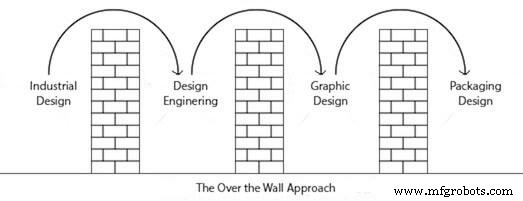
This traditional so-called “chimney” based new product development process describes a large vertical structure that only interacts downstream, with the following advantages and disadvantages.
Advantages and Disadvantages of sequential engineering
Advantages sequential engineering
- Easy to track progress and understand the requirements of the project and processes
- It is well defined for each team member or department
- Simple to understand and avoids misinterpretation
- It is an imposed disciplined approach that takes away any misunderstanding
Disadvantages of sequential engineering
- Increased product cycle time because of the rework during the latter stages of the NPD
- Change requests from others in the latter stages are often very expensive and difficult to manage
- Without staged feedback and specification evaluation gates, the product might creep out or fall short of the expectation
- Manufacturing and production costs might be too difficult and expensive making the final unit cost not economically viable
What is Concurrent Engineering (CE)?
Concurrent engineering is an approach developed in the 1980s to eliminate some of the issues with the ‘over the wall’ method. There are many advantages to concurrent engineering where different departments work on the different stages of engineering product development simultaneously while designing and developing new engineering products. More on Concurrent engineering new product development here including some key advantages.
Concurrent engineering vs sequential engineering
Let us look at a typical new product development journey a company takes and explore the differences between concurrent engineering and sequential engineering.
Sequential new product development
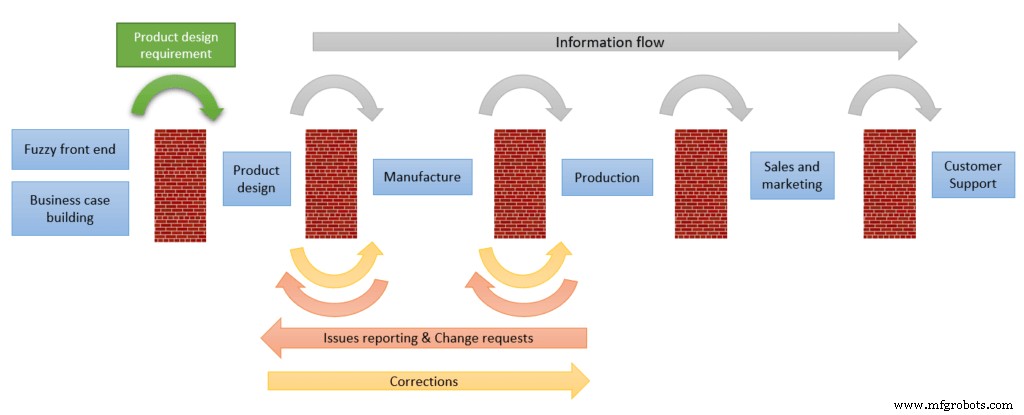
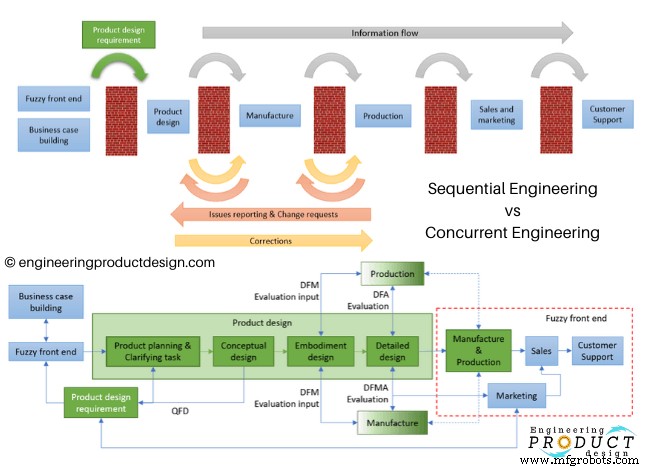
Figure 2 shows a typical product development team and its functionality in a traditional linear workflow.
- After identifying a product development opportunity and analysing the business case during the fuzzy front end of an NPD, the management passes on a Product Design Specification (PDS) to the design and development department.
- If the product design team did not have any input during the PDS, then they will start the product development journey with blank paper. Any idea generation, evaluation and customer evaluation data does not get passed on.
- Product design is completed as per the PDS until the detailed designs are in place. Detailed drawings are then released to the manufacturing engineer. This is the stage where lots of issues get flagged up by the manufacturing department who will request changes and flag up problems with the suppliers. Any issues raised by suppliers during the procurement phase will be fed back to the design department.
- After the request and change phase, parts will be ready to be delivered to the production department for assembly and test, where more issues are flagged up on the assembly
Concurrent new product development
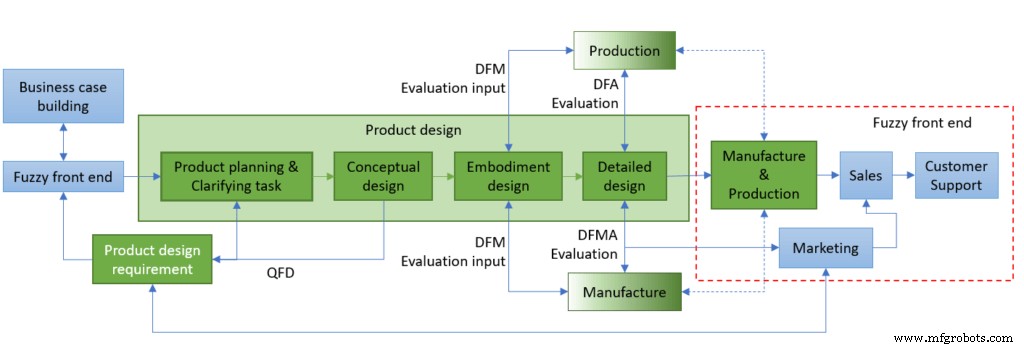
Same product development can be rejigged with very little extra resources to have a concurrent engineering workflow. As shown in figure 3 below, departments consult each other or relevant personnel before finalising their task. Let us delve into the process to explore the advantages.
- The company jointly defines a product design specification (PDS).
- Manufacturing and production are consulted to evaluate the manufacturability of the design. Tools such as DFM, QFD and DFMA can be used for evaluation.
- Tools such as design for assembly (DFA) is used to evaluate the design jointly with the production
- Detailed design information is shared with production enabling them to get the tools and production jigs ready.
- Finally, the design team shares information such as final specifications with sales and marketing teams enabling them to prepare datasheets, brochures, package design, promotional events, etc.
Costing comparison of CE vs SE
In sequential engineering product development, costs increase slowly as the activities are sequentially executed by the departments as they get involved in the process. But, at the design- manufacturing phase costs increase rapidly due to change requests & iteration loops where there is a back and forth change management process.
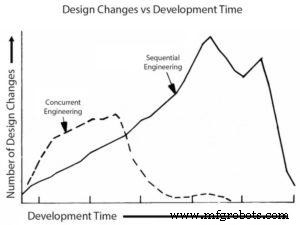
In concurrent engineering product development, costs increase rapidly at the beginning of the development due to a larger team getting involved and intensive activities. However, as the product development progresses into manufacturing and production it gets quicker and costs decrease due to fewer issues to sort and shorter iterative loops.
Here, product design or development costs range between 5-15% of the overall product cost. But, the decision taken during the design stage affects 60-95% of the cost. This shows how crucial it is to make the right decisions during the early design stages to save the overall cost of a product.
There is plenty of real-life practical data available on savings, such as,
- How Ford motor company substantially reduced their time to market while increasing the quality of some of their cars.
- DFM, QFD, cross-functional teams supported by the top management were key to the success of HPs 34401A multimeter
Summary
There are a lot of benefits in introducing Concurrent practice into product development. It does not have to be fully comprehensive. Some of the criticism is that it needs more resources at the beginning. But done correctly it can be minimised. Not all the departments will have to get involved from the start or at all the key stage meetings.
For companies who develop products regularly, it is worth putting some product development processes in place with defined stages.
Manufacturing process
- Overcoming Hurdles in New Product Development: A Proven Blueprint
- Choosing the Best Industrial Product Design & Development Company
- Medical Product Design: Expert Tips & Proven Practices
- Minterms & Maxterms in Karnaugh Maps: Clear Notation & Practical Examples
- New Product Development (NPD): Turning Ideas into Market Success
- Overcoming New Product Development Challenges: Strategies for Success
- Avoid These 6 Critical Pitfalls in New Product Development
- Master Remote Collaboration: Proven Tips for New Product Development Success
- Choosing the Right Solar Panel for Your Product and Future Growth
- Staubli Robotics Unveils Advanced Software Suite for Development and Maintenance