



The Evolution and Design of Modern Cameras
Background
Photography is the United States’ most cherished pastime, and today cameras range from pocket‑sized point‑and‑shoots to high‑performance professional systems, each tailored to a specific workflow and budget. The vision that every consumer could own a camera—championed by George Eastman—spurred innovations in film, optics, and electronics that birthed the snapshot era and paved the way for today's digital landscape.
Regardless of complexity, every camera shares five core components:
- Lens – glass or plastic elements that focus light onto the imaging medium.
- Diaphragm (Aperture) – an adjustable opening that controls exposure and depth of field.
- Shutter – regulates the duration the sensor or film receives light.
- Body – a light‑proof, durable housing that protects electronics, the film transport system, and the built‑in flash.
- Viewfinder – a dedicated lens or optical system that allows the photographer to frame shots.
History
The concept of a “camera” originates from the Latin *camera obscura*—a darkened room that projects inverted images through a small aperture. Early artists like Leonardo da Vinci used this principle to trace scenes. The first portable photographic devices emerged in the 1830s: wooden boxes with a front lens, a rear glass plate, and a manual shutter. Exposure times ranged from minutes to hours due to low sensitivity.
In 1889, George Eastman introduced roll film and the Kodak camera, which was hand‑held, inexpensive, and came pre‑loaded with a single roll. Users could simply press a button, and the factory would develop the negatives and return prints. This breakthrough democratized photography, allowing families to capture everyday moments.
Over the 20th century, advances included synchronized flash, interchangeable lenses, high‑speed shutters, and the iconic Leica, Zeiss, and Hasselblad systems. Pioneering photographers such as Alfred Stieglitz and Ansel Adams elevated photography to an art form, influencing both technology and aesthetic standards.
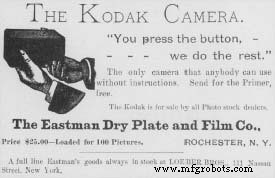 This Kodak Camera advertisement appeared in the first issue of The Photographic Herald and Amateur Sportsman, November 1889. The slogan “You press the button, we do the rest” summed up George Eastman’s revolutionary snapshot system. (From the collections of Henry Ford Museum & Greenfield Village.)
George Eastman’s Kodak ® camera was a landmark: lightweight, affordable, and built for roll film. It enabled ordinary Americans to document their lives, ushering in the snapshot era. By 1896, Kodak had sold 100,000 cameras.
Design Process
Camera design begins with market research and concept validation. Engineers use computer‑aided design (CAD) to model the body, optics, and electronic layout. Simulations verify mechanical tolerances, thermal performance, and optical alignment before any parts are fabricated.
Once a CAD model passes simulation, a prototype is built—often via additive manufacturing or CNC machining—to test real‑world performance. Rigorous field and laboratory tests confirm exposure accuracy, autofocus precision, and durability. Successful prototypes inform tooling, manufacturing processes, and final specifications.
Manufacturing Process
Chassis and Cover
- Body and back cover are molded from a polycarbonate composite containing 10–20% glass fiber, ensuring light‑weight, shock‑resistant construction. Precise tolerances are critical to accommodate internal mechanisms.
Shutter and Film Transport System
- Shutter assemblies and film magazines are assembled on a dedicated line. Advanced models read DX film codes via silver bands or embedded microchips, automatically adjusting shutter speed and flash timing.
- Shutters function as precise curtains, engineered to expose the sensor or film for the exact duration required.
Viewfinder Lens
- Viewfinders use optical glass or hybrid glass‑plastic elements. Most include illuminated reticles for framing. SLR viewfinders employ a prism to deliver a through‑lens view.
LCD Screen and Electronics
- Modern cameras feature LCD displays that present real‑time metadata—ISO, aperture, shutter speed, remaining shots, battery status—and support user interface functions. Embedded circuitry is fabricated as subassemblies linked to the camera’s mainboard.
Quality Control
Manufacturers enforce statistical process control across all departments, from machining to final assembly. Dedicated QA teams monitor performance metrics, identify deviations, and implement corrective actions to maintain consistency and precision.
Byproducts and Waste Management
Camera production generates minimal byproducts, but wastes such as resin shavings, cutting oils, solvents, and metal scraps are collected and sorted. These materials are recycled or treated in accordance with environmental regulations. Notably, Japan’s camera industry ceased using chlorofluorocarbons and trichloroethanes in 1993, reflecting a broader commitment to eco‑responsible manufacturing.
The Future
Digital cameras, introduced in the mid‑1990s, store images as electronic files—eliminating film and enabling instant review, deletion, and editing. With high‑resolution sensors, advanced autofocus, and connectivity (USB, Wi‑Fi, Bluetooth), cameras now function as portable media hubs, seamlessly linking to computers, smartphones, and cloud services. Emerging technologies such as computational photography, 5G streaming, and AI‑based scene recognition promise even greater creative freedom and integration with other digital ecosystems.
Manufacturing process
- Understanding Camera Lenses: Design, History, and Future Innovations
- BrickPi Bookreader: Automate Kindle Reading with Raspberry Pi and LEGO Mindstorms
- 9 Key Factors for Selecting and Designing Board‑Level Machine Vision Cameras
- DIY Face-Tracking Camera Powered by Arduino UNO
- Arduino Bluetooth Camera (ABC): Connect Your Phone via Bluetooth to Capture Images
- Automated Motion‑Tracking Camera Base with Arduino and Servo Control
- B&R Launches Fully Integrated Smart Cameras for Precise Automation
- NASA’s Langley Research Center Unveils Advanced Plenoptic Camera for 3D Color Imaging
- Understanding Camera Modules: Definition, Types, and Key Components
- MotoSight 3D CortexVision: Advanced 3D Vision for Precision Robotics