



The Evolution and Engineering of Modern Garbage Trucks
Background
Solid waste, commonly referred to as garbage, trash, or refuse, has challenged societies since ancient times. In 500 B.C., the Greek city of Athens pioneered the first municipal dump, mandating that refuse be discarded at least one mile (1.6 km) beyond its walls. By the 15th century, Paris faced so‑much garbage that it encroached on its fortifications.
Early disposal relied on simple piles, later evolving to two‑wheeled carts and horse‑drawn wagons that moved slow, often leaking barrels into open beds. The 1920s saw the first motor‑powered garbage vehicles, yet the familiar “Here comes the garbage truck” still triggered residents to close windows.
The post‑war consumer boom of the 1950s in the United States spurred a dramatic rise in disposable goods—paper plates, plastic cups, diapers—overwhelming municipal bins. Responding to this surge, manufacturers introduced enclosed refuse trucks with hydraulic rams that compressed trash on‑board, effectively doubling each load’s capacity.
Today, most U.S. municipalities outsource collection to large private firms that operate fleets of specialized, automated trucks designed to maximize efficiency and minimize cost.
Raw Materials
The core body of a garbage truck is predominantly steel. Sheets and plates of varying thicknesses form the floor, sides, top, and ends, reinforced with formed steel channels to balance strength and weight. Lift arms, forks, and torque tubes are cut from thick‑walled seamless steel tubing, while the packer blade—made of steel plate—slides on plastic, steel, or bronze shoes to compress waste during collection.
Additional components—vehicle cab, chassis, lighting, warning labels, electrical wiring, and hydraulic systems—are sourced from specialized suppliers and integrated during assembly.
Design
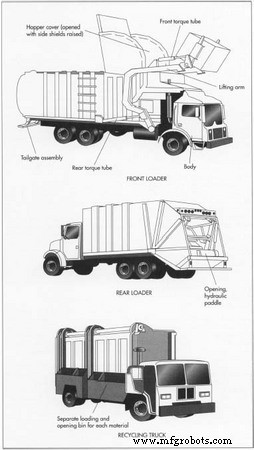
Garbage trucks are categorized into five primary types, each tailored to specific collection scenarios:
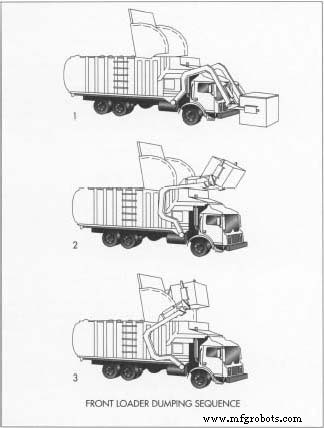
- Front Loader: Two hydraulic lift arms pivot behind the cab, engaging dumpsters (commonly 30–40 cu yd, 23–30.6 cu m). A packer blade compresses waste, and the load is tipped over the front of the body. Operated by a single crew.
- Rear Loader: Features a lower rear opening for manual dumping. Hydraulic paddle pushes waste forward. Capacities range from 20–30 cu yd (15.3–23.0 cu m). Requires two to three crew members.
- Side Loader: Similar to rear loaders but with a side opening behind the cab. Manual or automated versions use a hydraulic arm with a claw. Capacities 15–30 cu yd (11.5–23.0 cu m). Operated by one or two crew members.
- Recycling Truck: Equipped with separate bays for multiple recyclable commodities (newspapers, glass, metal). Designed for residential collections and typically operated by one or two crew members.
- Roll‑Off Truck: Carries a detachable container on a tilting ramp, suitable for construction sites and large debris removal. Typical hoist capacity: 60,000 lb (27,300 kg). Operated by a single crew.
The Manufacturing Process
Garbage truck bodies are fabricated on a fixed assembly platform rather than a conveyor line. The process involves:
Forming the Body Shell
- Cutting floor, sides, top, and front components in a machine shop using band saws, metal shears, and cutting torches. Flat panels are bent in press brakes; curved sections are formed in roller benders. Mounting holes are punched or drilled.
- Sub‑assembly of each component: floor, sides, top, front. Reinforcing channels are welded on flat tables using automated welders; manual welding and templates or clamps position parts precisely.
- Assembly of sub‑units into a complete shell, resulting in a near‑finished box shape.
Installing Operating Sub‑Assemblies
- While the shell forms, lift arms, forks, hopper cover, tailgate, and packer blade are fabricated and welded into sub‑assemblies.
- The packer blade is installed first inside the body, attached to its hydraulic cylinder (some designs use dual cylinders for added force).
- Hopper cover welded over the forward opening; hydraulic cylinder attached to mount points.
- Lift arms, forks, torque tubes, and hydraulic cylinders are mounted to the shell.
- Tailgate is hung from top‑mounted hinges and equipped with hydraulic cylinders.
Finishing the Body
- Installation of lighting, routing and connecting electrical wiring, and connecting hydraulic hoses to cylinders.
- Body may be painted before mounting or after, depending on manufacturer preference. Masking protects lights and exposed hydraulic rods.
- Application of name plates, decorative striping, and warning labels.
Modifying the Cab and Chassis
- Delivery of a low‑cab‑forward truck cab and chassis. Components such as hydraulic fluid tanks, filters, pumps, and power‑take‑off units are installed. Cab instrumentation and controls are integrated to operate the hydraulic system.
Mounting the Body
- Once the body and cab are ready, the body is lifted and bolted to the truck frame rails. Front brackets are spring‑mounted to allow minor flex over uneven terrain, preventing frame failure.
- Electrical connections and hydraulic lines are linked between truck and body; the hydraulic system is filled.
- Final operational tests include lighting checks and full‑cycle hydraulic actuation. The truck is then road‑tested before delivery.
Quality Control
Each component undergoes dimensional inspection prior to assembly. Welds are verified with templates or jigs, and after body mounting, all lights and hydraulic functions are tested to ensure reliability.
The Future
Urban landfills are reaching capacity, prompting a dual strategy: transporting waste to remote sites—potentially via dedicated trash trains to desert mines—and intensifying recycling and waste‑reduction initiatives. Municipalities may adopt “pay‑by‑the‑pound” schemes, embedding electronic chips in household bins that record weight and address during collection, enabling precise billing and encouraging responsible disposal.
Manufacturing process
- Armored Trucks: Design, History, and Modern Security Solutions
- Heavy‑Duty Truck Manufacturing: Design, Production, and the Road Ahead
- Smart Garbage Can: A Cellular IoT Solution for Automated Waste Management
- Autonomous Donkey Car: TensorFlow MobileNetV2 AI for Garbage Collection
- Intelligent Smart Waste Bin: Optimising Waste Collection with IoT Sensors
- Transform a Broken Toy Truck into a Raspberry Pi‑Powered RC Vehicle
- Java 10: Introducing the Garbage‑Collector Interface for Flexible, Efficient Memory Management
- Essential Pallet Truck Safety Practices for Warehouse Operations
- Perfectionist Pete: Your Truck’s Daily Safety Champion
- Articulated Trucks Explained: How They Power Construction and Heavy Transport