



Armored Trucks: Design, History, and Modern Security Solutions
An armored truck is a purpose‑built vehicle engineered to transport currency and high‑value assets safely.
Background
Before armored vehicles existed, moving cash securely relied on deception or armed escorts. Couriers in plain clothes disguised valuables in ordinary luggage, while large shipments were protected by armed caravans, galleons, and stagecoaches equipped with iron boxes and guards. These methods had two major flaws: the cargo ultimately had to be transferred to smaller, more vulnerable vehicles, and no matter how many soldiers or weapons a convoy carried, a larger hostile force could still breach it. As firearms grew more compact and lethal, the need for a dedicated armored transport became clear.
In the aftermath of World I, the success of military armored cars inspired the first commercial attempts. In 1920, Chicago‑area company Brink’s converted school buses into armored vehicles by affixing steel plates to the lower body and sealing the windows. That same year, Minneapolis‑based private detective Mike Sweeney commissioned the first true armored car, a custom‑built vehicle that formed the foundation of today’s industry.
Early models relied on steel plating only, retaining the wooden floors of their truck chassis. A 1927 incident—thieves detonated explosives on a Brink’s truck carrying $100,000 in payroll money—proved the weakness of that design. The 1930s and 40s saw experimentation with aluminum for weight savings, but the metal cracked under stress and was abandoned. During the 1970s fuel crisis, lightweight plastic armor was trialed, yet performance remained comparable to steel, which returned to dominance as the material of choice.
Raw Materials
Armored trucks are essentially sealed steel boxes, and their protective capability comes from the composition of that steel. The walls, floor, ceiling, and doors are constructed from hardened steel—often galvanized or stainless—to resist corrosion. Hardening is achieved through heat treatment or by alloying with chromium and nickel. Interior panels may be lined with ballistic fiberglass cloth (woven roving) or steel sheets. Windows are composed of multiple layers of automotive glass blended with bullet‑resistant optical plastic.
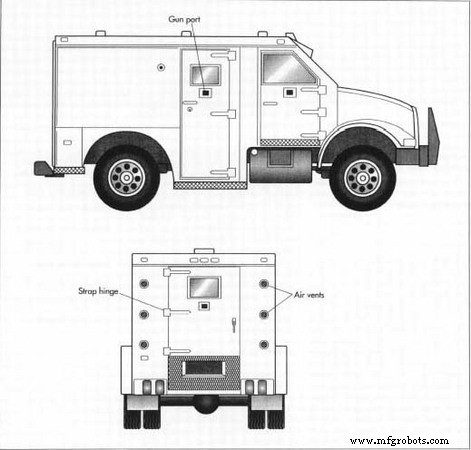
For added safety, the vehicle is fitted with roof vents that include a baffle to block direct lines of fire, and gun ports on each door feature a spring‑loaded plate that can only be opened from the inside.
Design
Four critical objectives drive the design of an armored truck, often competing against one another:
- Ballistic resistance – Manufacturers use hardened steel ranging from 0.125 in (0.317 cm) to over 0.25 in (0.635 cm) for the body, and laminated glass between 1.50 in (3.81 cm) and 3 in (7.62 cm) for windows. A combination of glass and optical plastic allows thinner, lighter panels. Windshields are angled at 45° to deflect projectiles and reduce drag. Tires are reinforced with a U‑shaped hard‑plastic liner, enabling continued travel if deflated.
- Weight – The Gross Vehicle Weight (GVW) is the maximum safe weight of the vehicle, including cargo and personnel. A typical “route truck” has a GVW of 25,000 lb (11,350 kg); its finished weight averages 12,000 lb (5,448 kg), leaving 13,000 lb (5,902 kg) for cargo and guards. Heavier cargo, such as coin pallets, requires tandem‑axle chassis with GVWs up to 55,000 lb (24,970 kg).
- Security – Beyond ballistic protection, the truck must isolate operators from cargo. Two armed guards—driver and hopper—operate inside a steel bulkhead. Doors to the cargo area are fitted with slam locks that auto‑seal, and the hopper can secure valuables in locked boxes or a drop safe. Gun ports remain locked until the driver releases them electronically.
- Crew comfort – The sealed steel box can become hot; therefore, trucks are equipped with dual HVAC units allowing independent temperature control for driver and hopper. Foam‑board insulation lines walls, ceiling, and floor to further moderate interior conditions.
The Manufacturing Process
Chassis
- The process starts with a bare heavy‑duty truck chassis, complete with drivetrain and suspension. Some manufacturers receive a full cab chassis, from which they remove the cab, while others work with a cowl chassis that only includes fenders and hood.
Body
- Steel framing is assembled on a jig: vertical square tubing forms walls, and horizontal hat rails (flat‑brimmed cross‑section) are tack‑welded to create a skeleton. Cut‑outs for windows and doors are left open during framing.
- Large sheets of hardened steel are cut to size with hydraulic shears, then shaped with plasma torches (often robotically guided) to cut windows and doors. The panels are formed on hydraulic presses, then welded or riveted to the frame.
- The floor is first insulated with hardwood, then the steel floor is clamped onto it. Walls are lifted onto the chassis, temporarily clamped or tack‑welded, followed by the roof. Once alignment is verified, all seams are permanently welded or riveted.
Outfitting the Interior
- Door hinges are bolted to the frames, using strap hinges with sealed grease fittings for smooth operation.
- Foam‑board insulation fills gaps between steel tubes, and interior steel or woven roving panels are installed.
- The bulkhead separating cab and cargo is secured, then shelves, bins, safes, vents, and gun ports are installed.
Finishing
- All welds are ground smooth and sealed. The interior is primed and painted, while the exterior receives multiple layers of sealant, primer, and paint per the customer’s specification.
- Electrical wiring runs through exposed conduits for easy maintenance; HVAC units are installed. Glass, locks, mirrors, bumpers, running boards, and grill guards are fitted, followed by interior trim such as seats, belts, visors, and handles.
- Finally, the truck is sent to a dedicated paint booth for a corrosion‑resistant undercoating.
The Life of an Armored Truck
The chassis is often the first component to wear out due to the added weight of armor and cargo. While the steel body endures for decades, many operators remove and refurbish it on newer chassis—sometimes three times—before ultimately selling older units to overseas markets or recycling the steel.
Quality Control
Manufacturers benchmark ballistic performance against Underwriters Laboratories (UL) standards, classifying materials from Class 1 (lowest) to Class 4 (highest). Because armored trucks are commercial vehicles, they must also comply with U.S. Department of Transportation regulations. Insurance underwriters play a decisive role, setting acceptable armor levels, lock configurations, and operating procedures.
The Future
Armored trucks will continue to evolve around lighter, stronger alloys and advanced glass laminates. The shift toward smaller chassis to accommodate the proliferation of ATMs means lighter, more frequent loads. Integration of GPS and real‑time tracking enhances routing efficiency and provides an additional deterrent against hijacking.
Manufacturing process
- Amber: From Ancient Resin to Scientific Treasure – History, Properties, and Modern Uses
- The Guillotine: History, Design, and Legacy
- Silicon: Properties, Production, and Market Outlook
- The Ukulele: From Portuguese Roots to Modern Craftsmanship
- The Complete Guide to the U.S. Chicken Industry: History, Production, and Quality Control
- Compost: The Ultimate Soil Enrichment Solution
- Gelatin: From Ancient Protein to Modern Applications – Production, Uses, and Safety
- The Evolution and Manufacturing of Modern Pin‑Tumbler Locks
- Vodka: From Ancient Distillation to Modern Production
- Milk: Production, Processing, and Nutrition in the United States