



Industrial Full‑Face Gas Mask Production & Quality Standards
Background
A gas mask protects wearers from harmful vapors, dust, and pollutants. It may supply its own fresh air or use a filter cartridge to screen contaminants. The latter, known as an Air‑Purifying Respirator (APR), features a tight‑fitting facepiece, one or more filter cartridges, an exhalation valve, and clear eye lenses. The first APR was patented in 1914 by Garrett Morgan of Cleveland, Ohio. Morgan’s invention proved its worth during the 1916 Cleveland Waterworks explosion when he used a gas‑filled tunnel to rescue workers. Since then, APR technology has advanced dramatically, especially in filtration aids, comfort, and fit. Modern APRs filter toxic industrial fumes, vaporized paint, particulate pollution, and some chemical‑war gases. They come in mouth‑nose and full‑face styles and serve both military and industrial applications, though military masks must meet stricter standards.
Raw Materials
A full‑face gas mask comprises a filter cartridge, a flexible face covering (skirt), transparent eye lenses, and straps or bands to secure the device. The cartridge is a 3–4 in (8–10 cm) diameter, 1 in (2.5 cm) deep plastic canister that holds the filtration aid. Carbon‑based filters are common because they adsorb large quantities of organic gases, especially high‑molecular‑weight vapors used in chemical warfare. Inorganic vapors are not strongly adsorbed on carbon; however, activating the carbon with specific reactants or catalysts enhances its performance. Activated carbon types are chosen to target particular contaminants. For example, Whetlerite carbon (chromium‑copper) was used from the 1940s to filter hydrogen cyanide, cyanogen chloride, and formaldehyde. Due to chromium toxicity concerns, modern cartridges use a molybdenum‑triethylenediamine combination. Other activated carbons incorporate silver, iron or zinc oxides, while sodium‑, potassium‑ or alkali‑treated carbon targets sewage vapors, chlorine, and similar gases.
The skirt holds the components in place and creates a seal around the face. Depending on the design, a one‑way exhalation valve may be incorporated to expel exhaust gases without admitting external air.
Eyepieces are chemically resistant, clear polycarbonate lenses that preserve vision. They can be treated to be shatter‑proof, fog‑resistant, or to filter specific light wavelengths. Most manufacturers outsource lens production to specialized suppliers.
Elastic straps are typically made from silicone rubber, and additional straps can allow the mask to be hung around the neck during breaks.
Design
Mask design varies by application. Some models include speech diaphragms, extra filter ports, or connections to external air supplies. While the core architecture remains consistent, the filtration media differ according to intended use. Manufacturers maintain a range of styles and cartridge types, enabling custom orders that meet specific performance requirements.
The Manufacturing Process
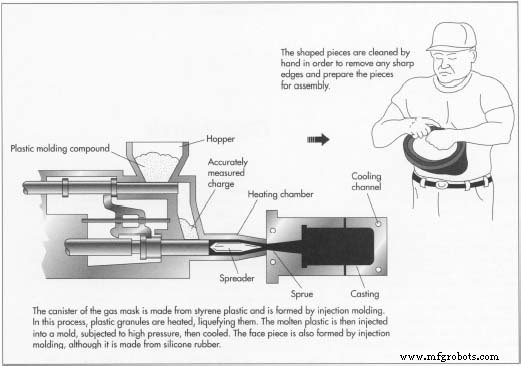
The cartridge is injection‑molded from styrene plastic, chosen for water resistance, chemical durability, dimensional stability, and suitability for high‑pressure molding. Two metal disk molds are clamped together; the molten plastic is injected under 50–2,500 tons of pressure, then cooled with water channels. After pressure release, the halves separate and the finished canister is ejected. Styrene’s thermoplastic nature allows scrap to be remelted, minimizing waste. A similar process creates the small circular screens that secure the activated carbon inside the cartridge.
The facepiece is molded from silicone rubber, prized for thermal stability, shape‑conformability, and recyclability. The molding process mirrors that of the cartridge. After ejection, the skirt is trimmed and any rough edges are hand‑cleaned before assembly.
Assembly occurs on a partially automated line overseen by two to four technicians. The filter canister is affixed to the facepiece, eye lenses are glued in place, and straps and bands are riveted. Each mask undergoes a final quality inspection. Approved masks receive markings per the American National Standard for Identification of Air‑Purifying Respirator Cartridges and Canisters. Packaging is designed for easy identification and rapid deployment in emergencies.
Byproducts/Waste
Activated carbon that has been chemically treated, such as chromium‑treated carbon, may be classified as hazardous waste. The injection‑molding process generates minimal waste, as excess resin can be remelted. Lens manufacturing is outsourced, so manufacturers need not manage polycarbonate waste.
Quality Control
Gas masks are regulated by the Code of Federal Regulations (CFR), which defines mask types—self‑contained breathing apparatus, non‑powered air‑purifying respirators, chemical cartridge respirators, and dust masks—and specifies testing protocols. Tests assess filter performance against designated contaminants under controlled temperature and humidity, measuring the time to saturation. Quality checks occur at multiple stages: incoming materials, post‑assembly cartridge, final mask fit (often on a mannequin), and final certification.
The Future
Over the past eight decades, gas‑mask technology has proven robust. Future challenges include developing respirators for infants, patients with head wounds, and other special needs. Advances in material science—particularly carbon chemistry—promise smaller, lighter, and more effective filter canisters, potentially halving current sizes. These innovations will spawn new generations of respirators for industrial, medical, and military use.
Manufacturing process
- Titanium: Key Properties, Applications, and Industrial Uses
- Natural Gas: From Extraction to Distribution – A Comprehensive Overview
- Castanets: History, Craftsmanship, and Performance
- The History, Production, and Future of Glue: From Ancient Adhesives to Modern Innovations
- Thread: Types, History, Production, and Quality Control
- Acetylene: Production, Uses, and Handling – A Comprehensive Overview
- Comprehensive Overview of Asbestos: From Ancient Uses to Modern Health Risks
- The History, Design, and Manufacturing of Dice: From Ancient Tools to Modern Gaming
- Helium: Properties, Production, and Global Supply
- Plywood: History, Production, and the Path Ahead