



The Craft of Beer: History, Ingredients, and Brewing Process
Background
Beer, the world’s oldest brewed beverage, traces its roots back to around 7,000 B.C. in Mesopotamia. While the Egyptians and Greeks produced various fermented drinks, the term “beer” first appears in Celtic and Biblical texts. Monastic communities in medieval Europe refined brewing techniques—most notably the addition of hops for aroma and preservation—laying the groundwork for modern ales, lagers, and bocks that emerged in the 13th century and crystallized in the 1600s.
By the time the United States declared independence in 1776, European immigrants had already introduced sophisticated brewing methods. Technological advances such as the yeast separator enabled mass production, while the 1875 introduction of bottled beer by Joseph Schlitz Brewing Company and the 1930s advent of canned beer expanded distribution. Today, the U.S. produces roughly 156,900 million barrels annually—each barrel equal to 117 liters or about 31 gallons—while Germany remains the largest per‑capita consumer at approximately 40 gallons per person per year.
Raw Materials
Beer’s flavor, color, carbonation, and alcohol content are determined by four core ingredients:
- Grains – Typically barley, corn, or rice, carefully stored to preserve quality. A 31‑gallon barrel requires roughly 35 lb (16 kg) of barley malt and 15 lb (7 kg) of adjunct grain.
- Hops – The scientific name Humulus lupulus provides bitterness, aroma, and preservative properties.
- Water – Pure, low‑mineral water is essential; high lime or iron content can interfere with fermentation and discolor the final product.
- Yeast – Fungal microorganisms that convert sugars into alcohol. Some breweries guard specific yeast strains as proprietary trade secrets.
Supporting chemicals, cleaning agents, and packaging materials—cardboard, aluminum, glass, stainless steel, and copper for kettles—round out the production process.
The Brewing Process
Malting
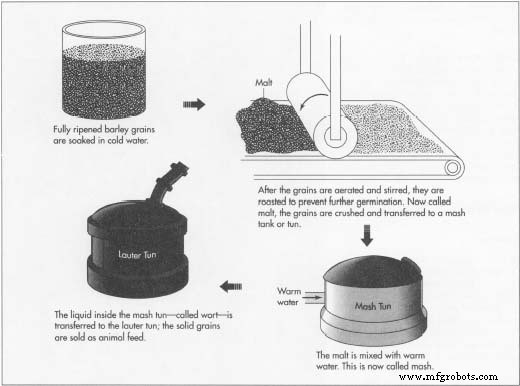
- Fully ripened barley is steeped in cold water, then aerated and stirred to induce germination. Enzymes like malt diastase break down starches into fermentable sugars. After six days of controlled germination, the grain is kilned to halt the process, producing malt whose flavor and color are set by the roasting schedule.
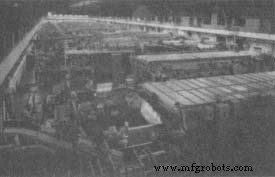 The automatic canning machinery dwarfs the workers in this 1970s brewery canning room.
(From the collections of Henry Ford Museum & Greenfield Village.)
The automatic canning machinery dwarfs the workers in this 1970s brewery canning room.
(From the collections of Henry Ford Museum & Greenfield Village.)
Commercial brews keep recipes confidential, balancing art and science under the stewardship of the brewmaster—a blend of craftsman, chemist, and engineer—while modern breweries incorporate automated lines for consistency and scale.
Preparing the Mash
- The malt is crushed and mixed with warm water in a copper or stainless‑steel mash tun to form a porridge‑like consistency. Temperatures rise incrementally from 100–170 °F (38–77 °C) to activate enzymes that convert starches to sugars. After steeping, solids settle to the bottom, leaving clear liquid for the next step.
Brewing the Wort
- The mash is transferred to a lauter tun, where gravity filters the liquid (wort) through the grain bed. Hot water “sparges” the remaining sugars, which are then boiled in copper kettles—often 7–12 ft (2–3.6 m) in diameter—to sterilize and integrate hops. Hops impart bitterness and aromatic compounds. Post‑boil, the wort is filtered again before being pumped into fermentation vessels.
Fermenting
- Yeast (≈1 lb per barrel) is inoculated in a temperature‑controlled environment of 50–60 °F (10–15 °C). As yeast consumes sugars, it produces alcohol and CO₂, transforming the wort into beer. The new beer is then transferred to aging casks at 33 °F (≈0 °C) for 2–24 weeks; shorter periods yield pale lagers, while extended aging produces richer European styles such as Pilsner.
Pasteurizing
- Post‑aging, many commercial beers undergo pasteurization—heating above 135 °F (57 °C)—to deactivate residual yeast and halt further fermentation. Draft or “ice” beers avoid pasteurization to preserve live yeast, maintaining optimal aroma and flavor.
Packaging
- Beer is transferred gently through bottling lines to preserve carbonation. CO₂ from fermentation may be added to enhance aroma. High‑speed lines can process thousands of cases daily, with computerized tracking across distribution networks. Common package sizes include 8‑oz “pony” cans, 12‑oz standard cans, 16‑ and 32‑oz jumbo cans, 40‑oz picnic bottles, and kegs ranging from 8 to 16 gallons. States often require deposit refunds to promote recycling.
- When dispensed from kegs, a tapper applies 2–6 PSI of CO₂ pressure to ensure a smooth pour.
Byproducts and Waste
Malting generates barley rootlets and hop husks that can serve as animal feed and fertilizer. Residual yeast, rich in B‑vitamins, is utilized by pharmaceuticals for vitamin and drug production. Recycled cans and bottles close the loop, supporting a circular economy.
The Future
In response to public health concerns, breweries now include labels warning of impaired driving and risks to pregnant women. Some states impose limits on alcohol content, prompting industry advocacy for responsible consumption.
Scientific research drives innovation: plant engineers are modifying barley genetics for disease resistance and yield; yeast scientists aim to create strains that ferment novel carbohydrates and resist contamination. Rapid contaminant testing—leveraging DNA probes and protein fingerprinting—draws on medical diagnostics to safeguard quality.
Manufacturing process
- Explore Bruges' Hidden Gem: The Two-Mile Beer Pipeline
- Craft Beer: From Kauai to Bar Harbor – A Nationwide Journey
- Custom Metal Fabrication Spotlight: Precision Beer Tanks for Premium Breweries
- IoT Revolutionizes Breweries: Boosting Beer Quality and Operational Efficiency
- Showcasing Plant Intelligence Through an In-House Beer Brewing Experience
- 6 Key Benefits of Onsite Nitrogen for Brewers
- Tennessee Brewery Adopts Oil‑Free Brewing Technology to Elevate Beer Quality
- Charlotte Brewery’s Rise: Old Mecklenburg Brewery Leads with Authentic German-Style Beers
- Ensuring Beer Purity: The Reinheitsgebot Explained
- Optimizing CO2 Recovery in Food & Beverage Processing