



The Bicycle: Evolution, Construction, and Future Innovations
Background
Bicycles rank among the most widely used forms of personal transport worldwide, with an estimated 800 million units—double the number of cars on the road. Beyond commuting, they fuel fitness, competition, and adventure. Energy‑wise, a cyclist expends roughly 35 calories per mile (22 kcal/km), a fraction of the 1,860 calories per mile (1,156 kcal/km) consumed by a car. Bicycles come in countless configurations: racing, all‑terrain, stationary, unicycle, tricycle, tandem, and more.
History
Leonardo da Vinci sketched a bicycle‑like machine as early as 1490, though he never built it. The first practical “hobby horse” appeared in the late 1700s with Comte de Sivrac’s Celerifere—a wooden, two‑wheel contraption powered by foot‑push. In 1816, German Baron Karl von Drais introduced a steerable version, sparking a European craze.
By 1840, Scottish blacksmith Kirkpatrick Macmillan produced a treadle‑driven two‑wheel design that could travel 40 miles (64 km) nonstop—a record of 140 miles (225 km) to Glasgow. Two decades later, French inventor Ernest Michaux added pedals and cranks, creating the Velocipede with wooden wheels and an iron frame. Nicknamed the “boneshaker,” it marked a pivotal shift toward pedal propulsion.
The 1860s saw ball‑bearing hubs, metal‑spoked wheels, solid rubber tires, and four‑speed gearshifts. James Stanley’s 1866 “Penny Farthing” featured a massive front wheel and small rear wheel, weighing 70 lb (32 kg) and costing $300—a premium investment at the time.
In 1885, John Kemp Starley’s Rover Safety introduced equal‑sized wheels, chain drive, and a diamond frame, eliminating the dangerous front‑wheel cartwheel of the Ordinaries. Pneumatic tires by John Boyd Dunlop, coaster brakes (1898), and freewheeling further refined performance.
By the 1890s, the modern bicycle’s core components were established. The early 20th century brought stronger steel alloys, thinner tubing, and derailleur gears, enhancing speed and comfort. Post‑WWII, bicycles waned amid automotive dominance but surged again during the 1970s oil crisis. Mountain bikes emerged from the fusion of wide‑tire “balloon” designs and lightweight racing technology, eventually eclipsing road bikes. Hybrids blended the best of both worlds.
The Raw Materials
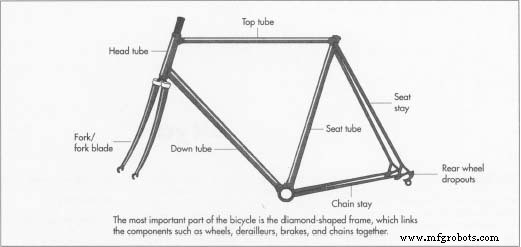
The diamond‑shaped frame is the bicycle’s backbone, dictating strength, rigidity, and handling. It comprises a front (top, seat, down, head tubes) and rear triangle (chainstays, seatstays, dropouts). Advances have shifted from heavy steel to lightweight aluminum in the 1970s, and later to high‑strength composites like carbon fiber in the 1990s. While steel and titanium offer decades of durability, aluminum can fatigue within 3–5 years.
Components such as wheels, derailleurs, brakes, and chains are typically stainless steel and sourced from specialized manufacturers.
Manufacturing Process
Seamless tubes begin as solid steel blocks, pierced and drawn into tubes. These are then butted—thicker at stress points, thinner elsewhere—to balance strength and weight. The tubes are assembled by hand‑brazing or machine welding, with composites joined by adhesive. Skilled builders fine‑tune alignment and perform final adjustments.
Tailoring the Tubes
- 1. Anneal the metal to soften, hollow out to form “hollows,” then heat, pickled in acid, and lubricated.
- 2. Measure, cut, and precision‑miter the hollows. Adult frames range from 19–25 inches (48–63 cm) from seat‑post top to crank‑hanger centre.
- 3. Fit hollows over a mandrel on a draw bench; pass through dies to thin and lengthen (cold drawing).
- 4. Shape and taper tubes to achieve desired strength, weight, and resilience.
Brazing, Welding, and Gluing
- 5. Join tubes by hand or machine. Brazing involves heating lugs to ~1600 °F (871 °C), melting a brass or silver filler to seal joints.
Aligning and Cleaning
- 6. Place assembled frames in jigs, adjust while hot.
- 7. Clean excess flux by acid pickling and grinding.
- 8. Perform precision realignments after cooling.
Finishing
- 9. Prime with undercoat, spray enamel (hand or electrostatic), then apply transfers and lacquer. Optional chrome plating enhances aesthetic and corrosion resistance.
Assembling the Components
Derailleurs and Gear Shift Levers
- 10. Mount levers on down tube (racing) or handlebar ends; connect cables to front and rear derailleurs.
Handlebars, Stems, and Headsets
- 11. Bolted handlebars attach to stems inserted into the head tube; the headset (bearings, cups, locknuts) enables smooth steering.
Brakes
- 12. Attach brake levers to handlebars; cable to calipers; apply tape for grip.
Saddles and Seat Posts
- 13. Seat posts (steel or aluminum) secured to frame; saddles now molded with nylon or plastic, leather largely obsolete.
Cranksets
- 14. Cranksets transfer pedal power; comprised of crank arms, chainrings, and a bottom bracket assembly. Pedals bolt to crank arms.
Wheels, Tires, and Hubs
- 15. Manufacturers follow ISO standards for diameter and tire size. Rims formed by welding steel hoops; spokes laced to hub flanges.
- 16. True the wheel radially and laterally; install rim liner, tire, and inner tube.
- 17. Rear freewheel units permit coasting.
- 18. Attach wheels via axle through hub; secure with bolts or quick‑release skewers.
The Future
Recent decades have accelerated bicycle innovation. Low‑profile recumbents offer superior aerodynamics and safety, while hybrids—such as the Dutch “Ecocar” introduced by Wim Van Wijnen—merge cycling with automotive comforts. Computer‑aided design now simulates forces like pedaling and road shock, expediting prototyping and refining performance.
Manufacturing process
- How Titanium Shapes Modern Bicycle Design
- Bicycle Seat Design, History, and Manufacturing: A Comprehensive Guide
- Bicycle Shorts Explained: Design, Materials, and Production Process
- Java Classes and Objects: A Practical Guide
- Carbon Fiber Bikes: The Future of Cycling Performance
- 4 Key Advantages of Greg LeMond’s Carbon Fiber Electric Bikes
- Arevo Unveils World's First Made-to-Measure 3D-Printed Bicycle Direct to Consumer
- Advancing Composite Bicycle Technology: Part 2 – Enhancing Frame and Rim Durability
- Arkansas-Based HIA Velo: Crafting Durable Carbon Fiber Bikes
- REIN4CED Partners with Accell to Deliver Advanced Composite Bike Frames