



Advanced Hearing Aids: Design, Manufacturing, and Future Innovations
Background
The hearing aid is a precision‑engineered device that amplifies speech and environmental sounds for individuals with hearing loss. Modern models are discreet—ranging from behind‑the‑ear units to in‑ear or eyeglass‑mounted versions—while delivering clear, natural sound. Each unit combines a microphone, an electronic amplifier, a receiver, and a custom ear shell that directs amplified sound into the ear canal. The entire signal path—from acoustic capture to electronic processing and acoustic output—ensures users experience balanced, comfortable hearing.
Microphones and receivers form the transducer that determines the aid’s frequency response. Adjustable gain and tone controls can be set manually or automatically, allowing the device to adapt to a user’s hearing profile and everyday listening situations.
History
The concept dates back to the 17th‑century ear trumpet, a horn‑shaped device that concentrated sound waves to increase perceived volume. The first truly electronic aid appeared in 1876 when Alexander Graham Bell adapted telephone technology to convert sound into electrical current and back again.
By the 1920s, the design resembled the modern hearing aid, featuring a microphone, diaphragm, circuit board, and battery. The 1948 transistor revolutionized the industry, shrinking devices into a size small enough to fit discreetly in the ear canal—an aesthetic advantage that remains a key selling point today. Ongoing research continues to push the limits of miniaturization, though it demands greater user dexterity for control operation.
The Manufacturing Process
Fabricating a hearing aid takes roughly two hours and requires highly skilled technicians working in a microminiature environment equipped with magnification tools. Precision assembly, guided by detailed wiring diagrams and assembly prints, ensures each unit meets stringent performance specifications.
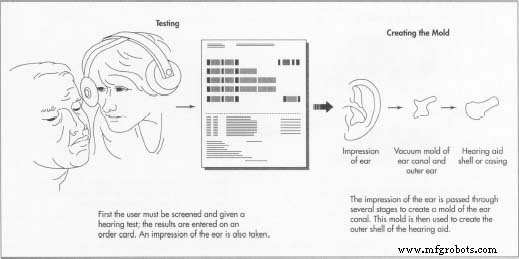
Before production, a trained audiologist performs a comprehensive hearing evaluation, producing an audiogram that informs the required amplification levels. An impression of the patient’s outer ear is also taken; this mold is essential for custom shell fabrication.
Data Entry
- All order data—including desired product features and audiogram results—are entered into a computer system that calculates the necessary amplification range and selects appropriate circuitry.
- Manufacturing order and parts cards are generated, then routed to the production line and stock room, respectively.
Vacuum Form of Impression
- A clear vinyl sheet is placed over the ear impression and heated; once cooled, the sheet is removed, trimmed, and coated in hot wax to create a paper‑thin, smooth surface for casting.
Cast of Finished Impression
- The wax‑coated impression is placed on a metal plate surrounded by rings. A clear liquid colloid is poured over it, cured into a rubber‑like silicone, and then the impression is extracted.
Creating the Shell
- The mold is cleaned by heating in 110°F water and purging with air. Liquid acrylic—mixed 1:1 monomer to polymer with pigment—follows, forming a thin shell that replicates the ear canal after a 10‑minute cure.
Building the Hearing Aid into the Shell
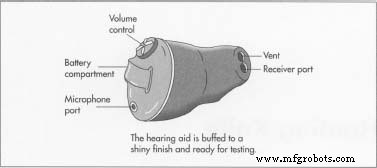
- The shell is trimmed, vented, and drilled for the receiver tube. A smooth, glossy finish is achieved by buffing and polishing. A face plate or flange is sized and positioned at the optimal angle for the wearer.
Creating Microminiature Circuits
- Circuits are printed onto a ceramic substrate using screen‑printing of conductive (gold/silver) and insulating (silicon) layers. The substrate is baked at 850°F for two hours to fuse the layers.
- Components are hand‑soldered to the gold tracks, interconnected with 0.001‑inch gold wire, and sealed in epoxy before heat hardening.
Assembling the Electronic Hardware
- Based on the bill of materials, technicians mount the microphone, amplifier, battery compartment, and volume control onto the face plate. The receiver is then fitted into the shell, followed by a preliminary hearing test.
Sealing and Finishing
- Components are carefully packaged and glued with plastic cement. After a listening check, excess face plate material is trimmed, edges ground with a hand lathe, and the aid is buffed to a high‑gloss finish. The unit is ready for final testing.
Quality Control and Testing
Throughout production, rigorous quality checks monitor shell integrity, cosmetic appearance, and functional performance. Each shell receives a serial number for traceability.
Hearing aids undergo ANSI‑standardized computerized testing that generates a performance chart. Technicians review tolerance levels and specifications, print the results, and attach them to the finished device.
The Future
Miniaturization remains the key frontier: current models fit comfortably in the ear canal, nearly invisible to observers. Cutting‑edge microchip technology enables fully programmable aids that let users switch between preset profiles—optimized for outdoor concerts, bustling restaurants, or quiet meetings—without manual adjustment. While premium custom models can cost up to $2,000, ongoing innovation promises more accessible, high‑performance options.
Manufacturing process
- Enhancing Autonomous Vehicles with Advanced Acoustic Sensing
- Integrating Primavera and SAP Cuts NPPD Shutdown Costs and Boosts Scheduling Accuracy
- South African Surgeons Achieve Groundbreaking 3D‑Printed Ear Transplant
- Mercury Systems' SSDRs Chosen to Power NASA’s Earth Dust Monitoring Mission
- Innovations in Hearing Aids: From DIY to Brain‑Responsive Tech
- Revolutionary App Detects Ear Infections in Children Using a Paper Funnel and Your Phone
- Brain‑Wave‑Driven Hearing Implant Achieves Accurate Auditory Calibration
- Tel Aviv University Robot Uses Locust Ear to Hear and Respond to Sound
- Avoiding Overprotection: Safely Using Hearing Protection in Loud Workplaces
- 11 Welding Processes Illustrated: A Comprehensive Guide