



Polyester: From Lab to Life – History, Production, and Future Innovations
Background
Polyester is a high‑performance synthetic fiber engineered from coal, air, water, and petroleum. The modern polyester family emerged in the 20th‑century laboratory, where chemists combined an acid and an alcohol to create long, stable molecules that repeat along their backbone. These molecules confer exceptional strength and durability to the resulting fibers.
Today, polyester is ubiquitous—from apparel and home furnishings to industrial textiles, computer tapes, and electrical insulation. Its hallmark traits—low moisture absorption, oil uptake, resistance to stains, and minimal shrinkage—make it ideal for water‑, soil‑, and fire‑resistant finishes. Because polyester resists mildew and can be pre‑shrink, it is a preferred choice for durable clothing, pillows, quilting, and outerwear. Its ease of dyeing and non‑allergenic insulation properties further broaden its applications.
History
In 1926, E.I. du Pont de Nemours & Co., led by W.H. Carothers, pioneered research into large‑molecule synthetic fibers, culminating in the first synthetic fiber, nylon. British chemists soon joined the quest; between 1939 and 1941, researchers at Calico Printers Association produced what became known in England as Terylene, the first commercial polyester.
By 1946 du Pont secured U.S. manufacturing rights and, in 1951, launched the fiber under the brand Dacron. Over subsequent decades, companies worldwide refined polyester for varied uses. Two main types dominate the market today: PET (polyethylene terephthalate), prized for its versatility and strength, and PCDT (poly‑1,4‑cyclohexylene‑dimethylene terephthalate), favored for its elasticity and resilience in heavy‑use applications such as draperies and furniture coverings.
Raw Materials
The term polyester derives from “poly” (many) and “ester” (an organic functional group). The cornerstone ingredient is ethylene, sourced from petroleum. In the polymerization step, ethylene combines with other monomers to build the polyester backbone.
The Manufacturing Process
Polyester can be produced in several forms—filament, staple, tow, and fiberfill—each suited to specific end uses. Filament fibers, continuous and smooth, yield high‑quality fabrics; staple fibers, cut to length, blend easily with natural fibers; tow consists of loosely joined filaments; and fiberfill provides bulk for pillows and insulation.
Manufacturing Filament Yarn
Polymerization
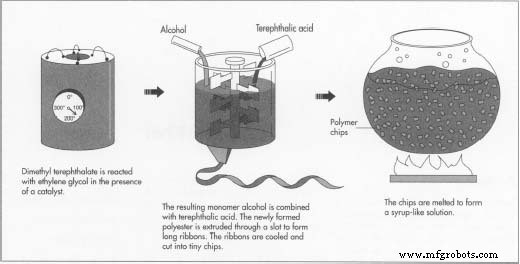
- Dimethyl terephthalate reacts with ethylene glycol in the presence of a catalyst at 302–410 °F (150–210 °C).
- The resulting monomer is combined with terephthalic acid and heated to 472 °F (280 °C), producing clear, molten polyester that is extruded into long ribbons.
Drying
- Molten ribbons cool to brittle solids, are chopped into chips, and thoroughly dried to ensure uniformity.
Melt Spinning
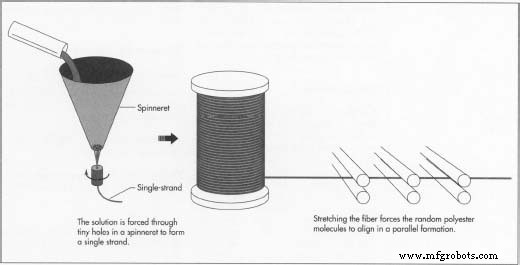
- Polymer chips melt at 500–518 °F (260–270 °C), forming a syrup‑like solution poured through a spinneret. The spinneret’s hole pattern (round, pentagonal, etc.) determines fiber shape and diameter.
- Optional additives—flame retardants, antistatics, dye‑assistants—are incorporated during this stage.
Drawing the Fiber
- Freshly extruded fibers are stretched up to five times their original length, aligning polymer chains and enhancing tensile strength and resilience.
- During drawing, fibers may be textured or twisted to achieve desired fabric feel and appearance.
Winding
- Finished yarn is wound onto large bobbins or flat‑wound reels, ready for weaving or knitting.
Manufacturing Staple Fiber
The staple fiber process mirrors filament production up to melt spinning, but the spinneret contains many more holes, producing rope‑like tow bundles.
Drawing Tow
- Tow is rapidly cooled in cans and then drawn on heated rollers to three‑ or four‑fold its original length.
Crimping
- Drawn tow is compressed into boxes, forcing fibers into an accordion‑like crimp at 9–15 crimps per inch (3–6 cm⁻¹). This structure preserves cohesion during later stages.
Setting
- Crimped tow is heated to 212–302 °F (100–150 °C) to dry fibers and lock in the crimp. Some crimp loss occurs in subsequent processing.
Cutting
- After heat setting, tow is cut to lengths tailored for specific blends: 1.25–1.50 in (3.2–3.8 cm) for cotton blends, 2 in (5 cm) for rayon blends, and 6 in (15 cm) for heavy fabrics such as carpets.
The Future
Since its U.S. debut in 1951, polyester has grown into the nation's fastest‑growing fiber, propelled by easy‑care, permanent‑press fabrics. While early perceptions lagged, the 1990s brought transformative advances: microfiber, a softer and silk‑like variant introduced in 1991, revitalized the material’s appeal. Designers like Mary McFadden now showcase microfiber in high‑fashion lines. Researchers at North Carolina State University are pushing boundaries further, engineering a polyester variant comparable in strength to Kevlar, poised for use in aerospace and automotive composites.
Manufacturing process
- Powder Bed Fusion: The Future of High‑Strength 3D Printing
- Polyester Fleece: Origins, Production, and Sustainable Futures
- PTC & Rockwell Automation Forge Strategic IoT Alliance
- Fiberglass vs. Polyester for Shade Structures: A Technical Comparison
- Polyester Resins: Essential Guide for Composite Applications
- Unlocking Efficiency: The Role of Vertical Form Fill Seal Machines in Modern Packaging
- Polyester vs. Polyether Polyurethane: Which Is Best for Your Application?
- Mastering Form Tools on CNC Lathes: Expert Techniques & Benefits
- FANUC & Plus One Forge Alliance to Boost E‑Commerce Fulfillment
- FANUC America & Rockwell Automation Launch Coalition to Accelerate Apprenticeship Programs in Advanced Manufacturing