



Understanding Plastic Eyeglass Lenses: History, Materials, and Manufacturing
Background
Eyeglass lenses—crafted from glass or plastic—are precision optical components that fit inside frames to correct or enhance vision. The first optical lens, a magnifying glass invented in the early 1200s, was made from quartz and beryl. Its success demonstrated that carefully ground reflective surfaces could amplify visual clarity. In the 16th century, Alessandro di Spina popularised eyeglasses among the general public, and as demand grew, quartz and beryl were largely replaced by glass. The introduction of the convex lens corrected farsightedness, while concave lenses addressed nearsightedness. More sophisticated designs, such as those for astigmatism, followed, culminating in Benjamin Franklin’s bifocals in 1784.
Today, over 80 % of eyeglasses use plastic lenses. Although glass dominated until the 1950s, plastic lenses—lighter and more impact‑resistant—rapidly overtook them. Modern production techniques are largely the same for both materials, involving successive grinding, polishing, and shaping stages. The same process applies to lenses for telescopes, microscopes, and cameras, though those typically require greater precision and larger sizes. This article focuses on plastic eyeglass lenses.
Historically, opticians outsourced lens fabrication to specialized laboratories. Contemporary full‑service optical shops can produce lenses on‑site, but they still rely on “blank” lenses—pre‑ground plastic discs that match specific optical prescriptions—sent in by external labs. These blanks come with pre‑ground front curves and varying thicknesses, usually ranging from 0.25 mm to 0.75 mm, depending on the prescription.
Raw Materials
Plastic blanks received from laboratories are typically round discs of polycarbonate, approximately 25 mm thick or thicker, and slightly larger than the final lens dimensions. Finished lenses are ground to at least 0.25 mm thickness, with variations based on prescription power. Other materials used in lens fabrication include adhesive tape, lead‑alloy liquids, metal components, and dyes or tints for coloration.
- Adhesive tape
- Lead‑alloy liquid
- Metal components
- Dyes and tints
Design
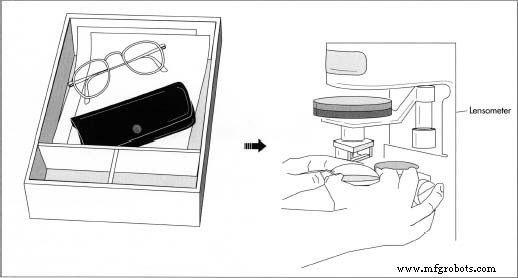
Eyeglass lenses are shaped to match a frame’s geometry. The thickness and contour vary with the optical prescription. After blanks are received, a technician uses a lensometer to locate and mark the optical center— the point that aligns with the wearer’s pupil. The bevel around the lens edge is then designed to secure the lens within the chosen frame, with extra precision required for metal or rimless styles.
Convex and concave (spherical) lenses require a single ground curve per side, while astigmatic corrections demand additional curves. The degree and angle of each curve determine the lens’s optical strength.
After shaping, lenses receive coatings or tints. Coatings are applied by dipping lenses into heated baths containing the desired treatment—such as UV protection, scratch resistance, or impact resistance. Light‑adaptive tints, which darken in bright sunlight, combine clear lens clarity with sun protection.
The most popular plastic is “Feather‑Weight” polycarbonate—an impact‑resistant material that is 30 % thinner and lighter than standard plastic. Other common options include the CR‑39 monomer plastic and high‑index lenses, which can be 20 % thinner and lighter than ordinary plastic.
The Manufacturing Process
The following steps outline how a typical optical laboratory produces a pair of plastic lenses.
- The technician inputs the prescription into the lab’s computer, which generates a detailed printout for the job.
- Using the printout, the technician selects the appropriate blank and places it, along with the frames and work order, into a prescription tray. The technician then mounts the lens on a curve generator to grind the required back‑side curves, after which the lens is polished and beveled. Any necessary tint is applied before the lens is fitted into the frames.
- The technician places the lens in a lensometer to verify the optical center and marks it with adhesive tape to protect the front surface. The lens is then set in a blocker machine that fuses a lead‑alloy block to the front surface, securing it during grinding and polishing.
- The lens is mounted on a generator configured for the prescription. The generator carves the precise back‑side curves. After grinding, the lens undergoes a finishing (polishing) stage.
- Polishing is performed in a fining machine using a series of pads: a sandpaper pad, a smooth plastic pad, and a final pad with an aluminum‑oxide polishing compound. Water circulates to cool and clean the lens.
- Following polishing, the block is removed with a gentle hammer, and the adhesive tape is hand‑removed. The lens is marked L or R with a grease pencil to indicate left or right eye.
- The lens is placed in an edging machine that shapes the bevel to fit the frame geometry. For metal or rimless frames, a hand‑mounted power grinder may be used for additional precision.
- Finally, the lens is dipped in the chosen tint or treatment bath, dried, and then ready for insertion into the frames.
Blocking
- Adhesive tape protects the front surface during blocking.
- A lead‑alloy block secures the lens for grinding and polishing.
Polishing
- Finishing pads progressively smooth the surface.
- Polishing compounds enhance clarity and reduce surface imperfections.
- All equipment is sterilized between uses to maintain hygiene.
Beveling
- The bevel is machined to match the frame’s edge contour.
- Additional hand grinding ensures a perfect fit for high‑precision frames.
- Tint or treatment baths finish the lens before final assembly.
Byproducts
Waste from the process includes plastic dust, fine shavings, and polishing slurry (aluminum oxide, water, and polymers). These materials are collected in metal bins, treated with sanitation agents, and disposed of after a 48‑hour quarantine period.
Quality Control
Plastic eyeglass lenses must meet stringent standards set by the American National Standards Institute (ANSI) and the Food and Drug Administration (FDA). Licensed optical laboratories belong to the National Optical Association, which enforces strict quality and safety guidelines. During production, lenses undergo four key inspections: prescription verification, optical center alignment, visual inspection for defects, and final alignment with the frames. Additional periodic checks may be performed as required.
Manufacturing process
- Eyeglass Frames: The Ultimate Fashion Accessory
- Sunglasses: Design, Materials, and Eye‑Protection Standards
- Understanding Camera Lenses: Design, History, and Future Innovations
- Contact Lenses: History, Materials, and Future Innovations
- Lexan HP92AF Antifog Film: Unmatched Clarity for COVID‑19 PPE and Industrial Lenses
- Spin-Independent Plasmonic Lens for Uniform Surface Plasmon Polariton Focusing
- Affordable Arduino Data Glasses for Multimeter Readings
- Wireless Smart Contact Lenses Detect and Treat Diabetes
- Revolutionary Ultra-Thin Sensor Enhances Smart Contact Lens Functionality
- Ensuring Camera Module Quality: Key Issues and Effective Solutions