



Contact Lenses: History, Materials, and Future Innovations
Background
Contact lenses are thin, transparent devices placed directly on the cornea to correct refractive errors or alter eye color. They float on the tear film, delivering a stable optical surface. For certain visual disorders, contact lenses can provide superior visual acuity compared to spectacles. Beyond vision correction, many users choose lenses for cosmetic benefits or for the freedom they afford during physical activities. The market is dominated by three primary categories: soft, hard (rigid gas‑permeable), and hybrid lenses, each balancing comfort, durability, and oxygen permeability. Typical daily‑wear lenses are removed nightly for cleaning, while extended‑wear and disposable one‑day options expand user convenience.
History
The first contact lens was crafted by German physiologist Adolf Fick in 1887. Fick’s lens was glass and classified as a scleral lens because it covered the white part of the eye. By 1912, optician Carl Zeiss introduced a glass corneal lens that fit over the cornea. In 1938, scientists Obrig and Müller pioneered a plastic scleral lens made from Plexiglas, lighter and more comfortable than glass. Kevin Touhy followed in 1948 with the first plastic corneal lens, initially 10.5 mm in diameter; by 1954 he reduced it to 9.5 mm for better wearability. Around this time, Bausch & Lomb developed the keratometer, eliminating the need for eyeball impressions.
Soft contact lenses emerged in the early 1950s when Czech chemists at the Technical University in Prague discovered a hydrophilic hydrogel (pHEMA) suitable for eye implants. Otto Wichterle, a key figure, refined the material at home, producing 5,500 test lenses in 1961. The breakthrough caught Bausch & Lomb’s attention, leading to the launch of Softlens in 1971 (Bausch & Lomb, 1971). That year alone, 100,000 pairs were sold, establishing soft lenses as a mainstream choice.
Raw Materials
Contact lenses are fabricated from polymeric plastics. Hard lenses are typically made from polymethyl methacrylate (PMMA). Soft lenses use hydrophilic polymers such as poly hydroxyethyl methacrylate (pHEMA) that absorb water while retaining optical clarity. Manufacturers continually refine these materials, and specific formulations vary by brand.
The Manufacturing Process
Lens production begins with shaping a plastic blank into the required curvatures. Two primary curves are formed first: the central anterior curve (CAC) that determines refractive power, and the central posterior curve (CPC) that conforms to the eye. A lens is considered semi‑finished after these curves are shaped; it becomes finished once peripheral and intermediate curves are added and the edge is defined.
Molding Method
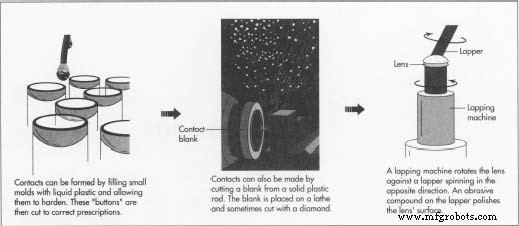
- Early Prague lenses employed spin‑casting: fluid polymer was poured into rotating molds, with centrifugal force shaping the inner curvature. The technique laid the groundwork for modern mass production.
- Injection molding now dominates: molten polymer is forced into a pressurized mold, then cooled. The lens can be finished entirely by computer‑controlled machining, eliminating the need for lathe cutting.
- Images illustrating spin‑cast and injection‑molded lenses:
Lathe Process
- Alternatively, a plastic blank is first cut from a rod or sheet. The blank is mounted on a steel button with wax and spun on a lathe. A diamond or laser tool engraves the CPC to precise depth.
- The blank is then lapped: it is rubbed against a rotating abrasive disk that matches the CPC, polishing the surface while a figure‑eight motion ensures uniformity.
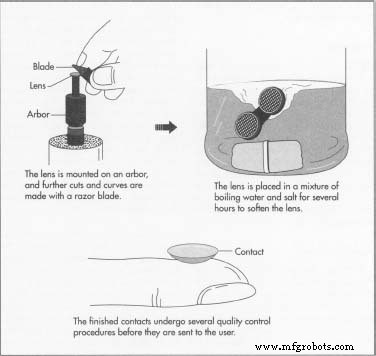
- After lapping, the lens is mounted on an arbor whose tip is ground to match the CPC. The lathe then creates convex cuts for the CAC, followed by final polishing of both sides. The lens is now semi‑finished.
Finishing
- Additional shallow cuts create peripheral anterior/posterior and intermediate curves that define the lens edge. These are ground with emery paper or razor blades. The lens diameter may also be trimmed at this stage.
Quality Control
- Each stage of production undergoes meticulous inspection. Lenses are examined under magnification for defects and measured using a shadow graph system that projects a magnified silhouette onto a calibrated screen. Any shape anomalies appear as distortions in the shadow, enabling automated corrections.
Packaging
- After passing inspection, lenses are sterilized by boiling in a saline‑water solution to soften the material. They are then sealed in glass vials filled with saline, which hydrates the hydrophilic lenses to a comfortable, tear‑like consistency. The vial is stoppered with rubber or metal to maintain sterility.
The Future
Research into new polymers continues to push the boundaries of comfort, durability, and oxygen permeability. Siloxane—a silicon‑oxygen compound—has shown the potential to allow up to 25 times more oxygen to reach the cornea than conventional soft lenses. Challenges such as lipid fouling and poor wettability are being addressed by fluorination and the addition of surfactants that become water‑absorbing after saline immersion. These advances could enable extended‑wear lenses that remain safe and comfortable for weeks.
Innovations also target scleral lenses, which rest on the sclera and vault the cornea, providing a reservoir of artificial tears for damaged corneas. New materials aim to increase oxygen permeability and reduce debris accumulation, potentially offering non‑surgical relief for patients with severe corneal disease.
Even spaceflight experiments—such as those aboard NASA’s Space Shuttle Endeavour—have explored microgravity’s influence on polymer formation, promising materials that repel debris and enhance oxygen transport. While still experimental, such research hints at a future where contact lenses could be manufactured in orbit, leveraging conditions that traditional labs cannot replicate.
Manufacturing process
- Designing Reliable Switch Contacts: Materials, Types, and Protection Strategies
- Eliminating Contact Bounce in Mechanical Switches
- Understanding Time-Delay Relays: Types, Applications, and Advanced Features
- Sunglasses: Design, Materials, and Eye‑Protection Standards
- Understanding Camera Lenses: Design, History, and Future Innovations
- Understanding Plastic Eyeglass Lenses: History, Materials, and Manufacturing
- Affordable Arduino Data Glasses for Multimeter Readings
- Wireless Smart Contact Lenses Detect and Treat Diabetes
- Innovative Soft Contact Lenses for Early Detection and Monitoring of Eye Diseases
- Revolutionary Ultra-Thin Sensor Enhances Smart Contact Lens Functionality