



Cowboy Boots: History, Craftsmanship, and Modern Trends
Background
Traditional cowboy boots feature narrow toes, high‑sloped heels, and leather tops that extend halfway up the shin. Designed for men who spent most of their day in the saddle, these boots prioritize riding comfort over walking ease. Though modern iterations have improved fit, they remain ill‑suited for most on‑ground ranch work. Over the past century, cowboy boots have transitioned from utilitarian gear to iconic fashion statement, largely driven by Hollywood’s mythologizing of Western life. Today, the majority of boots sold are crafted for style rather than for riding.
History
In the 19th century, Anglo‑American settlers in the Southwest adopted cattle‑handling techniques from Spanish vaqueros, who originally wore flat, short boots unsuitable for the demands of long‑range ranching. The modern cowboy boot is a direct descendant of the Northern European riding boot, refined by German bootmakers who settled in Texas. Their design incorporated narrow toes to ease mounting and dismounting from stirrups, a high heel to prevent foot slippage, and extended leather tops to reduce stirrup chafing. These features, while essential for horseback work, make the boots cumbersome on foot.
Custom workshops and mass‑production factories now dominate the industry. Large manufacturers such as Tony Lama and Justin Industries grew from family‑run shops to automated plants capable of producing thousands of pairs weekly. Custom artisans, often family‑owned, retain hand‑crafted techniques, dividing labor into “top men” (cutting, decorating, and assembling) and “bottom men” (shaping heels and soles). Texas remains the heart of U.S. cowboy‑boot production.
Raw Materials
Calfskin is the preferred leather, prized for its workability and durability. Most calfskins come from Europe, where skins are less likely to bear brand marks or barbed‑wire scars. Despite a global leather shortage in the 1990s, calfskin remains dominant. Alternative leathers include pigskin, horsehide, and kangaroo hide. For dress boots, exotic skins such as armadillo, ostrich, shark, alligator, eel, lizard, and python are sometimes used.
The Manufacturing Process
Cutting the Upper
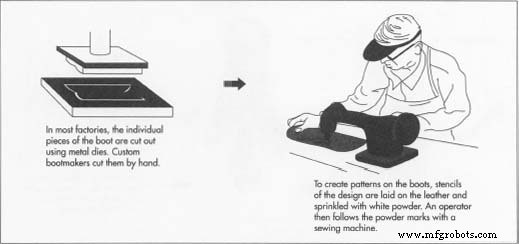
- After leather selection, the upper—comprising the vamp (top and sides), counter (heel enclosure), and uppers (shin wraps)—is cut. Custom shops hand‑cut; factories use metal dies. The lining is cut and glued to each piece, especially critical for fragile skins.
Decorating
- Stitched embellishments—ranging from simple patterns to elaborate scenes—are applied before assembly. Custom shops sketch stencils and use marking agents; factories employ computerized sewing with preprogrammed designs, dyeing additional colors as needed.
Assembling the Upper
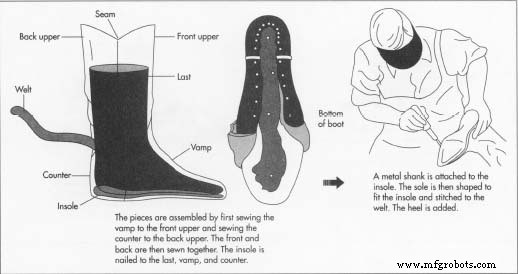
- The vamp attaches to the front upper; the counter to the back upper. A welt strip is affixed to the back of the counter. Front and back halves are glued, sewn inside‑out, then soaked to allow turning right‑side‑out.
Attaching the Insole
- The insole is tacked to a last—a foot model—then the vamp and counter are nailed to the insole. A stiff leather toe‑reinforcement is added, and the welt is sewn onto the vamp and insole.
Assembling the Sole
- With the welt integrated, nails are removed. A metal shank reinforces the arch, and the sole is stitched to the welt. The heel is nailed on, and both heel and sole are sanded into shape.
Finishing
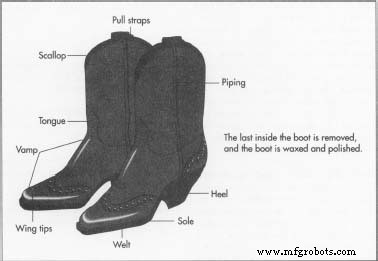
- The last is removed, a boot tree is used for final shaping, seams trimmed, and any stray threads cut. Final dyes are applied, then the boot is waxed and polished. Quality checks focus on stitch density, leather grade, and welt integrity. Custom shops assess fit individually; factories rely on statistical standards.
The Future
Since the 1980s, cowboy‑boot sales have swung with fashion cycles, from the “urban cowboy” boom to a steadier rise fueled by celebrities and country music’s popularity. While the “urban cowboy” era revealed the risks of rapid expansion, sustained growth in recent decades suggests a resilient market. Today, with fewer people working on horseback, cowboy boots function primarily as fashion items, yet their heritage craftsmanship continues to resonate with consumers seeking authenticity.
Manufacturing process
- What is VMC Machining? An Expert Overview of Vertical Machining Centers
- Expert Guide to Aluminum Laser Marking: Precision, Durability, and Industry Applications
- MIG vs. TIG Welding: Selecting the Right Arc Welding Technique for Your Project
- Comprehensive Guide to Laser Marking: Types, Benefits, and Applications
- Key Considerations for High‑Volume Swiss Machining
- CNC Prototyping Guide: Precision, Speed, and Cost‑Effective Production
- Expert Shaft Manufacturing: Precision Processes & Custom Solutions
- The Evolution of Galoshes: From Medieval Boots to Modern Innovation
- Cowboy Boots: History, Craftsmanship, and Modern Trends
- Why Every Cowboy Should Consider a Carbon Fiber Cowboy Hat