



Sunglasses: Design, Materials, and Eye‑Protection Standards
Background
Sunglasses are engineered to shield the eyes from harmful sunlight. Exposure to intense visible and non‑visible radiation can cause temporary symptoms such as snow blindness or welder’s flash, and long‑term damage including cataracts and night‑vision loss. UV light is the primary culprit, literally burning the corneal surface.
Originally invented to reduce glare, early sunglasses were simply tinted glass or plastic. As scientific understanding of UV damage grew, manufacturers developed lenses that actively block these rays. Today, sunglasses range from inexpensive plastic models to high‑end designer frames with ground glass lenses. Lens darkness is not a reliable indicator of UV protection, nor does price guarantee performance.
Raw Materials
Most lenses are made from colorized polycarbonate, chosen for its impact resistance and lightweight nature. Premium brands use optical glass—borosilicate that is ground, polished, and tempered to resist scratches and impact. Additives such as soluble organic dyes and metallic oxide pigments absorb or reflect specific light frequencies while maintaining color fidelity. Gray lenses offer the least color distortion; amber and brown provide superior blue‑light filtering, though at a slight color shift. Chemical coatings can reduce glare or block polarized light.
Frames are typically constructed from metal or plastic. Metal frames often incorporate nickel, silver, stainless steel, graphite, or nylon, and feature engineered nose pads, self‑locking hinges, and flexible temples. Plastic frames rely on tension mounting to secure lenses without screws.
Design
Sunglasses sit at the intersection of fashion and function. Designers—whether in apparel, fragrance, or sports equipment—create styles that reflect brand identity, but functional requirements vary by activity. For example, trap shooters need lenses that enhance contrast for clay targets, while skiers require lenses that mitigate snow glare. Specialized lenses such as blue blockers filter out violet and blue wavelengths, while polarized lenses eliminate horizontal glare from reflective surfaces. Photochromic lenses darken outdoors and lighten indoors, though their limited spectrum coverage means they are not a substitute for dedicated UV protection.
Children’s sunglasses must also adapt to seasonal trends and popular characters, requiring frequent redesigns.
The Manufacturing Process
Lenses
- Colorants are added either during the melt phase of plastic or glass, or applied post‑coating to achieve the desired hue. Soluble dyes and metallic oxides are incorporated into the molten material, while metal particles are mixed into glass.
- Once mixed, the material is cast into a lens puck. Premium lenses undergo optical profiling with a lensometer to locate the optical center.
- Precision grinding shapes the back of the lens according to prescription, and edge grinding bevels the rim to fit the frame.
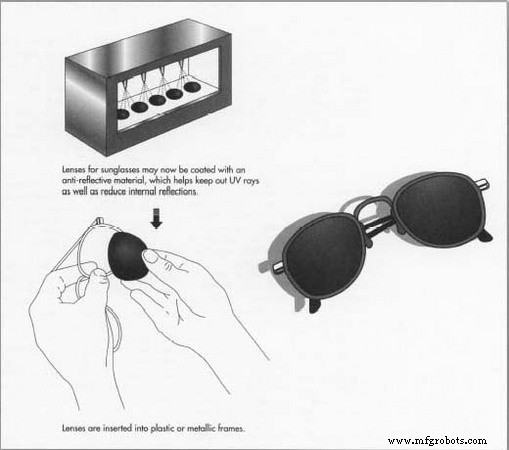
- Anti‑reflective coatings—applied via vacuum deposition—reduce internal reflections and enhance visual clarity.
Frames
- Plastic frames use a tension mount: the lens opening is slightly smaller than the lens, allowing the lens to snap into place from the front. A peripheral groove mates with a ridge on the lens.
- Metal frames employ a screw mount: the frame is extruded into an open loop, the lens is inserted, and a screw secures the loop, preventing deformation.
Quality Control
While regulations ensure shatter‑proof materials, labeling of UV absorption is largely voluntary. The American National Standards Institute (ANSI) sets transmittance guidelines: general cosmetic lenses must block 70% of UVB, general lenses 95% of UVB and most UVA, and special‑purpose lenses 99% of UVB. Optical perfection is assessed by simple visual tests—holding the glasses at arm’s length and observing straight lines for distortion.
Byproducts/Waste
Manufacturing generates minimal waste: plastic, glass, and metal scrap from grinding and frame production.
The Future
Advances in optics, surface chemistry, and metallurgy continue to refine sunglasses. New coatings offer superior UV protection, while patented frame designs—such as single‑piece metal construction (U.S. Patent 5,583,199)—improve durability and style. Ongoing research promises high‑performance, eye‑protective eyewear that meets evolving consumer and regulatory demands.
Manufacturing process
- Understanding Camera Lenses: Design, History, and Future Innovations
- Contact Lenses: History, Materials, and Future Innovations
- Understanding Plastic Eyeglass Lenses: History, Materials, and Manufacturing
- 7 Key Benefits of Carbon Fiber Sunglasses That Set Them Apart
- Lexan HP92AF Antifog Film: Unmatched Clarity for COVID‑19 PPE and Industrial Lenses
- Create Smart Match‑Making Sunglasses with Arduino 101 and tinyTILE BLE
- Wireless Smart Contact Lenses Detect and Treat Diabetes
- Innovative Soft Contact Lenses for Early Detection and Monitoring of Eye Diseases
- Revolutionary Ultra-Thin Sensor Enhances Smart Contact Lens Functionality
- Crafting Cutting‑Edge IR Optics for UAVs