



Stetson Hat: From Frontier Innovation to Modern Icon
Background
The Stetson hat, christened after its creator John B. Stetson, has become the definitive cowboy hat, embodying Western pride and rugged style. From classic film stars such as John Wayne, Clayton Moore (the Lone Ranger), and Gene Autry to contemporary icons like Garth Brooks and Larry Hagman’s J.R. Ewing (whose hat now resides in the Smithsonian National Museum of American History), the hat has worn the faces of Western legends. Women—from Dale Evans to Trisha Yearwood—have also championed the Stetson, proving its versatility beyond a male fashion statement.
Founded in Philadelphia in 1865, the Stetson Hat Company mass‑produced the modified sombrero John Stetson originally crafted for a long western expedition. His “Boss of the Plains” model—characterized by a high, creased crown and a wide, molded brim—set the standard for all cowboy hats. Today, the company operates factories in St. Joseph, Missouri, and Galveston, Texas, continuing to produce the iconic “Boss of the Plains” alongside more than 100 modern variations for both men and women.
History
Born in 1830 in Orange, New Jersey, John B. Stetson was the 12th of 13 children of hatmaker Stephen Stetson. After a diagnosis of tuberculosis, he left the family business to explore the American West—a venture that would become his only chance at survival. Settling in St. Joseph, Missouri, he outfitted expeditions to Pike’s Peak and other western locales.
During the 1860s, Stetson undertook a Pike’s Peak expedition. Despite initial ill‑health, he recovered and, with his companions, fashioned shelters from muskrat, rabbit, beaver, and coyote skins. Lacking tanning facilities, he applied a felting technique he learned from his father’s shop: shaving fur, agitating it with a hickory bow, and repeatedly immersing it in hot water to create a water‑repellent blanket. The same process yielded the first felt hat, a high‑crowned, wide‑brimmed design modeled on the Mexican sombrero. Legend says a Mexican bullwhacker once offered Stetson a five‑dollar gold piece for the invention.
After a year of gold mining, Stetson returned to Philadelphia in 1865, invested $100 in tools and fur, and established a small hat‑making business. After several prototypes, he perfected the modified sombrero—4 in (10 cm) crown and brim—and named it the “Boss of the Plains.” The hat found immediate success in the Southwest, and by 1906, Stetson’s enterprise was thriving. The company’s legacy endures, with hats sold across the U.S. and worldwide.
Raw Materials
Stetson hats are primarily crafted from felt made of beaver, rabbit, and wild hare pelts. The felting process uses hot water to bind fibers, dyes to color the felt, and a powder to soften the material. Leather forms the interior sweatband, while a two‑ply or two‑cord band encircles the crown’s base. Small metal eyelets provide ventilation, and a satin name pad is pressed inside the crown.
Design
Key design elements that set a Stetson apart include the crown slope, brim roll, and crown creases. These characteristics give each hat a unique silhouette and are often tailored by the customer or pre‑fabricated by the hatter. Decorative options—feathers, embroidery, or silver accents—can further personalize the look. When paired with cowboy boots, a well‑fitted Stetson can visually elevate the wearer by up to 6 in (15 cm).
The Manufacturing Process
Carroting, Cutting, and Sorting
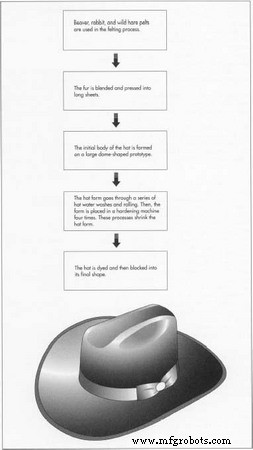
- 1. Pelts of beaver, rabbit, and wild hare are cleaned to remove grease and impurities.
- 2. An acid solution prepares the fur for felting (carroting).
- 3. Skins are fed fur‑side down into a cutting machine to separate fur from hide.
- 4. Fur is sorted using blowing and picking machines.
- 5. Sorted fur is bagged in 5 lb (2.27 kg) increments and baled for shipment.
Felt Mixing and Initial Shaping
- 6. Fur is weighed and blended to company specifications.
- 7. The blend is cleaned, placed in a giant bin, and finely mixed.
- 8. Fur is fed into a feeder to achieve an even softness.
- 9. The feeder directs fur to a blowing machine; defective fibers are manually removed.
- 10. Sheets are formed on a conveyor and pressed into long sheets.
- 11. Sheets are blown onto a former dome (prototype) that shapes the hat’s initial body.
- 12. The former dome is submerged in hot water for 35 s to set the fur fibers.
Felting and Dyeing
- 13. The dome undergoes “starting” and “stumping”—hot water, pressure, and rolling—to mold the fur.
- 14. The hat is hardened in a machine four times, shrinking from its original ~2 ft (61 cm) size.
- 15. Hat bodies are dyed with pigments to produce a wide color range.
Initial Blocking and Pouncing
- 16. A three‑person team performs blocking: a tipper stretches the crown, a brimmer shapes the band and brim, and a blocker finalizes the form and applies stiffening.
- 17. The hat is turned inside out and hung to dry overnight.
- 18. The next day, pouncing removes residual surface hair; the hat is then back‑shopped.
- 19. A two‑ply band is stitched around the outer crown where it meets the brim.
Western Blocking and Finishing
- 20. The hat is steamed and shaped on a wooden block.
- 21. The crown is ironed and the brim plated.
- 22. A crown‑pouncing machine fine‑sandpapers the hat’s exterior.
- 23. Powder softens the hat and deepens color (skipped on dark hats).
- 24. The hat undergoes a second pouncing cycle.
- 25. Brim shape is set, dry heat is applied, and the brim is pressed to maintain form.
Sweatband
- 26. Excess polyreed wire is trimmed from the leather sweatband.
- 27. The band is hand‑fitted inside the hat.
- 28. Excess leather is trimmed.
- 29. The band is stitched and secured with tack or glue.
- 30. The hat is cleaned, brushed, and steamed.
- 31. Final brim trimming is performed.
Creasing and Miscellaneous Details
- 32. A bow is stitched to the outer two‑ply band.
- 33. The hat is hand‑creased.
- 34. A satin name pad is pressed and steamed inside the crown.
- 35. Eyelets are inserted if required.
- 36. A cleaning‑instructions tag is affixed to the crown.
Quality Control
Every Stetson undergoes rigorous inspections to verify finish, shape, body, and feel. The felt’s quality—reflected by the number of “x” markings on the sweatband—depends on fur type, animal habitat (wild, domestic, seasonal), age, and natural color. These factors drive pricing and ensure consistent craftsmanship.
The Future
Western hats remain as fashionable today as when they first appeared. Stetson and other manufacturers continue to innovate, exploring alternative materials such as straw and leather to offer fresh variations while preserving the timeless silhouette.
Manufacturing process
- Industrial Hard Hats: Standards, History, and Future Trends
- Build a DIY Google Voice HAT for Your Raspberry Pi
- Comprehensive Pi Servo Hat Setup Guide: Hardware, Wiring, and Python Control
- SparkFun Qwiic HAT for Raspberry Pi – Complete Hookup Guide
- Why Every Cowboy Should Consider a Carbon Fiber Cowboy Hat
- Eiger’s New Brim Feature: Reliable, Warp‑Free Prints for Thin Parts
- NEVS' Revolutionary Car‑Sharing Initiative in Trollhättan: A New Era of Mobility
- Sierra Wireless Introduces Octave: A Unified Edge‑to‑Cloud Solution for Industrial IoT
- Weekly Real‑Time Analytics Update – Oct 16: Red Hat OpenShift Tool Enhancements
- Heavy Vehicles Lead the Way: Self-Driving Is Already a Reality